Website: Europe.com

  • Massive hydrogen reservoir discovered beneath an Albanian mine could be an untapped source of clean energy

    Massive hydrogen reservoir discovered beneath an Albanian mine could be an untapped source of clean energy

    A massive hydrogen reservoir may be lurking deep beneath a chromium mine in Albania, a new study has found.

    The reservoir sits within a portion of Earth’s crust and mantle that once lay at the bottom of the ocean and was scraped off when the tectonic plate it rode on slid beneath another plate. The crumpled slab of crust and mantle was thrust onto land between 45 million and 15 million years ago and formed a 1,900-mile-long (3,000 kilometers) rocky belt, known as an ophiolite, that extends from present-day Turkey to Slovenia.

    Ophiolites exist worldwide, and research has previously documented hydrogen gas leaking from boreholes and mines drilled into these formations. In the new study, scientists discovered the reservoir thanks to huge clouds of hydrogen gas wafting from pools of water inside the Bulqizë mine, which is located 25 miles (40 km) northeast of Tirana, Albania. Such hydrogen reservoirs could be tapped to provide carbon-free fuel, but the deep infrastructure needed to do so is lacking and the gas is inherently difficult to extract.

    “We have seen plenty of hyper alkaline springs hosted in ophiolites worldwide where hydrogen is bubbling [out],” lead study author Laurent Truche, a professor of geochemistry at Grenoble Alpes University in France, told Live Science in an email. But “what we have observed deep in the mine is another dimension,” Truche said, and “turns a draining pool inside a mine gallery into a breathtaking 30-square-meter [323 square feet] jacuzzi bubbling with almost pure hydrogen.”

    Truche and his colleagues explored the deepest levels of the Bulqizë chromium mine and recorded extreme quantities of hydrogen gas leaking from the rocks and bubbling through pools of water. Their measurements suggest that at least 220 tons (200 metric tons) of high-quality hydrogen escape from the mine every year, which is one of the largest natural hydrogen flow rates documented to date.

    Hydrogen is a highly flammable gas. The high concentrations measured inside the Bulqizë mine are thought to have sparked three explosions since 2011, killing four miners and injuring many more. “Our study will help to understand the phenomenon and to improve safety,” Truche said.

    The discovery also sheds light on the geological conditions that seal large reserves of natural hydrogen underground. Hydrogen venting from the Bulqizë mine likely accumulated in tectonic fractures between two blocks of rock deep within the ophiolite, according to the new study, which was published Thursday (Feb. 8) in the journal Science. This fault zone is estimated to be 33 feet (10 meters) wide, up to 3,300 feet (1,000 m) long and up to 16,400 feet (5,000 m) deep, and it “can easily be observed in the deepest mine galleries,” between 1,640 feet (500 m) and 3,300 feet deep, Truche said.

    “We still don’t know how this fault is sealed, but it has no visible footprint at the surface,” he added.

    As much as 55,000 tons (50,000 metric tons) of hydrogen could lurk in the reservoir beneath the mine — enough to sustain the high flow rate for 238 years, according to the study.

    Deposits of natural hydrogen are a promising source of carbon-free energy if they are extractable and sufficiently large.

    “What sets our discovery apart is the large flux of almost pure [hydrogen] gas we have observed,” the authors wrote in the study. “In the context of energy transition, our findings could substantially affect the ongoing search for new energy resources.”

  • EU, US to align global minerals push against China’s supply grip

    EU, US to align global minerals push against China’s supply grip

    The US and the European Union are in talks to merge a core area of their efforts to engage suppliers of critical minerals in resource-rich nations, seeking to streamline their push against China’s dominance in materials key for future technologies.

    The aim is to combine the EU’s high-level policy approach with the US focus on specific projects, according to people familiar with the discussions.

    Specifically, the move would merge the EU’s critical raw materials club concept with the Biden administration’s flagship Minerals Security Partnership. It comes after the EU delayed plans to launch its own program in Dubai last year at the COP 28 climate summit, said the people, who asked not to be identified describing internal policy discussions.

    The new initiative, known broadly as a “minerals security partnership forum,” would align outreach efforts to buyers in developed countries and resource-rich nations to cooperate on projects and policies, said the people.

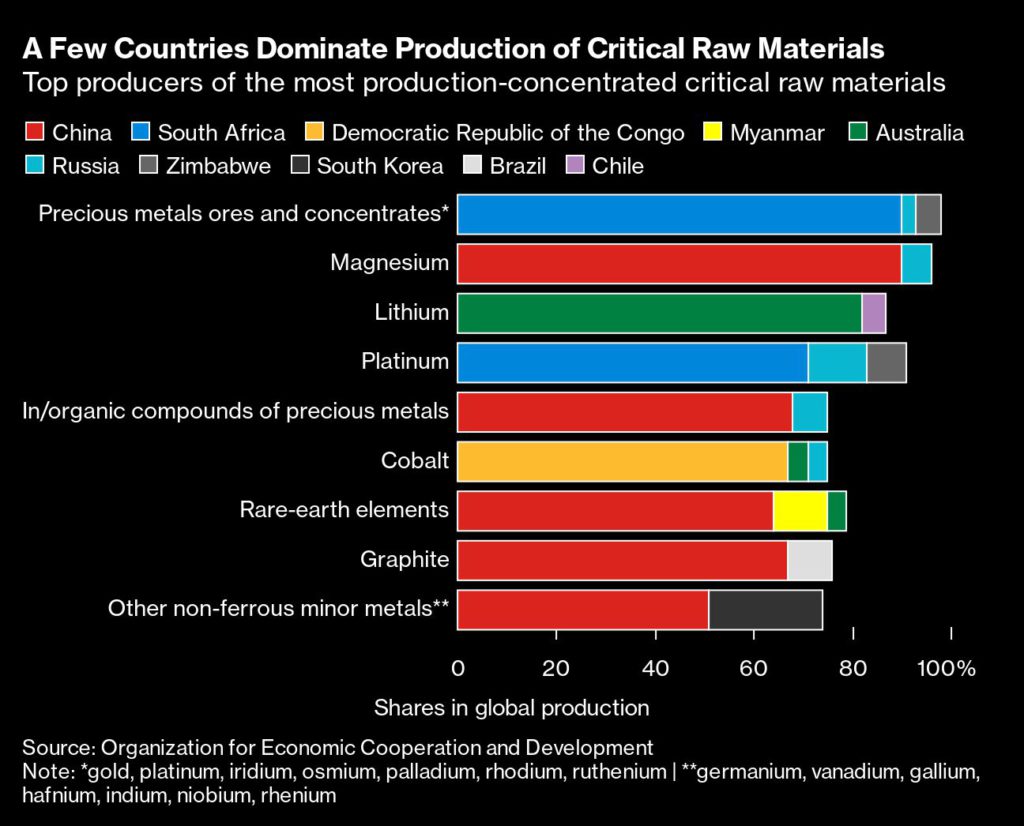
    As part of their broader economic security strategies, Washington and Brussels are seeking to counter China’s domination of the supply chain for so-called critical minerals, a broad term that includes inputs for electrical vehicles and other green energy technologies.

    Key to their combined efforts is working with resource-rich nations to develop standards on investment, trade, research and environmental issues that the US and EU see as an alternative to working with China.

    The allies, who’ve identified more than a dozen potential projects, have taken on a daunting challenge. The lengthy and expensive process of developing mining or refining projects means Beijing’s dominance will likely continue for decades. And US officials have conceded it’s impossible to fully replace China.

    US and EU officials aim to reach an agreement later this month and officially launch the project in March, according to one of the people. They will discuss the plan at the Munich Security Conference in Germany next week, said a separate person.

    The EU and the US are discussing how to optimize their efforts in fostering international cooperation on critical raw materials, Olof Gill, a spokesperson for the European Commission, said in a response to questions, adding that an important aspect of these talks is to find “the best synergies” between the EU’s critical raw materials club and other international activities.

    A US State Department official, who asked not to be identified discussing internal matters, said the two sides believe separate outreach plans to resource-rich nations duplicated efforts and risked creating confusion. They also want to ensure alignment on the broader goal of reducing the West’s dependence on China for the production and processing of many critical minerals like lithium, manganese and cobalt, and properly coordinate mobilizing state finances and private companies, the official said.

    The EU was already a part of the US-led minerals security partnership alongside Australia, Canada, Finland, France, Germany, India, Italy, Japan, South Korea, the UK and others, which aims to funnel foreign investment into the green energy sector.

    The EU has also signed its own minerals pacts with several countries, including the Democratic Republic of Congo, which supplies about 70% of the world’s supply of cobalt, and Zambia.

    As well, Central Asian members of the C5+1 group — which includes Kazakhstan, the Kyrgyz Republic, Tajikistan, Turkmenistan, and Uzbekistan — have also expressed interest in the minerals security partnership, the US State Department official said.

    Separate EU-US talks on a bilateral critical minerals agreement remain stalled over labor rights and concerns over the feasibility of adopting a trade pact in an election year.

    US officials, who have already struck a bilateral deal with Japan, have wanted to kick-start new mining and processing projects by acting as a bridge between private companies seeking raw materials and developing nations that have relied in recent years mainly on China for resource investments.

  • European Lithium poised to become key player in production on the continent

    European Lithium poised to become key player in production on the continent

    European Lithium Ltd  is gaining traction in the lithium and rare earth sectors in its namesake target market, says Martin Place Securities, with a series of strategic initiatives placing it on a growth trajectory.

    The key drivers of this growth include the company’s Wolfsberg Lithium Project, a diverse portfolio that spans across Europe, and a listing on the Nasdaq.

    The company’s market capitalisation, as of January 30, stands at A$117 million.

    Revaluation due

    In its appraisal, Martin Place Securities suggests that the company’s stock is currently trading below its see-through asset backing of around A$0.80, indicating room for a substantial market revaluation.

    The report sets a value target of A$0.58 per share for European Lithium Ltd by the end of 2025.

    Martin Place Securities sees European Lithium as uniquely positioned to play a significant role in the European Union’s clean energy transition, especially with the EU’s target to phase in electric vehicles by 2035.

    The company’s diversified portfolio, strategic partnerships and involvement in critical mineral projects such as the Wolfsberg Lithium Project and the Tanbreez REE deposit, place it at the forefront of an industry poised for growth.

    Nasdaq milestone

    European Lithium’s flagship asset, the Wolfsberg lithium spodumene mining project, is slated for a Nasdaq listing, which is expected to impart a fully diluted value of A$0.61 per share, considerably enhancing the company’s market presence.

    The project, situated in Austria with a production capacity of 8.8ktpa LHM, is poised to become the first European Union producer of battery-grade lithium.

    A March 2023 definitive feasibility study (DFS) pointed to a net present value (NPV) of US$1,504 million, bolstered by high lithium hydroxide (LiOH) prices.

    “Wolfsberg would be one of the first operating lithium mines in Europe where EU regulations for the energy transition call for growing a major lithium industry to assist in the phasing in of electric vehicles there by 2035,” the report said.

    “BMW, recognising the need for security of supply, has entered into an offtake agreement with a US$15 million prepayment for all of the Wolfsberg Zone 1 output for its own battery manufacturing centre in Germany.”

    The company also has plans to access the largest lithium resource in Ukraine, which is also potentially one of Europe’s largest hard rock lithium resources.

    The report suggests that, following a resolution to the conflict in that country, an EU-Ukraine strategic partnership on critical raw materials could sponsor this development of the Shevchenkivske and Dobra deposits.

    Growth prospects in Austria and Ukraine

    The company is actively exploring additional lithium resource projects in Austria and is advancing towards acquiring significant lithium deposits in Ukraine.

    These ventures represent a strategic expansion and diversification of the company’s lithium asset portfolio.

    The lithium sector is showing signs of bottoming out, indicating a potential upswing that could benefit European Lithium’s strategic investments and market position.

    World’s largest REE deposit

    Along with its lithium exposure, European Lithium Ltd (ASX:EUR, OTCQB:EULIF) holds a 7.5% stake in the Tanbreez deposit in Greenland, touted as the world’s largest rare earth element (REE) deposit.

    The involvement in the Tanbreez REE deposit underscores European Lithium’s commitment to diversifying its portfolio in the critical minerals sector, aligning well with global trends and demands.

    This investment could yield a pass-through value potential of more than A$0.20 per European Lithium share, further enhancing the company’s asset base.

    The company is likely to target a Nasdaq listing for Tanbreez in 2025 to fund its development.

  • Investor Expectations Moderately Balanced in Gabriel Resources vs. Romania Outcome

    Investor Expectations Moderately Balanced in Gabriel Resources vs. Romania Outcome

    The shares of Gabriel Resources, the Canadian company that owns 80% of the Roşia Montană gold mining project in Romania – traded at the Toronto Stock Exchange – boasted a 37.6% advance as of February 6 from five days earlier when international media reported the Romanian state would pay at least USD 2bn in compensation, in litigation at World Bank’s ICSID court.

    However, the company’s market value reached only CAD$663mn, the equivalent of USD 490mn, Ziarul Financiar announced. The sentence is expected on February 10. This indicates an increase in the company’s market capitalization by USD 140mn – a small portion of the USD 2bn, the lowest value of the compensations Romania may have to pay.

    Five shareholders own 70.4% of Gabriel Resources shares, according to Ziarul Financiar. The investment group Kopernik Global Investors, based in Florida, owns a 17.11% stake. The financial services firm Tenor Capital Management, established 20 years ago in New York, USA, has a 16.3% stake.

    Electrum Global Holdings owns 13.25% of the capital. Electrum is an investment and consulting company, also from New York, founded and led by Thomas Kaplan, an entrepreneur and investor in natural resources.

  • The challenges for European lithium-ion gigafactory projects

    The challenges for European lithium-ion gigafactory projects

    Thomas Herman, of counsel at law firm Herbert Smith Freehills (HSF), is nonetheless bullish on the potential of European gigafactory projects, pointing to various underlying factors, whilst admitting they have substantial challenges ahead.

    “Europe is interesting because it has plenty of automotive original equipment manufacturers (OEMs) that can provide long-term bankable offtake agreements for projects, which can help them get financing,” Herman tells Energy-Storage.news.

    “The European market also benefits from proximity to reliable power sources, good transportation systems, skilled labour pools and strong public backing for these projects, including through various subsidies through funds.”

    Backing from automotive OEMs is the cornerstone of these projects. Some energy storage systems (ESS) integrators have moved to secure offtake from future gigafactories in Europe – Fluence from Northvolt, Powin from Freyr, and Nidec from Verkor, for example – but these aren’t enough to build a business case.

    “Given the capex involved in a gigafactory project, you cannot build a gigafactory based only an offtake from an energy storage company,” says Herman.

    “Instead, projects are having a main anchor OEM for the bulk of its capacity and then contracting with others (which could be an energy storage company) for the excess. BESS in Europe is still fairly underdeveloped relative to the UK. Financing will be done on the basis of automotive OEM offtakes.”

    One interesting counter-example was the apparent intention of the buyer of failed UK gigafactory firm Britishvolt to pivot away from the automotive sector to making batteries for ESS, and a McKinsey partner discussed the pros and cons of this approach with Energy-Storage.news at the time (March 2023, Premium access).

    This wasn’t specifically mentioned by Herman, but another point to consider alongside the potentially lower size of an ESS companies offtake is their generally relatively lower bankability rating compared to automotive OEMs, which are much larger.

    Even assuming a developer has the necessary bankable offtake partners, there are significant challenges around the financing process itself, securing the necessary raw materials and the obvious question of competitiveness of their battery products once they do enter the market.

    The biggest question is whether lithium-ion batteries produced in Europe will be competitive in the European and global markets, given the US is paying producers US$35 per kWh produced as a tax credit, while production in China is already cheaper.

    Automotive OEMs in Europe are driving gigafactories’ business case in Europe through long-term offtake agreements and, Herman explains, they are making the bet that, although EU-made batteries might be more expensive, eventually the premium that cars made using them can garner will offset that.

    “There are a lot of subsidies into gigafactory projects which will help,” says Herman. “OEMs are also betting that, at some point, environmental, social and governance (ESG) criteria will become a criteria for applying premiums to specific cars, and so cars produced with European batteries become competitive compared to Chinese cars.”

    “But for now, it’s true that this market is being built as we speak. OEMs have to play on two levels. They are entering into contracts with established battery makers in China and South Korea for their current models while also investing with a long-term view in battery production in Europe or through partnerships or offtake agreements.”

    Energy-Storage.news asked Herman if the business case for gigafactories in Europe is now less strong than two years ago, to which he says: “The gigafactory business case has struggled, but these projects take time to develop. The business case continues to evolve but, at some point, it needs to be set in stone and that’s a difficulty.”

    “Its been wagered that the gigafactory projects currently in development will come online quickly enough. The construction schedules are very tight. Lithium-ion is the tech being used right now and OEMs have been designing their cars around this tech.”

    The other big challenge is intimately tied to the above market dynamics and is the fact that OEMs, by backing these projects, are finding themselves in unfamiliar territory by doing so.

    “One of the biggest challenges is the financing. Lenders are keen to ensure the gigafactory company can benefit from a bankable long-term offtake agreement with the OEM. This can create a disconnect, as OEMs are not used to the extensive bankability requirements in the project financing space,” Herman says.

    “When negotiating the offtake agreements, banks and investors may consequently have contrasting views and priorities to the OEMs. The challenge becomes reaching an agreement that works for both sides.”

    There are also challenges around securing raw materials for lithium-ion production such as lithium, nickel, cobalt, manganese and graphite. As is the case in project financing, Paul Morton, another partner at HSF, explains that this a new space for automotive OEMs.

    “Securing access to key raw materials is the challenge for gigafactory projects but also the OEMs,” says Morton. “There security of supply challenge is compounded by the politics around where those are and who is controlling them. Both production and processing is often controlled by a small number of countries, particularly China.”

    “OEMs are looking at increasingly complex and longer-term offtake agreements to secure those volumes, and investment structures that these types of companies have not historically been involved in.”

    On top of that, Morton notes that a “constellation” of stakeholder pressure around sustainability and ESG has arisen in the last few years.

    “There is also a constellation of stakeholder pressures on sustainability, including management of human rights and environmental risks throughout the supply chain, traceability and carbon footprint for car and battery manufacturers that are having a big impact on the way they can procure minerals,” says Morton.

    “Five years ago an offtake contract may have been much shorter and simpler, but now supply chain due diligence obligations (to not only identify but mitigate against environmental and human rights risks) require more complex relationships between seller and buyer. It’s a very different world to be operating in for both producers and offtakers.”

  • Jadar and Rađevina Appraisal: Revealing the Valuation of Strategic Resources and Future Outlook

    Jadar and Rađevina Appraisal: Revealing the Valuation of Strategic Resources and Future Outlook

    The answer to the question of how much Jadar and Rađevina cost has not been provided, nor will it be given as long as the destruction of the landscape and the relocation of the population are considered inevitable damage that has not been assessed, and lithium, known as “white gold,” is considered more valuable than anything else. When something is not assessed, it is considered trivial, or until it is assessed, it has no value (price). This question was raised at a meeting at the Serbian Academy of Sciences and Arts (SANU) titled “Jadar Project – What is known?” Even then, no answer was given, or it was avoided as if Jadar were located on another lifeless planet.

    What was known then, and still remains unclear today, is the approximate technology for obtaining lithium carbonate and borates from the Jadarite ore through leaching with concentrated sulfuric acid. The assessment includes the cost of production, the planned duration of exploitation, and likely the company’s profits from the exploitation. Additionally, it is probable to consider the mining royalty that the state will collect according to existing regulations, which is approximately five percent of the foreign company’s realized profit.

    If we were to elaborate on the initial question, it would be about the value of natural and human-made biological resources on the surface of the mineral deposit, as well as surface and even more so underground water resources that would be extensively used in the lithium extraction process. This value is in comparison to the “white gold” that will primarily benefit the profit of the foreign mining company. The fact that water, as a natural resource, is vital for the future of any society is neglected. Finally, not least, the population that lives and earns a livelihood from these resources is also overlooked.

    Indeed, the complete disregard for the value of biodiversity, ecosystem services provided by natural vegetation, especially forest ecosystems, and agricultural land is concerning, especially at a time when climate disruptions (climate change) are evident as a global problem with increasing challenges for any human community.

    Paradoxically, by ignoring the significance of nature in mitigating the effects of climate disruptions, mega-projects that lead to increasingly visible negative consequences are favored. The problem of accumulating carbon dioxide in the atmosphere, which enhances the greenhouse effect and global warming, cannot be effectively addressed by technologies like carbon dioxide vacuum cleaners or by depositing waste biomass in anoxic parts of the sea (e.g., the Black Sea), which are offered as salvation. Meanwhile, the assimilation potential, which is the only means capable of binding and/or depositing excess carbon dioxide in biomass and soil, continues to be ruthlessly destroyed.

    Not to mention the oceans, which perform this function more efficiently than terrestrial ecosystems, thanks to the enormous surface they occupy. It is now time to recognize that forests, as the most productive part of terrestrial ecosystems, cannot be valued solely based on the quantity of wood mass, but also through functionality. Even from an anthropocentric perspective, considering ecosystem services crucial for every human community whose survival ultimately depends on these services. It is imperative that in the future, they must be comprehensively evaluated, taking into account multiple benefits, and that the practice of belittling, neglecting, and trivializing them must cease.

    Whether we like it or not, human communities at any spatial scale depend on nature, whether it be original or modified over thousands of years of human civilization, primarily through artificial selection of wild plant and animal species for various human needs, especially for sustenance. Not to mention the enormous potential that biological diversity holds. American ecologist Leopold compared biodiversity to a vast library that remains unread, and every day, books are deteriorating and disappearing from its unique collection. Whether the idea of preserving biodiversity and valuing it will become an obligation and prove effective is a big question mark.

    The care for the preservation of nature and biodiversity as its foundation cannot be solely the concern of biologists, ecologists, and nature enthusiasts.

    Past experiences indicate that the idea of sustainability and sustainable development, which is prevalent in various international and domestically adopted documents, is often just a dead letter on paper. The preservation of biodiversity is fundamentally part of the sustainability agenda. In practice, everything goes against this idea – from the exploitation of natural resources as quickly and extensively as possible, with a lack of restraint when it comes to the profit of those who use resources in an uncontrolled manner.

    In that context, the idea of building mines in the Jadar region, as well as all projects that envision and prepare the territory of Serbia as a state for mining and dirty technologies, should be considered. It is not surprising that foreign companies are rushing to Serbia when they see how the state and a significant part of the population treat their own environment. The excuse that this is necessary and that all countries have gone through this Machiavellian phase of natural resource destruction, and that they will only realize later, as society becomes wealthy, that the “devil has taken the joke,” simply does not hold water.

    Advocates for building mines in the Jadar region attempt to minimize environmental damage by pledging adherence to the highest ecological standards in mining, often using the catchphrase “green mining.” Systematically labelling something as “green” when, figuratively speaking, only chlorophyll in plants is green, creates the illusion that the problem either is or will be solved, and this is far from making sense. A more accurate term would be “environmentally responsible mining.” Such practices are rarely implemented globally, and they involve minimizing all damages to the greatest extent possible. For instance, in environmentally responsible mining, the waste material (tailings) generated from processing ore is returned to the exploited part of the mine after treatment. It is clear that such practices significantly increase the costs of exploitation, making it less and less profitable.

    The issues surrounding the construction of mines in the Jadar region cannot be isolated from the behavior of foreign mining companies towards natural resources in other countries, typically former colonies or developing nations. What is happening in Serbia in this regard closely resembles the conduct of foreign mining companies, aided by the stance of the state that everything is up for sale. One only needs to look at the environmental conditions in Bor and Majdanpek and the projected future for the Žagubica area to clearly see the approach of foreign mining companies, especially Chinese ones, regarding environmental protection in Serbia.

    Indeed, such companies often behave as if they are a state within a state. It is worth mentioning that Chinese companies hold around 14% of shares in Rio Tinto. These are all examples of environmentally irresponsible but highly profitable mining practices, the consequences of which will be evident for hundreds of years after exploitation. The remediation or masking of these consequences is not easy, quick, or inexpensive.

    Can someone imagine the environment of Bor and Majdanpek after the completion of exploitation, and the first association not be, looking at the abandoned surface mines, that everything resembles the landscape of a lifeless planet? Or, let’s not consider such massive devastations, but the quarries that sprout in Serbia like mushrooms after rain, and after exploitation, nature is left to revitalize them on its own, which will be a very long and slow process. Behind all these mentioned mining endeavours stands the Big Brother called profit, where what is being destroyed has a price only in the raw material being exploited with the prior consent of the guardian or host, which is the state.

    What’s the reason for such a rush towards Serbia’s mineral wealth?

    The fundamental question naturally arises: why such a rush for Serbia’s mineral wealth? For what reasons do foreign mining companies come to Serbia, and what is it that attracts them so much? I believe the answer is quite simple and boils down to the fact that the state’s attitude toward environmental preservation is the last “missing piece” and is evident at nearly every turn, from air pollution and wastewater, which serves as waste collectors, to garbage dumps and waste scattered in various locations, destruction of nature, lack of law enforcement, poorly conducted environmental impact studies, various projects that exist only on paper, the population’s attitude towards the environment in which they live, and the list goes on, as it would indeed be quite extensive.

    On the other hand, the noticeable dysfunctionality and incompetence of institutions, the lack of transparency in decisions and finances, and the corruption that plagues this society make Serbia a severely ill patient.

    In a nutshell, Serbia is a country where non-transparent agreements often lead to hasty and ill-considered projects. Speaking about the Jadar project with the residents of Gornje Nedeljice, the President of Serbia stated that “we do not have the right to ruin the lives of a greater number of people than originally planned,” directly highlighting how uncritically and thoughtlessly the Jadar project was approved and handed over to Rio Tinto to begin resettlement and persuade the population with neatly packaged propaganda and irresistible offers.

    On the other hand, it is clearly demonstrated what a neglectful attitude the state has towards the environment and natural resources, including the population that lives and earns a living there. In short, everything started haphazardly, as is often the case when there is no clear insight into the technological process and its consequences, except for the declaration that everything will be according to the latest standards, which is a commonplace in Rio Tinto’s propaganda portfolio. The meeting at the Serbian Academy of Sciences and Arts (SANU) highlighted all the deficiencies and ambiguities of this project, especially those involving the actors engaged by Rio Tinto in the preparation of the study, related to the projection of the industrial-mining process and facilities, the disposal of mining waste left after the production of lithium carbonate, as well as the infrastructure of the complex, water borrowing for the process, and so on.

    The experts from the Mining and Geological Faculty and the “Jaroslav Černi” Institute, as expected, unequivocally gave the green light for the mining project, while those from the Biological and Forestry Faculty, who assessed the biodiversity and natural and human-made values on the surface of the mining deposit, gave a negative assessment of this project.

    Serbia must put an end to such thoughtless and superficially assessed projects and consider how it will progress further. In any case, the practice of selling off resources and planning excessive and oversized projects, as is currently happening, should cease. Serbia’s developmental opportunity lies in organizing and improving many aspects of society. To begin with, one of the secure developmental opportunities could be the restoration of the neglected environment, as there is a significant and long-term task ahead in that regard, given the prolonged negligence. At least, let our air and waterways become cleaner, and let’s stop the reckless conversion of agricultural and forest land into construction and industrial areas.

    The case of the planned mine in Jadar is a paradigm of environmentally and socially irresponsible behaviour, which, if realized, would be evidence that the old practice of selling off and managing natural resources continues to the detriment of the harmonious and balanced life of the population that has inhabited and endured in that part of Serbia for centuries, in a beautiful, gentle, and fertile region. Therefore, the value of the Jadar region far exceeds the money from lithium carbonate that Rio Tinto will reap, and which, as is often the case, will leave devastation in its wake after exploitation.

  • KGHM Secures a $450 Million Credit Facility to Cover Operational Costs

    KGHM Secures a $450 Million Credit Facility to Cover Operational Costs

    KGHM Polska Miedź S.A., a leading copper producer, has announced its plan to sign a substantial credit agreement by February 26, 2024. The management board has approved the procurement of a $450 million unsecured revolving credit facility from Bank Gospodarstwa Krajowego. This strategic financial move is aimed at covering the company’s current operational expenses. The credit facility, which will be available for an initial financing period of up to 60 months with an option to extend for an additional 24 months, offers KGHM flexible financial support. For the first 36 months following the signing of the agreement, the credit will function as a renewable line of credit, where each repayment refreshes the available credit limit. After this period, the credit will convert into a term loan, repayable in four equal semi-annual capital instalments, unless an extension is exercised. KGHM has the option to extend the renewable credit line for two additional 24-month periods, with the first extension request possible after 30 months and the second after 54 months. The credit can be utilized in USD, and the funds will be allocated to general corporate purposes. The interest rate for the credit is based on the SOFR benchmark rate plus a margin, which is contingent on the financial ratio of net debt to EBITDA. The other terms of the credit are consistent with standard conditions for such transactions. 

  • Revolutionizing Resource Management: PGE Ekoserwis Leading the Charge

    Revolutionizing Resource Management: PGE Ekoserwis Leading the Charge

    In 2023, PGE Ekoserwis, a subsidiary of the PGE Group, successfully managed 3.5 million tons of residual combustion products. Gypsum, ashes, and slag, byproducts of the combustion process in energy production, found applications across various sectors including construction, agriculture, livestock farming, and mining. This strategic utilization not only conserved natural resources but also minimized the creation of new landfills, consequently reducing carbon dioxide emissions.

    Pioneering Research and Development

    Through its research and development arm, the GOZ Research and Development Center in Bełchatów, along with a team of highly skilled technologists and collaborations with academic and scientific institutions, PGE Ekoserwis has pioneered the development and implementation of high-quality materials and products for diverse applications, notably in the construction sector.

    Sustainable Infrastructure Solutions

    The adoption of alternative materials, derived from ashes and slag generated during coal combustion in energy production, is increasingly prevalent in the construction industry. These materials offer ecological benefits and contribute significantly to reducing the extraction of natural minerals, optimizing resource consumption, mitigating carbon dioxide emissions, and minimizing waste generation.

    Driving Green Initiatives

    Within the PGE Group, prioritizing eco-friendly practices is paramount, with PGE Ekoserwis leading the Closed-Loop Economy (GOZ) segment. This entity specializes in collecting residual combustion products, processing them into high-value construction materials, and ensuring their full integration into various construction projects nationwide.

    Transforming Byproducts into Assets

    In the preceding year, PGE Ekoserwis procured over 800,000 tons of synthetic gypsum, primarily supplying the cement and construction industries. Gypsum, utilized as a fertilizer, contributed to agricultural enhancement and mushroom cultivation. Additionally, it was exported to the Netherlands for construction purposes.

    Versatile Applications in Construction

    Ashes were directed towards cement factories, concrete plants, precast element manufacturers, chemical construction companies, and foundries. Noteworthy applications included road engineering projects such as the A2 motorway and various expressways and bypasses across the country.

    Diverse Utilization Across Industries

    In addition to road construction, the products derived from residual combustion products were instrumental in railway infrastructure projects, environmental remediation efforts, and large-scale engineering endeavors. Hydrotechnical binders supplied by PGE Ekoserwis were vital components in water management and land reclamation projects, including flood protection embankments along the Nysa Łużycka River.

    Leadership in Sustainable Business Practices

    PGE Ekoserwis, with over three decades of experience in managing residual combustion products, offers a portfolio of over 200 certified products derived from both combustion and mining byproducts. These products adhere to stringent environmental standards and undergo rigorous quality assurance m

  • Akobo secures NKr6m bridge loan from shareholders

    Akobo secures NKr6m bridge loan from shareholders

    Scandinavian gold exploration and mining company Akobo Minerals has secured a NKr6-million bridge loan. As part of the ongoing efforts to secure new funding, the company said on February 9 that it had successfully addressed a short-term liquidity requirement and that the bridge financing of NKr6-million has been secured from existing shareholders.

    The proposed loan matures in August 2025 and has an interest rate of 20% a year. The loan may be converted into shares at the next share issue or at the maturity date, subject to certain conditions being met.

    If converted, the conversion of the loan will take place by each lender subscribing for shares through offsetting the loan amount, including accrued interest. The loan, including accrued interest, may be converted into shares at the earliest of the resolution of a private placement of shares, or at the maturity date.

    Akobo said this financial measure provides the company with flexibility to navigate the current landscape and conclude a financial solution that involves all stakeholders in the company.

    Akobo said it remained actively engaged in discussions with relevant stakeholders to explore various long-term financing options to address its overall liquidity requirements.

  • Ukraine: Krasnolimanske buys license for coal deposit in Donetsk region

    Ukraine: Krasnolimanske buys license for coal deposit in Donetsk region

    Krasnolimanske LLC has become the winner of the auction to sell a special license to use subsoil – the mine site No. 1 in Mirnograd, Donetsk region.  The auction was held on February 8 on Prozorro.  Three companies participated in the trade of the lot with the starting price of 2.22 million UAH. The bid of Krasnolimanske in the amount of 4 million UAH won.  The license is valid for 20 years.