Finland has become the first European country to complete construction of a full-cycle battery-grade lithium project, with Keliber Oy’s €783 million ($922 million) facility in Syväjärvi in western Finland ready to begin production in the second quarter of 2026 and ramp to full output by 2028 — a landmark moment for a continent that currently imports 100% of its refined lithium, almost entirely from China.
The Keliber project will produce battery-grade lithium hydroxide from domestically mined ore, with the entire supply chain — from mine to concentrator to refinery — contained within a 43-kilometre radius. At full capacity, the Kokkola refinery will produce approximately 15,000 tonnes of lithium hydroxide annually for at least 18 years, equivalent to around 10% of Europe’s current demand. Keliber Oy is 80% owned by South African mining major Sibanye-Stillwater, with the remaining 20% held by the Finnish state through Finnish Minerals Group.
An additional €200 million ($235 million) has been committed by the Finnish government and Sibanye-Stillwater to support project ramp-up, while the European Investment Bank has contributed €150 million ($177 million) in financing. The project has been designated a Strategic Project under the EU’s Critical Raw Materials Act.
Finnish Minister of Economic Affairs Sakari Puisto described the project as a key component of Finland’s National Battery Strategy that increases the country’s and the EU’s self-sufficiency in critical raw materials. Keliber CEO Hannu Hautala said the facility would help Europe reduce dependence on imports from Asian countries and Australia, with lithium hydroxide output destined for the European battery industry.
The project spans more than 500 square kilometres with six additional mining sites planned in the area. Europe currently relies on foreign sources for approximately 81% of extracted lithium and 100% of refined lithium, with EU demand projected to grow twelve-fold by 2030 and twenty-one-fold by 2050.
KGHM Polska Miedz, the European Union’s largest copper producer, is pursuing an international expansion strategy focused on adding up to 100,000 tonnes of annual production through acquisitions in Europe and Africa while simultaneously evaluating takeover targets across the Americas, as record copper prices and surging demand from the energy transition drive the Polish miner’s most ambitious growth push in years.
Chief executive Remigiusz Paszkiewicz said the company’s nearer-term expansion priority is securing long-term, stable raw material supplies for its Polish smelters — a strategic necessity given rising processing costs and the company’s deliberate policy of not over-exploiting its domestic deposits. A memorandum on potential investments in Morocco’s raw materials sector has already been signed, and several other locations are under consideration. “The plans for Morocco and several other locations are directly linked to the necessity of securing long-term, stable supplies for our smelters,” Paszkiewicz said.
KGHM’s stock has surged 180% since the start of last year, lifting its market capitalisation to nearly $18 billion, as copper traded near record highs on demand from artificial intelligence infrastructure, electric vehicles and renewable energy deployment. The company has also benefited from its rare dual position as a significant producer of both copper and silver.
In the Americas, the company is evaluating assets in Chile, Argentina, the US and Canada and expects to narrow its target list and make a final decision within several months. KGHM’s international operations, acquired primarily through its $2.84 billion purchase of Quadra FNX Mining in 2011, have only recently turned consistently profitable but now generate nearly half of group EBITDA despite accounting for just 20% of volumes. Its Sierra Gorda open-pit mine in Chile reported first-quarter C1 costs 47% lower than its Polish underground operations, underlining the financial rationale for further Americas exposure.
Domestically, KGHM sees opportunity in Lumina Metals’ discovery of rich copper deposits near its existing Polish sites. Rather than viewing the Canadian company as a competitive threat, Paszkiewicz framed it as a processing opportunity. “There’s no better place for processing their raw materials than at our Glogow smelter,” he said, adding that Lumina’s investment could also provide impetus for reducing Poland’s copper extraction tax — a cost burden that weighs on domestic production economics.
Allied Critical Metals has announced a transformational $40 million financing and off-take package for its Borralha and Vila Verde tungsten projects in northern Portugal, positioning the Vancouver-based company for initial production at its Vila Verde pilot plant by the fourth quarter of 2026 and a potential Nasdaq listing later this year.
The financing comprises a $25 million private placement at $2.05 per share, of which $10 million closed on 27 April 2026 with the remainder expected by mid-July, plus a separate $15 million project financing facility to fund construction of the Vila Verde pilot plant. The existing strategic investor has also entered into an off-take agreement covering 50% of tungsten concentrates produced at the pilot plant, underpinned by a floor price of $1,000 per metric tonne unit for 2026. Notably, the agreement includes flexibility for US Department of War agencies and Portuguese defence sector body IdD Portugal Defense — which has recognised the project as strategically important for Portugal, Europe and NATO supply chains — to purchase concentrates directly from the company.
Allied’s total available liquidity now stands at over $45 million, covering both pilot plant construction and stated operational objectives through 2026. Chief executive Roy Bonnell said being fully financed through to the end of 2027 one year into the company’s public life represented a strong position.
On the exchange front, Allied has applied for Tier 1 mining issuer listing on the TSX Venture Exchange, expected to complete within approximately four weeks. Upon completion, the company intends to file a Form F-10 registration statement with the US Securities and Exchange Commission to pursue a Nasdaq listing, aimed at broadening its shareholder base and enhancing share liquidity.
At the Borralha project, a 20,000 metre drilling campaign is underway with six rigs now mobilised, targeting completion by end of July. Drilling has intersected over 200 metres of breccia with multiple zones of visible wolframite, molybdenite and chalcopyrite mineralisation at the newly identified Venise Breccia target. First assay results are expected in early June. A preliminary economic assessment published in April outlined a net present value of $473 million and an internal rate of return of 48.8% at a medium tungsten price scenario of $1,000 per mtu, based on a resource of 13 million measured and indicated tonnes grading 0.21% tungsten trioxide. At the Vila Verde project, long-lead equipment procurement for the pilot plant has begun, with delivery of major packages targeted for late 2026 and commissioning to follow.
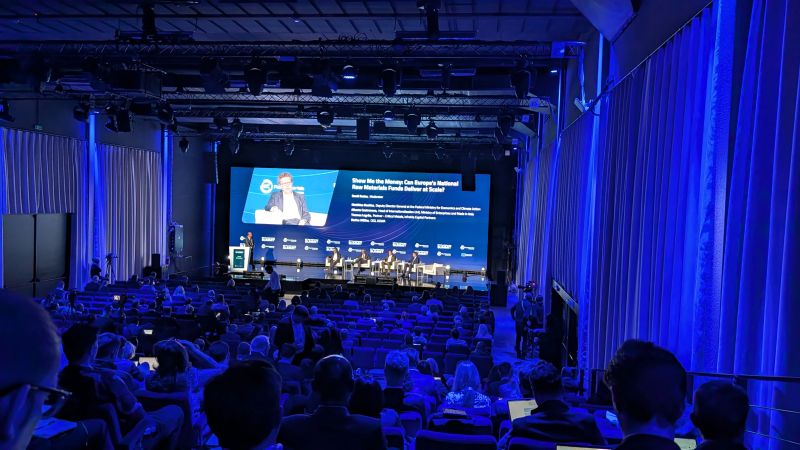
Europe’s national raw materials funds are moving from commitment to deployment, but significant structural challenges remain between the billions pledged by France, Germany, Italy and the Netherlands and the actual financing of projects that can deliver supply chain security, according to a frank discussion at the EIT Raw Materials Summit in Brussels.
The session, which brought together fund representatives and industry figures, centred on what participants described as the “valley of death” facing Europe’s raw materials sector — the financing gap between early-stage project development and the bankable infrastructure investments that traditional capital markets are willing to fund.
A clear consensus emerged on the role these funds should play: catalyst, not replacement. The German and French models in particular emphasise minority positions and the necessity of robust private sector co-investment, with a target ratio of roughly one euro of public money for every euro of private capital. The objective is to de-risk projects sufficiently to attract commercial investors, not to substitute for the market indefinitely. The tension between strategic necessity and commercial viability was acknowledged as genuine: many projects that are vital for European sovereignty are currently un-bankable by conventional metrics, and the funds must navigate the gap between these two realities without becoming permanent subsidies.
The discussion highlighted fragmentation as a persistent obstacle. Industry developers need a unified “Team Europe” signal — a coherent, harmonised approach across national fund criteria — but the current landscape of diverging eligibility requirements adds complexity and weakens Europe’s ability to compete with the more centralised approaches taken by the United States and China. Moving beyond national silos was identified as essential for credible global competition.
Participants also flagged the midstream gap as underappreciated relative to its strategic importance. While mining dominates public and political attention, processing and refining capabilities represent a more immediate vulnerability — one that risks being permanently lost to global competitors if investment does not accelerate.
The overall verdict was cautiously optimistic: the policy phase is over, the tools are in place, and deployment is beginning. Whether Europe moves fast enough will depend on its ability to synchronise national efforts, attract private capital at scale and protect midstream capacity before it disappears.
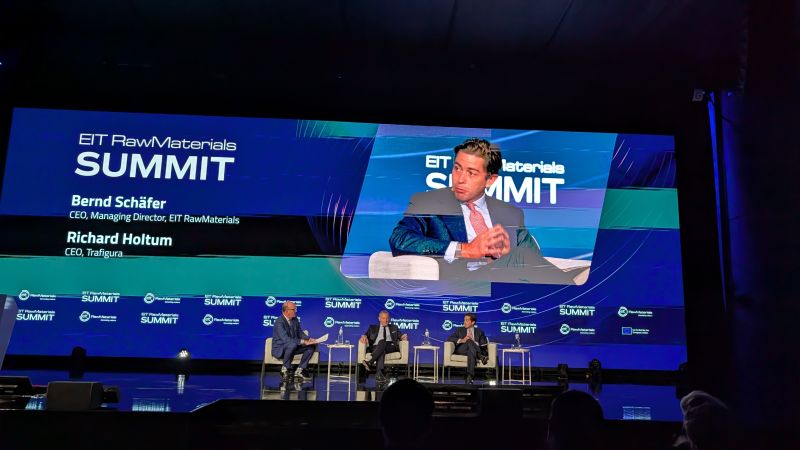
Europe has built the regulatory architecture for critical minerals security — now it must actually build the infrastructure. That was the central message from a RawMaterials Summit session featuring EIT RawMaterials CEO Bernd Schäfer and Trafigura CEO Richard Holtum, who argued that the continent’s critical minerals strategy is approaching a decisive moment in which continued policy discussion without project delivery will itself become a strategic failure.
The sharpest reframing offered at the session concerned smelting. Industry leaders argued that midstream processing capacity — smelting, refining, separation — should now be regarded as a pillar of national security comparable to defence capability, not as a commercial infrastructure question to be resolved by market forces. Relying on foreign powers for processing is no longer sustainable, the discussion concluded, and maintaining existing European capacity on what was described as “life support” is insufficient without a funded, long-term plan covering both capital and operating expenditure.
The discussion pushed back against a tendency to evaluate critical minerals investment through the lens of short-term cost. The true metric, participants argued, is the cost of inaction — the economic and strategic price of failing to build domestic value chains. The American model of socialising capital expenditure to secure strategic advantages was cited as a template Europe needs to study and selectively adopt, prioritising long-term necessity over short-term price volatility.
On execution, the session drew a clear line between the regulatory phase — now largely complete through instruments such as the Critical Raw Materials Act and various industrial accelerators — and the delivery phase that must define the coming year. A pipeline of more than 60 strategic projects has been identified and designated. The priority is now to move those projects beyond memoranda of understanding and into operational reality. The CRMA’s single-point-of-contact mechanism for strategic projects was identified as a genuine competitive advantage, with continued regulatory harmonisation needed to create the stable and predictable investment environment that long-term capital deployment requires.
On international partnerships, the conversation reflected an evolution in European strategy beyond simple resource extraction agreements. The current emphasis is on creating local value in partner countries through infrastructure support, energy access, professional training and job creation — an approach framed as essential not only for ethical reasons but for the practical goal of building supply relationships durable enough to underpin multi-decade industrial planning.
The European Union has identified tungsten, rare earths and gallium as priority candidates for its first coordinated critical minerals stockpile, marking one of the bloc’s most concrete steps yet toward shielding its economy from supply disruptions after China tightened export controls on several strategic materials over the past two years.
Discussions have begun with major logistics hubs including the Port of Rotterdam — Europe’s largest port and a key gateway for industrial supply chains — over potential storage arrangements for the proposed reserves. Sources familiar with the matter also indicated that magnesium is expected to be included on the priority list, with germanium and graphite also likely to make the final selection. Most of the minerals under consideration, with the exception of magnesium, appear on NATO’s list of materials considered critical to defence production.
Ten EU member states are participating in planning groups led by Italy, France and Germany. France, holding the G7 presidency, is pushing for a permanent secretariat to oversee the initiative beyond the bloc’s rotating political leadership cycles — a sign of ambition to make the stockpile a durable institutional feature rather than a temporary political response.
The initiative follows a late 2025 announcement of plans for coordinated stockpiling and reflects mounting concern that China could weaponise mineral exports during future trade or geopolitical disputes. Beijing’s export restrictions on gallium, germanium and graphite have already disrupted global markets in recent years, while restrictions on heavy rare earths imposed in April 2025 sent dysprosium, terbium and yttrium prices surging. China’s dominance is structural: the bloc imports 93% of its permanent magnets for wind turbines from Chinese suppliers, and the combined market share of the top three producing countries for key transition minerals rose from 82% in 2020 to 86% in 2024.
Europe’s push to build domestic supply chains has encountered obstacles. Projects designated as strategic under the EU Critical Raw Materials Act, such as the Chvaletice manganese development in the Czech Republic, have faced lengthy permitting delays, with fast-track measures under the legislation yet to be fully incorporated into Czech national law.
The stockpile discussions reflect a broader shift across Western governments from market-driven supply models toward more interventionist industrial policy as competition for strategic resources intensifies. The US, Japan and South Korea are also building reserves or financing alternative supply chains to reduce exposure to Chinese production dominance.
Russia has publicly expressed concern about the accelerating pace of US and European efforts to secure access to rare earths and critical minerals in Central Asia, with Deputy Foreign Minister Mikhail Galuzin warning that Washington’s campaign goes beyond commercial competition and amounts to an attempt to build Western-controlled infrastructure on Russia’s borders.
“We are concerned by the intensity with which Washington is pushing agreements on critical minerals and rare earth metals,” Galuzin told Izvestia in an interview published on Wednesday. “This is not merely about economic competition, but about an attempt to push Russia out and create a Western-controlled infrastructure in the immediate vicinity of our borders.”
The remarks reflect Moscow’s growing unease as the G7 nations — including the US and EU member states — have intensified diplomatic and financial engagement with Kazakhstan, Kyrgyzstan, Tajikistan, Turkmenistan and Uzbekistan in pursuit of alternatives to China’s dominant position in rare earth and critical mineral supply chains. Russia has traditionally regarded the five Central Asian republics as its sphere of influence, a position now being tested simultaneously by Chinese economic expansion into the region and Western strategic outreach.
The US has been particularly active. President Donald Trump hosted the leaders of all five Central Asian nations at the White House in November, describing critical minerals as a key administration priority and using the summit to advance new supply chain agreements. The US has since signed memoranda of understanding with both Kazakhstan and Uzbekistan and backed a $1.1 billion tungsten investment in Kazakhstan with Export-Import Bank financing.
Finnish metals company Terrafame is studying the feasibility of producing scandium from its existing uranium recovery operation, a move that could make it Europe’s only producer of the rare earth metal used in high-performance aluminium alloys, defence applications and other advanced industries.
The Trafigura-backed company has launched a pre-feasibility study to assess whether scandium can be recovered as a side stream at its uranium recovery plant in Finland. A final investment decision is targeted for early 2027, with production estimated to begin approximately two years after that if the project proceeds. The study is expected to be completed by year-end.
Approximately 85% of global scandium supply currently comes from China, which restricted exports of the metal last year as part of its broader retaliation against US tariffs — making European domestic production a strategic priority. Terrafame said the primary end-use target for its scandium would be high-performance aluminium alloys, where scandium additions enable lighter, stronger and more durable components with applications across aerospace, defence and transportation.
The company said it would also approach potential customers and explore opportunities linked to national strategic stockpiling initiatives — a reference to the growing number of European government programmes seeking to build reserves of critical materials outside Chinese supply chains.
Chief executive Antti Koulumies framed the initiative as a resource efficiency measure as much as a strategic one. “By exploring the recovery of scandium from Terrafame’s existing ore feed, we are utilising the full value of our resources, while also addressing the need for domestic European supply of this critical metal,” he said.
Researchers at Germany’s Fraunhofer Research Institution for Energy Infrastructures and Geotechnologies have begun developing a mobile lithium extraction plant designed to recover the metal from deep geothermal brines beneath the North German Basin — a geological formation estimated to hold one of Europe’s largest lithium resources.
The work is being carried out under the RoLiXX project, a $3.2 million initiative supported by the German Federal Ministry of Research, Technology and Space, involving Fraunhofer IEG and several academic and industry partners. The target is the Rotliegend — a 300-million-year-old layer of sandstone and volcanic rock several miles below the surface — whose geothermal waters are considered highly promising for lithium extraction. Estimates suggest the basin’s underground reserves could contain up to 1.27 trillion tonnes of lithium equivalent.
The project aims to create a dual-use model in which geothermal heat production and lithium recovery happen simultaneously, allowing operators of existing geothermal facilities to extract lithium without disrupting power generation. The pilot system has been deliberately designed for mobility: it weighs approximately 250 kilograms, occupies roughly two cubic metres and can be transported by van or forklift directly to geothermal sites.
A central engineering challenge is preventing corrosion and mineral buildup inside the extraction system, which the team is addressing through an adaptive plant capable of adjusting process parameters and chemical additives based on the local thermal water composition. The system also employs a solid-free extraction process to avoid mineral residues that could interfere with geothermal infrastructure.
Fraunhofer IEG project manager Tilman Cremer said the initiative demonstrated that critical raw materials could be sourced locally. “Europe needs its own sources of strategic raw materials. By developing lithium resources in the North German Basin, Germany could in the future play a central role in covering both German and European demand,” he said. The team plans to analyse samples and drilling data spanning from the Dutch border to Poland to better understand how lithium accumulates and how it can be safely recovered.
Давайте начнём с одной цифры. Семьдесят процентов. Именно столько критического минерального сырья Центральной Азии сегодня уходит в Китай. Двадцать пять активных китайских проектов в регионе — это в пять раз больше, чем у всех европейских компаний вместе взятых. При этом Казахстан способен производить половину из тридцати четырёх материалов, которые Евросоюз называет критически важными: литий, кобальт, медь, вольфрам, редкоземельные элементы. В Сенате Казахстана оценивали потенциал казахстанских недр в сорок шесть триллионов долларов. Вдумайтесь в эту цифру.
Вопрос в том — кто станет партнёром в превращении этого богатства из руды в готовую продукцию? Кто поможет выстроить полную цепочку — от геологоразведки до переработки? И кто предложит не просто деньги, а технологии, рынки сбыта и промышленные компетенции?
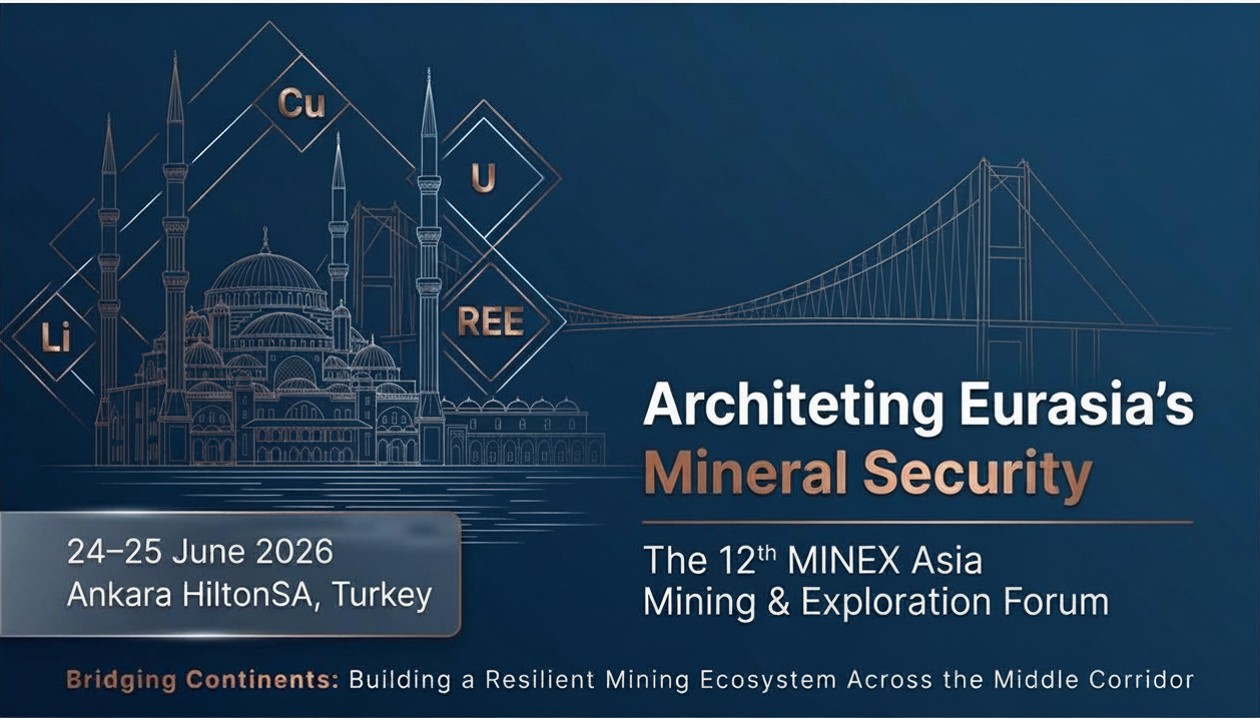
Именно для того, чтобы ответить на эти вопросы, мы проводим двенадцатый Международный горно-геологический форум МАЙНЕКС Азия, который состоится двадцать четвёртого и двадцать пятого июня в отеле HiltonAnkara.
Выбор Турции в качестве места проведения форума не случаен. Форум проводится в номад-формате, перемещаясь из страны в страну и повторяя маршруты Великого Шёлкового Пути. В этом году мы предпринимаем в своём роде уникальную попытку дать глубокую оценку процессов укрепления связей между тюркскими народами и перехода в новое качество объединения богатых минеральными ресурсами странами Центральной Азии с промышленной мощью Турции, а также финансовым капиталом стран Запада и Ближнего Востока.
Буквально неделю назад, тринадцатого-четырнадцатого мая, Президент Эрдоган совершил государственный визит в Астану. Было подписано тринадцать соглашений в сферах инвестиций, энергетики и инфраструктуры, включая историческую Декларацию о вечной дружбе и партнерстве. Реализация проектов позволит привлечь свыше 920 миллионов долларов инвестиций и создать более 3 100 рабочих мест в Казахстане.
Президент Токаев особо подчеркнул, что горнодобывающий комплекс является одним из приоритетных направлений взаимодействия. Он отметил богатый опыт турецких компаний и призвал их активнее участвовать в казахстанских проектах. Это не протокольная фраза. Это конкретный политический сигнал. И мы уже видим реальные плоды: компания Miryıldız построит ГОК в Абайской области, Çelikler Holding развивает угольную химию, а Aksa Energy реализует энергетический проект в Кызылорде. На сегодняшний день в Казахстане с участием турецких компаний осуществлено около 100 инвестиционных проектов на 4 миллиарда долларов, и еще 50 проектов на аналогичную сумму находятся в стадии реализации. Общий объем инвестиционного сотрудничества достиг внушительных 8 миллиардов долларов.
Чтобы придать этому еще большее ускорение, Президент Токаев предложил создать совместный фонд для горнодобывающих проектов. Более того, новый Налоговый кодекс Казахстана теперь прямо поощряет глубокую переработку сырья через благоприятный режим роялти.
Активизация взаимодействия с турецким бизнесом происходит практически во всех странах Средней Азии. Недавно в Ташкенте состоялся турецко-узбекский бизнес-форум, на котором были представлены амбициозные планы довести товарооборот до пяти миллиардов долларов. Узбекистан запускает программу развития критических минералов на два с половиной миллиарда долларов. В сентябре прошлого года прошёл кыргызско-турецкий бизнес-форум, задавший новую планку экономического сотрудничества. Кыргызстан определил двадцать два критических минерала для стратегического развития, а турецкие инвестиции в страну уже превышают полтора миллиарда.
Мы наблюдаем системный сдвиг. Тюркские государства переходят от политической риторики братства к прагматическому экономическому партнёрству. И горнодобывающая отрасль находится в самом центре этого процесса.
Теперь о Турции. Это уже давно не просто транзитная страна Среднего коридора. Минерально-сырьевой потенциал Турции оценивается в три с половиной триллиона долларов. Проект Бейликова— одно из крупнейших в мире месторождений редкоземельных элементов. Турция объявила о создании горнорудной биржи в двадцать шестом году и готовит масштабную национальную программу по переработке критически важных металлов. Страна целенаправленно переходит от экспорта сырья к высокотехнологичной переработке — от бора до магнитов из редких земель и батарейных прекурсоров.
Что именно будет обсуждаться на форуме?
Первый день — стратегия и капитал. Мы начнём с горнорудной стратегии Турции и её перехода к модели промышленной автономии. Затем — Средний коридор: как Транскаспийский маршрут может стать не просто логистическим обходом, а интегрированным промышленным поясом, связывающим добычу, переработку и рынки сбыта. Отдельная сессия посвящена острейшему вопросу — кто финансирует будущее горнодобычи в нашем регионе? Китай, Запад, Ближний Восток — каждый играет свою партию, и странам региона необходимо выстроить сбалансированную многовекторную стратегию. Первый день завершится презентациями проектов, реализуемых турецкими компаниями в странах Средней Азии и в Прикаспийском регионе.
Вечером в резиденции посольства Великобритании совместно с Департаментом Бизнеса и Торговли мы проведем фуршет с участием высокопоставленных лиц.
Второй день — технологии и устойчивое развитие. Как Казахстану и странам Центральной Азии вписаться в европейские цепочки поставок с учётом механизма CBAM и требований к цифровым паспортам продукции? Как управлять хвостохранилищами по мировым стандартам? Как искусственный интеллект уже сегодня меняет геологоразведку — от обработки советских архивных данных до беспилотной геофизики?
Кто планирует участвовать в форуме?
Среди ключевых партнёров в организации форума с турецкой стороны принимают участие Высший Горный Совет Союза торговых палат и товарных бирж Турции (TOBB), Ассоциация золотопромышленников и Ассоциация горнопромышленников Турции, на долю которой приходится около 75% всей добычи полезных ископаемых. В форуме также ожидается участие высшего руководства Фонда благосостояния Турции, а также ведущих компаний, таких как Dama Engineering, Argetest, KSE Mining, Kayen Maden, Positive Group Makine Muhendislik, DMT Türkiye, ExxonMobil и многих других.
Теперь — самое важное. Что конкретно даёт этот форум казахстанским компаниям?
Первое. Казахстан производит девятнадцать из тридцати четырёх критических минералов для стран ЕС. Но основная часть по-прежнему уходит на экспорт в необработанном виде. Форум — это площадка, где можно найти партнёра по переработке, и Турция с её промышленной инфраструктурой и логистическим плечом Среднего коридора — естественный кандидат.
Второе. Инвестиции. На форуме предусмотрена специальная сессия, где ваши проекты — медные, золотые, литиевые, редкоземельные — могут быть представлены напрямую инвесторам. Не через посредников, не через переписку, а лицом к лицу с теми, кто принимает решения.
Третье. Корейский институт KIGAM в прошлом году обнаружил месторождение лития в Восточном Казахстане стоимостью почти шестнадцать миллиардов долларов. Комплексный план развития редких и редкоземельных металлов до двадцать восьмого года уже запущен. Но конкурировать с Китаем в переработке сложно — и именно поэтому партнёрство с турецкими компаниями, которые сами строят перерабатывающие мощности, открывает для Казахстана новый маршрут на западные рынки!
И четвёртое. Нетворкинг. Форум — это цифровая система подбора партнёров, двусторонние встречи, неформальный приём в Посольстве Великобритании в Анкаре и гала-ужин. Это те контакты, которые невозможно завязать по электронной почте.
Коллеги, давайте посмотрим на ситуацию широко. Европа ищет альтернативу китайской зависимости в критических минералах. США запустили диалог C5+1 по критическим минералам. Турция строит перерабатывающие хабы. А Казахстан и страны Центральной Азии сидят на ресурсной базе, которую мир буквально разыскивает.
Именно поэтому МАЙНЕКС Азия в Анкаре — это не просто ещё одна конференция. Это место, где ресурсы встречаются с капиталом, а стратегии — с конкретными партнёрами. Регистрация открыта на сайте 2026.minexasia.com.
Приходите не слушать — приходите договариваться. Будем рады видеть вас на форуме двадцать четвёртого и двадцать пятого июня!