Website: Eurasia.com

  • Kazatomprom announces changes in the Board

    Kazatomprom announces changes in the Board

    National Atomic Company Kazatomprom JSC (hereinafter referred to as Kazatomprom or the Company) informs that the following changes have been made to the composition of the Company’s Management Board.

    Due to the merger of the production unit and the nuclear fuel cycle unit (hereinafter referred to as the “NFC”) into one business area under the supervision of the Chief Production Director and the abolition of the position of the Chief Director for the NFC, the powers of Dosbolat Sarymsakov, the Chief NFC Director.

    Thus, at present, the Board of Kazatomprom includes:

    • Yerzhan Mukanov, Chairman of the Board; 
    • Kuanysh Omarbekov, chief production director;
    • Dastan Kosherbaev, Chief Commercial Officer;
    • Ermek Kuantirov, Chief Director for Legal Support and Corporate Governance;
    • Alibek Aldongarov, Chief Director for HR and industrial safety;
    • Mukhit Magazhanov, Chief Procurement and General Director.

    Information on members of the Management Board of Kazatomprom is available on the Company’s corporate Internet resource www.kazatomprom.kz .

  • KAZ Minerals’ Impressive Production and Sales Performance in H1 and Q2 2023

    KAZ Minerals’ Impressive Production and Sales Performance in H1 and Q2 2023

    In a remarkable display of operational prowess and strategic finesse, KAZ Minerals has unveiled its production and sales report for the first half (H1) and second quarter (Q2) of 2023, showcasing a compelling trajectory of growth and success. This comprehensive report reveals a substantial 11% surge in copper production compared to H1 2022, propelled by enhanced throughput and recoveries emanating from the Aktogay sulphide plants. Notably, this achievement underscores KAZ Minerals’ commitment to excellence and its ability to capitalize on synergies within its operations.

    Copper Production Surges by 11%: A Testament to Operational Excellence

    One of the standout highlights of this report is the remarkable 11% increase in copper production, firmly establishing KAZ Minerals as a trailblazer in the mining industry. This impressive upswing can be attributed to the company’s unwavering focus on operational efficiency, resulting in enhanced throughput and recoveries from the Aktogay sulphide plants. This accomplishment reflects KAZ Minerals’ profound understanding of the intricacies of its operations and its proactive approach to optimizing every facet of its processes.

    Silver Production Soars by 14%: Quality Grades Leading the Way

    The report also reveals a significant 14% upsurge in silver production, a testament to the company’s prowess in leveraging higher grades to achieve exceptional results. KAZ Minerals’ commitment to extracting and utilizing higher-grade resources has paid off, showcasing its ability to adapt and thrive in dynamic market conditions. This achievement bolsters the company’s reputation as a stalwart player in the mining sector.

    Zinc Output Skyrockets by 24%: Leveraging Improved Grades and Recovery Rate

    In yet another display of operational excellence, KAZ Minerals has achieved an impressive 24% rise in zinc concentrate output. This remarkable increase can be attributed to the company’s strategic focus on improving grades and recovery rates. By leveraging these key factors, KAZ Minerals has not only demonstrated its ability to optimize its processes but has also positioned itself as an industry leader in harnessing the full potential of its resources.

    Gold Production Adapts, Despite 8% Decrease

    KAZ Minerals’ adaptability and resilience shine through in its approach to gold production. Despite facing a decrease of 8% in gold output due to lower expected grades, the company’s ability to navigate such challenges while continuing to deliver results underscores its commitment to maintaining a diversified and robust production portfolio.

    Market Performance and Sales Mastery

    The report unveils an extraordinary accomplishment in sales, with KAZ Minerals selling an impressive 223 kt of copper in H1 2023—surpassing production figures by a staggering 23 kt. This resounding success is further amplified by the fact that all by-products’ sales volumes have exceeded production figures, a clear testament to the company’s strategic prowess and market responsiveness.

    Operational Efficiency Mitigates Inflation: Rail Logistics and Chinese Demand Take the Lead

    Amidst the challenges of high cost inflation, KAZ Minerals has deftly navigated these headwinds through a combination of improved rail logistics and robust demand from its Chinese customers. These measures have not only mitigated the impact of inflation but have also aided in the reduction of finished goods inventories. This strategic approach speaks volumes about the company’s ability to adapt, innovate, and proactively manage market dynamics.

    6m
    2023
    6m
    2022
    Q2 2023 Q1 2023 Q2 2022
    Copper production1 kt  199.5  179.9  104.4  95.1  90.0
    Aktogay kt  126.6  104.2  64.7  61.9  53.5
    Bozshakol kt  50.2  51.6  26.5  23.7  24.9
    East Region & Bozymchak kt  22.7  24.1  13.2  9.5  11.6
    Gold production2 koz  77.9  84.5  41.4  36.5  41.8
    Silver production2 koz  1,978  1,732  1,141  837  844
    Zinc in concentrate kt  23.9  19.2  14.8  9.1  8.5
    Copper sales3 kt  223.1  187.5  114.8  108.3  96.7
    Gold sales4 koz  92.9  99.5  49.9  43.0  49.1
    Silver sales4 koz  2,033  1,992  1,059  974  990
    Zinc in concentrate sales kt  29.2  24.1  15.6  13.6  9.1

    1. Payable metal in concentrate and copper cathode from Aktogay oxide ore
    2. Payable metal in concentrate
    3. Payable metal in concentrate, toll processed metal and copper cathode from Aktogay oxide ore
    4. Payable metal in concentrate and toll processed metal

    Highlights

    • KAZ Minerals produced 200 kt of copper in H1 2023, an increase of 11% compared with H1 2022 due to the strong performance of the Aktogay sulphide plants which raised ore throughput and copper recoveries.
    • Silver production in H1 2023 increased by 14%, benefiting from higher grades. Zinc in concentrate output increased by 24% due to higher grades and an improvement in the recovery rate, while gold output reduced by 8% due to expected lower grades at Bozshakol and Bozymchak.
    • The Group has continued to make progress in the sale of its accumulated finished goods inventories, with copper sales in H1 2023 of 223 kt, 23kt above production. Sales volumes of all by-products were also in excess of production. The Group has benefited from improved rail logistics compared with the prior year and strong demand for its products from customers.

    Andrew Southam, Chief Executive Officer, said: “KAZ Minerals produced 200 kt of copper in H1 2023, an increase of 11% compared with H1 2022 as Aktogay raised throughput and recoveries, supported by strong operational performances from Bozshakol, East Region and Bozymchak. The Group has progressively reduced its finished goods inventories, benefiting from improved rail logistics and strong demand from customers in China.”

    For further information please contact:

    KAZ Minerals
    Marie Edwards

    Maksut Zhapabayev

    Company Secretary, London

    Corporate Communications, Almaty

    Tel: +44 20 7901 7832

    Tel: +7 727 244 03 53

    REGISTERED OFFICE

    7th Floor, 83 Victoria Street, London SW1H 0HW, United Kingdom

    PLEASE FOLLOW THE LINK TO DOWNLOAD THE FULL ATTACHMENT

  • Chaarat Gold Announces Sale of CJSC Kapan

    Chaarat Gold Announces Sale of CJSC Kapan

    In a strategic move that underlines Chaarat Gold’s commitment to optimizing its portfolio, the international gold mining company has reached a definitive agreement with Gold Mining LLC to divest its subsidiary, CJSC Kapan. This subsidiary boasts ownership of the renowned Kapan gold-polymetallic mine, a cornerstone of Chaarat Gold’s operations. The sale, marked by its forward-looking nature, is set to reshape the dynamics of the gold mining landscape and cement Chaarat Gold’s position as a visionary industry leader.

    A Transformative Transaction for a Prosperous Future

    At the heart of this transformative transaction lies the buyer, Gold Mining LLC, which currently oversees the operations of the esteemed Lichkvaz mine located within the Armenian terrain. The Lichkvaz mine has consistently supplied high-quality ore to the Kapan plant, facilitating seamless processing operations. The strategic alignment between CJSC Kapan and the Lichkvaz mine is poised to create synergistic efficiencies, thereby bolstering the potential for enhanced operational performance.

    Monetary Breakdown: $55.4 Million Deal Structure

    The financial contours of this momentous sale are both comprehensive and intricate. The transaction’s total compensation stands at an impressive $55.4 million, strategically divided to optimize value for all parties involved. Out of this sum, a substantial portion of $5 million will be exchanged in cash, manifesting Chaarat Gold’s commitment to immediate liquidity and financial flexibility. A noteworthy component of the compensation involves the assumption of Chaarat Kapan’s intra-group debt, accounting for $50.4 million. This nuanced approach to deal structuring showcases the acumen of both parties involved.

    A Chronicle of Value Creation and Community Empowerment

    Chaarat’s acquisition of the Kapan mine in 2019 heralded a new era of operational excellence and value creation. Over the ensuing four years, Chaarat Gold undertook rigorous measures to augment the mine’s operational efficiency, thereby extending its lifespan. Notably, the company remained undeterred by geopolitical complexities, steadfastly investing in the community and bolstering Environmental, Social, and Governance (ESG) standards.

    The Catalyst: Armenian Dram’s Appreciation

    The commendable progress achieved through years of performance enhancements and financial stewardship found a catalyst in the appreciating Armenian dram. The significant uptick in the currency’s value propelled Chaarat Gold’s decision to explore expansion avenues. The company’s strategic vision encompassed not only the Kapan mine’s value realization but also the broader exploration of growth opportunities.

    Charting New Trajectories: Growth Prospects

    In tandem with the sale of CJSC Kapan, Chaarat Gold sets its sights on new horizons. Among these growth trajectories are the Tulukubash and Kyzyltash mines, which present compelling prospects for further value creation. These ventures symbolize Chaarat Gold’s unwavering commitment to sustained growth and the relentless pursuit of excellence.

    Conclusion: Pioneering Change in the Mining Landscape

    In conclusion, Chaarat Gold’s decision to divest CJSC Kapan in favor of a strategic sale marks a watershed moment in the gold mining industry. The alignment between CJSC Kapan and the Lichkvaz mine is poised to drive operational efficiencies, while the financial deal structure mirrors the company’s nuanced approach to value optimization. Chaarat Gold’s legacy of value creation, community empowerment, and ESG commitment is testament to its industry leadership.

    As the company navigates toward the future, the appreciation of the Armenian dram acts as a compelling catalyst, prompting strategic explorations into new growth avenues. The envisioned expansion into the Tulukubash and Kyzyltash mines is a testament to Chaarat Gold’s unyielding pursuit of excellence, innovation, and transformative change within the mining landscape.

  • Chaarat discussing timeline for investment deal with Xiwang

    Chaarat discussing timeline for investment deal with Xiwang

    Chaarat Gold Holdings Ltd – Gold mining company with an operating mine in Armenia, and assets in the Kyrgyz Republic – Says it is in the process of negotiating an extension to the maturity date of its USD31.7 million conversion loan notes.

    Adds it is in discussions with Xiwang International Co Ltd about the completion of its potential USD250 million investment deal, which will support the development of Chaarat’s organic pipeline and facilitate external growth through value-added acquisitions. The investment will be in the form of a new issue of shares in Chaarat at a price of GBP0.20 per share, resulting in Xiwang holding 60% of the shares in the company.

    Current stock price: 7.67 pence, down 12% on Monday

    12-month change: down 37%

    By Sabrina Penty, Alliance News reporter

    Comments and questions to newsroom@alliancenews.com

    Copyright 2023 Alliance News Ltd. All Rights Reserved.

  • Anglo Asian suspends flotation plant operation before report

    Anglo Asian suspends flotation plant operation before report

    Anglo Asian Mining PLC – Azerbaijan-focused copper and gold producer – Updates on operations at a tailings dam in Gebabek, Azerbaijan. As a ‘precautionary measure’, suspended operation of flotation plant on Monday. Says move is ‘in accordance with a draft protocol with the government’. Anglo-Asian notes consultants from Micon International Co Ltd visited Gebabek last week to carry out full environmental inspection on behalf of government. Micon will issue a full report by September 8. Flotation plant is to remain suspended until all environmental and safety deficits, if any are found by Micon, are fixed. Anglo Asian notes that level of cyanide in existing tailings dam was below the legal limit required by the government.

    It also notes exploration continues as normal. Adds suspension will result in reduced production of around 400 tonnes of copper and 300 ounces of gold in August.

    Current stock price: 68.80 pence, down 4.4% on Wednesday

    12-month change: down 23%

  • Column: Europe adds aluminum to its critical raw materials list

    Column: Europe adds aluminum to its critical raw materials list

    [vc_section][vc_row][vc_column][distance desktop_type=”30″][lvs][distance desktop_type=”30″][vc_btn title=”Source – Mining.com” color=”sky” i_type=”material” i_icon_material=”vc-material vc-material-perm_device_information” add_icon=”true” link=”url:https%3A%2F%2Fwww.mining.com%2Fweb%2Fcolumn-europe-adds-aluminum-to-its-critical-raw-materials-list%2F|target:_blank”][distance desktop_type=”30″][vc_column_text]European Union (EU) countries have added aluminum to the list of minerals and metals covered by the Critical Raw Materials Act (CRMA).

    The Act is the centerpiece of the EU’s strategy for ensuring it has the necessary inputs to compete with the United States and China in the global race to decarbonize.

    The initial omission of aluminum from the CRMA was greeted with outrage from parts of the industry, the Federation of Aluminium Consumers in Europe lambasting EU policy-makers for “doing the opposite of what should be done”.

    The last-minute inclusion of the metal, together with its upstream feeds of bauxite and alumina, attests both to the criticality of aluminum to the green revolution and Europe’s increasingly precarious security of supply.

    Green metal

    Aluminum is already the second most widely used metal in modern society after steel thanks to its high strength-to-weight ratio.

    Usage is expected to grow strongly over the coming years as the energy transition gathers pace.

    The World Bank has identified aluminum as a “high-impact” and “cross-cutting” metal in all existing and potential green energy technologies from solar to geothermal.

    Moreover, aluminum will play an important role in light-weighting electric vehicles, allowing automakers to get more mileage out of lithium-ion batteries.

    Global demand is forecast by the International Aluminium Institute (IAI) to increase by almost 40% to 119.5 million metric tons by 2030, meaning the aluminum sector needs to produce an extra 33.3 million metric tons of metal over the decade.

    Falling output

    As things stand, Europe is going to struggle to lift primary production at all over that time-frame.

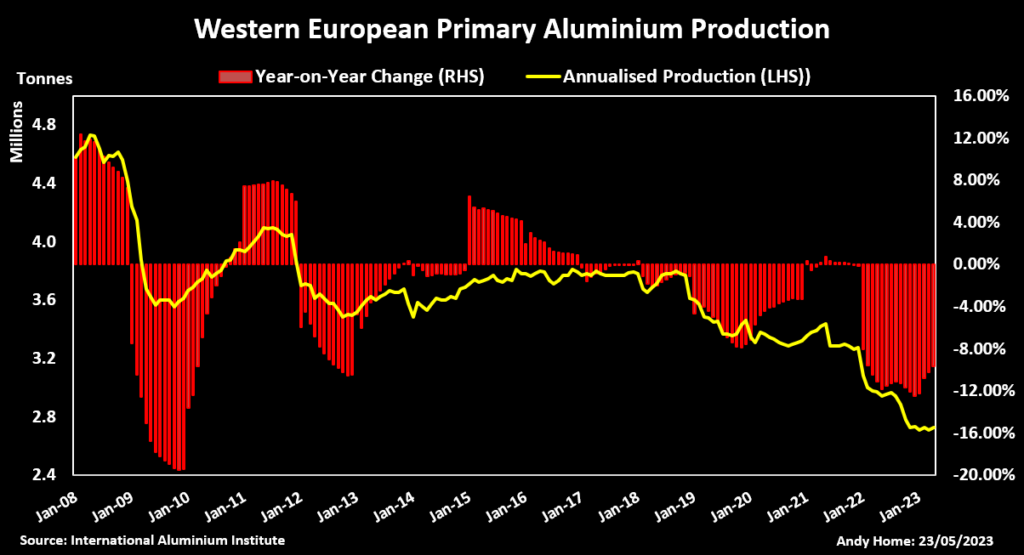
    Western European production has been sliding steadily over the last 15 years with run-rates dropping from over 4.5 million metric tons to a current 2.7 million.

    The sector has been squeezed between high European energy prices and years of high Chinese exports, largely in the form of semi-fabricated products.

    Aluminium smelters consume a lot of power and the sector has taken another hit from the energy crunch that has followed Russia’s invasion of Ukraine.

    Europe lost another 850,000 tonnes of primary smelter capacity between October 2021 and March 2022, according to the EU.

    Some, such as Alcoa’s Spanish plant, will return after new, lower-carbon power supplies are secured. Some may well never return.

    Import dependency

    European aluminum consumption averaged just over 5.0 million metric tons per year over the 2016-2020 period, according to the EU.

    Import reliance averaged 56% over the same period, which is much lower than the bloc’s 89% import reliance for bauxite and probably the reason why EU planners didn’t originally include aluminum in the CRMA.

    However, the key difference is where Europe sources its bauxite and primary aluminum.

    Imports of bauxite over the 2016-2020 period came primarily from Guinea (70%), Brazil (14%) and Sierra Leone (10%).

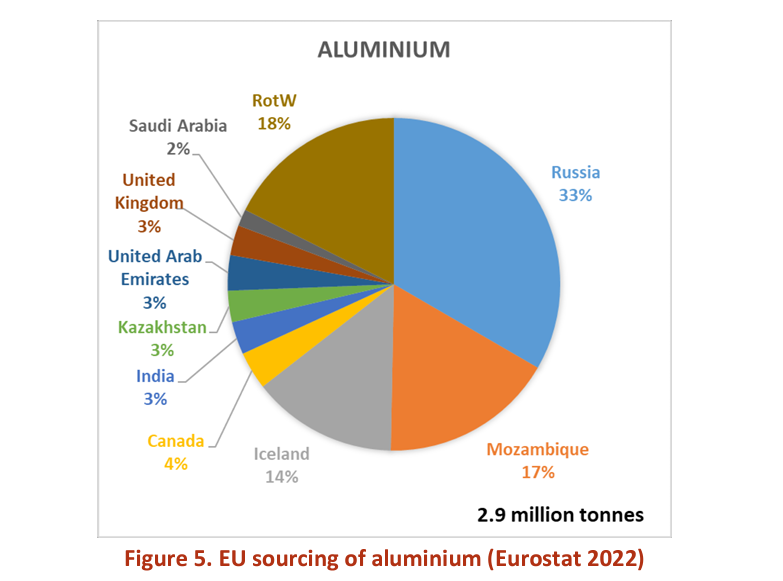
    Imports of primary aluminum, by contrast, were dominated by Russian metal, which accounted for an average 33% over the same five-year period, according to the EU. The next largest supplier was Mozambique, which accounted for 17% of total imports, followed by Iceland, which accounted for another 14%.

    Both the United States and Britain have imposed penal duties on imports of Russian metal but the importance of Russia to Europe’s supply chain has meant there are no official European sanctions against Rusal, Russia’s dominant producer.

    However, the dependence on Russian supply is highly problematic given the increased tensions between the EU and its eastern neighbour after the invasion of Ukraine in February 2022.

    If Russian supply were taken out of the import picture, Europe’s aluminum dependence would become much more acute.

    Power problems

    Getting aluminum onto Europe’s critical raw materials list is an important win for the region’s aluminum sector.

    However, it’s just the start.

    Preserving what remains of the bloc’s primary smelting capacity, let alone rebuilding it, is dependent on low-cost power, something that the EU is running short of right now.

    The problem is compounded by aluminum producers’ need to lower their carbon footprint. That requires lots of renewable power, something the region is even more short of.

    The EU’s proposed carbon border adjustment mechanism is another bone of contention. The European aluminum industry fears it will raise the cost of imports while not having any impact on global emissions in an industry dominated by China.

    It’s worth remembering that European processors are also paying import duties on both primary aluminum and alloy as a result of legacy attempts to protect the region’s smelters.

    Those import duties have evidently only slowed not halted the steady decline in European smelter production.

    Targets

    The EU’s CRMA sets 2030 self-sufficiency targets of 10% of the bloc’s consumption for production, 20% for recycling and 50% for processing. The last two have just been raised from 15% and 40% respectively.

    In addition, no more than 65% of imports should come from any individual supplier.

    If the EU is going to meet all those targets for aluminum, it’s going to need a holistic approach that includes affordable green power pricing, a re-think of its legacy import duties and a possible fine-tuning of the proposed carbon border mechanism to reflect the reality of the global aluminum sector.

    Putting it on the list of critical raw materials may be the easy part of that multi-dimensional challenge.[/vc_column_text][distance desktop_type=”30″][/vc_column][/vc_row][/vc_section]


  • The EU Supports Kazakhstan’s development and processing of rare earth and other critical metals

    The EU Supports Kazakhstan’s development and processing of rare earth and other critical metals

    [vc_section][vc_row][vc_column][distance desktop_type=”30″][lvs][distance desktop_type=”30″][vc_btn title=”Source – kursiv.media” color=”sky” i_type=”material” i_icon_material=”vc-material vc-material-perm_device_information” add_icon=”true” link=”url:https%3A%2F%2Fkz.kursiv.media%2F2023-04-20%2Fzhnb-titaniumetceu%2F|target:_blank”][distance desktop_type=”30″][vc_column_text]The European Union (EU) has promised to support Kazakhstan in the development and processing of rare earth and other critical metals. The commitment was made during the MINEX Qazaqstan mining forum, where the EU’s strategic partnership with Kazakhstan for the sustainable production of raw materials, batteries, and hydrogen chains was discussed. The European Commission spokesperson, Robert Thomas, mentioned the EU’s strategic partnership with Kazakhstan for the sustainable production of raw materials, batteries, and hydrogen chains.

    The strategic partnership agreement between Kazakhstan and the EU was signed on 7 November 2022, focusing on the sustainable production of raw materials, batteries, and hydrogen chains. The countries are required to develop a partnership roadmap within six months.

    Europe continues to work towards establishing a sustainable supply of critical raw materials, including rare earth metals, for its industries. The European Commission recently introduced a package of legislative amendments to stimulate the supply of such materials. The demand for these materials is driven by various sectors, including renewable energy, aerospace, defence, and the military-industrial complex. The article mentions Europe’s support for Ukraine in terms of weapons and ammunition supply, highlighting the importance of raw material supply for defence purposes.

    To reduce dependence on a single country, particularly China, Europe aims to diversify its sources of raw materials. The European Commission aims to ensure that by 2030, no more than 60% of strategically important raw materials come from a single country. Europe’s increasing demand for new fuels and related materials, driven by its commitment to carbon neutrality by 2050, further intensifies the competition for these resources.

    Kazakhstan plays a significant role in supplying certain critical metals to Europe. For example, it covers 71% of Europe’s phosphorus needs, which is used in the production of lithium-ion batteries, explosives, and incendiary compositions. Additionally, Kazakhstan supplies 36% of Europe’s titanium needs, which is used in the production of civil and military aircraft and tanks.

    The Vice Minister of Foreign Affairs of Kazakhstan, Almas Aidarov, mentioned that the country will consider greater state participation in the exploration of rare earth metals. He emphasized the importance of having a comprehensive understanding of these deposits to attract foreign investors. Aidarov also proposed expediting the return of licenses for unused deposits and ensuring that they are operated by companies committed to exploration and development.[/vc_column_text][distance desktop_type=”30″][vc_btn title=”Subscribe to news digest” color=”danger” i_type=”openiconic” i_icon_openiconic=”vc-oi vc-oi-heart-empty” add_icon=”true” link=”url:https%3A%2F%2Fminexforum.com%2Fuser-subscriber-registration%2F|target:_blank”][distance desktop_type=”30″][/vc_column][/vc_row][/vc_section]