Website: Asia.com

  • Qarmet must return to the status of one of the leaders in metallurgy in the CIS

    Qarmet must return to the status of one of the leaders in metallurgy in the CIS

    President Kassym-Jomart Tokayev ordered the production of high-tech steel grades for the automotive industry and other industries, LS reports.

    The head of state recalled that the Karaganda plant (Qarmet) was transferred to the national investor on the terms of a comprehensive modernization of the enterprise. And to ensure uninterrupted operation of the plant and prevent accidents, it is necessary to restore the mines as soon as possible, strengthen industrial safety, and update the material and technical base. The president also added that large-scale investments are needed in the creation of new industries and the production of goods with high added value.

    “It is necessary to establish the production of high-tech steel grades for the automotive industry and other industries. Over the next five years, the enterprise must significantly increase production and regain the status of one of the leaders in metallurgy in the CIS,” Tokayev instructed.

    During his speech, the head of state also listed a list of promising areas that should be paid attention to: road and construction equipment, equipment for the energy sector, reclamation systems, finished metal products.

    “If such production is not created in Kazakhstan now, then the total import of equipment will become chronic. Therefore, it is important that industrial policy is consistent with plans to modernize infrastructure and develop the mineral resources complex. The domestic automotive industry has made some progress here,” the president noted.

    Tokayev emphasized that now it is necessary to consistently move to a more complex level of car assembly. He noted that it is necessary to strengthen other promising sectors of the manufacturing industry.

    “At the same time, business should be oriented towards the fact that after our market is saturated, it will have to export. This will be an indicator of the high competitiveness of domestic entrepreneurs,” Tokayev added.

    He noted that in general it is necessary to give a new impetus to the industrial development of the country. And for this, the head of state recalled, a separate ministry was created last year.

    “Enough time has passed; it’s time to show concrete results. The ministry should develop guidelines for the industry and investors. Specific measures and approaches that would stimulate investment in new high-tech production have not yet been developed,” the president emphasized.

    According to the head of state, a list of breakthrough projects has been prepared, but requires thorough revision. Tokayev noted that these industries should change the structure of the economy, create a strong industrial framework and points of technological growth. However, the president noted that all this has not yet happened. In particular, funding sources have not been identified for many of the projects.

    At the same time, according to the president, large-scale and innovative projects that lay the foundation for economic growth for many years to come should receive priority state support.

    “We are talking about both the modernization of existing production facilities and the development of completely new industrial sectors for our country. The government will have to intensify a constructive dialogue with international financial institutions, transnational corporations and domestic businesses. In general, there must be answers to the questions of what the industrial appearance of Kazakhstan will be, which enterprises will play an important role tomorrow. We need to act proactively, in accordance with the requirements of the time,” Tokayev emphasized.

    In addition, the president separately focused on the modernization of existing production facilities. According to him, we should start with metallurgical plants, whose condition is at a low level.

    “The reason is known – the lack of investment in modernization and expansion of production. As a result, added value of products and quality jobs are lost. Strict control over maintaining the technical condition of enterprises is also extremely important. We have before our eyes a situation where an investor siphoned off profits, ignoring issues of enterprise modernization, ecology, and labor safety,” the president noted.

    At the same time, Tokayev recalled that he had repeatedly raised the issue of establishing strong medium-sized businesses in the industrial sector. However, he added, a systematic action plan was never developed. The head of state noted that there are no answers yet to questions about what the priorities should be and what support will be provided to entrepreneurs.

    “We have opportunities for the emergence of new advanced production facilities. For example, large oil and gas and mining and metallurgical companies must introduce technological innovations when developing subsoil, changing the structure of the national economy,” the president concluded.

  • EU, US to align global minerals push against China’s supply grip

    EU, US to align global minerals push against China’s supply grip

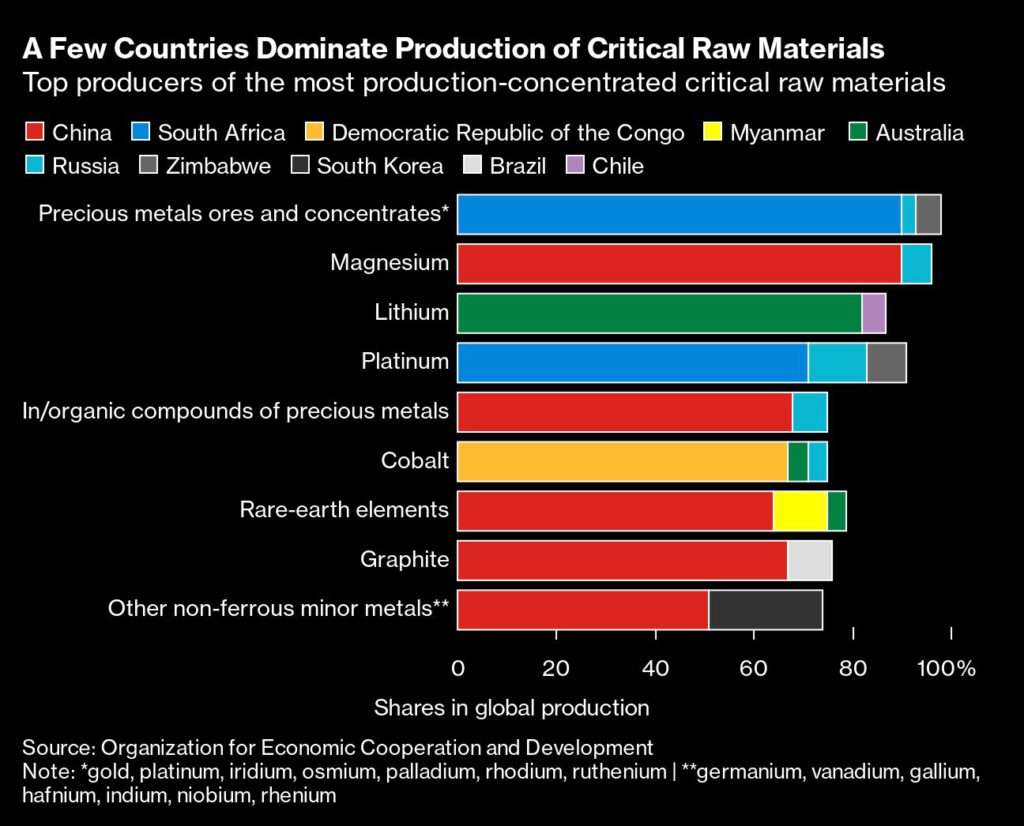
    The US and the European Union are in talks to merge a core area of their efforts to engage suppliers of critical minerals in resource-rich nations, seeking to streamline their push against China’s dominance in materials key for future technologies.

    The aim is to combine the EU’s high-level policy approach with the US focus on specific projects, according to people familiar with the discussions.

    Specifically, the move would merge the EU’s critical raw materials club concept with the Biden administration’s flagship Minerals Security Partnership. It comes after the EU delayed plans to launch its own program in Dubai last year at the COP 28 climate summit, said the people, who asked not to be identified describing internal policy discussions.

    The new initiative, known broadly as a “minerals security partnership forum,” would align outreach efforts to buyers in developed countries and resource-rich nations to cooperate on projects and policies, said the people.

    As part of their broader economic security strategies, Washington and Brussels are seeking to counter China’s domination of the supply chain for so-called critical minerals, a broad term that includes inputs for electrical vehicles and other green energy technologies.

    Key to their combined efforts is working with resource-rich nations to develop standards on investment, trade, research and environmental issues that the US and EU see as an alternative to working with China.

    The allies, who’ve identified more than a dozen potential projects, have taken on a daunting challenge. The lengthy and expensive process of developing mining or refining projects means Beijing’s dominance will likely continue for decades. And US officials have conceded it’s impossible to fully replace China.

    US and EU officials aim to reach an agreement later this month and officially launch the project in March, according to one of the people. They will discuss the plan at the Munich Security Conference in Germany next week, said a separate person.

    The EU and the US are discussing how to optimize their efforts in fostering international cooperation on critical raw materials, Olof Gill, a spokesperson for the European Commission, said in a response to questions, adding that an important aspect of these talks is to find “the best synergies” between the EU’s critical raw materials club and other international activities.

    A US State Department official, who asked not to be identified discussing internal matters, said the two sides believe separate outreach plans to resource-rich nations duplicated efforts and risked creating confusion. They also want to ensure alignment on the broader goal of reducing the West’s dependence on China for the production and processing of many critical minerals like lithium, manganese and cobalt, and properly coordinate mobilizing state finances and private companies, the official said.

    The EU was already a part of the US-led minerals security partnership alongside Australia, Canada, Finland, France, Germany, India, Italy, Japan, South Korea, the UK and others, which aims to funnel foreign investment into the green energy sector.

    The EU has also signed its own minerals pacts with several countries, including the Democratic Republic of Congo, which supplies about 70% of the world’s supply of cobalt, and Zambia.

    As well, Central Asian members of the C5+1 group — which includes Kazakhstan, the Kyrgyz Republic, Tajikistan, Turkmenistan, and Uzbekistan — have also expressed interest in the minerals security partnership, the US State Department official said.

    Separate EU-US talks on a bilateral critical minerals agreement remain stalled over labor rights and concerns over the feasibility of adopting a trade pact in an election year.

    US officials, who have already struck a bilateral deal with Japan, have wanted to kick-start new mining and processing projects by acting as a bridge between private companies seeking raw materials and developing nations that have relied in recent years mainly on China for resource investments.

  • Uzbekistan is aiming to double exports to the EU countries by the end of 2024

    Uzbekistan is aiming to double exports to the EU countries by the end of 2024

    President Shavkat Mirziyoyev has publicly expressed his concern over the country’s export volumes in recent months, replacing Deputy Investment, Industry and Trade Minister Badriddin Abidov, and firing a slew of local officials in a bid to shake up the country’s economic order book. According to Mirziyoyev, Uzbekistan should be exporting around 30 percent more than it currently does,

    Despite Uzbekistan’s efforts in recent years to position itself as a leading player in sectors like energy, minerals and textile production, Tashkent is determined to do more, particularly given the volume of foreign shipments decreased in four regions and two major industries last year.

    One of the challenges lies in the fact that half of Uzbek exports go to just four countries: Russia, China, Kazakhstan, and Turkey – meaning the Central Asian nation is eager to diversify and find new partners. Uzbekistan joined the EU’s GSP+ preferential tariff arrangement in 2021, but exporters haven’t fully taken advantage of the range of goods covered by the scheme, according to the Uzbek government.

    OECD overview of Uzbekistan 

    In 2021, Uzbekistan was the number 76 economy in the world in terms of GDP (current US$), the number 81 in total exports, the number 78 in total imports, the number 165 economy in terms of GDP per capita (current US$) and the number 79 most complex economy according to the Economic Complexity Index (ECI) .

    During the last five reported years the exports of Uzbekistan have changed by $7.31B from $7.37B in 2016 to $14.7B in 2021. The most recent exports are led by Gold ($4.53B), Non-Retail Pure Cotton Yarn ($1.61B), Refined Copper ($741M), Petroleum Gas ($722M), and Radioactive Chemicals ($407M).

    The top imports of Uzbekistan are Packaged Medicaments ($1.04B), Motor vehicles; parts and accessories (8701 to 8705) ($1.01B), Cars ($656M), Refined Petroleum ($608M), and Wheat ($535M), importing mostly from China ($5.63B), Russia ($5.12B), Kazakhstan ($2.47B), South Korea ($1.92B), and Turkey ($1.87B).

    Another obstacle is the international certification of products, with less than 35% of enterprises in key industries meeting global standards.

    President Mirziyoyev has now set ambitious goals, aiming to increase export volume to EU countries to $1.2 billion and nearly doubling the number of product categories exported to the EU. The plan includes implementing 1,700 international standards and 19 regulations by the end of 2024, along with transitioning 1,200 enterprises to global quality standards.

    The Uzbek government is also looking to deepen its ties with China, with a view to becoming an export partner for Chinese firms. On a recent visit to China, which was a main focus of Uzbek media in recent weeks, President Mirziyoyev made a detour to Shenzhen to visit EV giant BYD, where joined the manufacturer’s CEO Wang Chuanfu in watching the launch of a BYD plant in Jizzakh. This comes with the right to export Uzbek-manufactured BYD vehicles in Central Asia.

    While some may view this as a welcome state focus on exports, others might interpret it as a sign that free-market reforms haven’t had the desired impact. As Uzbekistan strives to become an industrial, high-middle income country at a time of geopolitical insecurity its diversification of trade partners will be key. The scrutiny will be on its commitment to reforms and promotion of private-sector-led growth, as investors and entrepreneurs consider the country for potential partnerships and business opportunities.

  • Казахстан: гонка за критически важным сырьем и иностранными инвестициями ускоряется

    Казахстан: гонка за критически важным сырьем и иностранными инвестициями ускоряется

    Минеральные ресурсы Казахстана приобретают все большее значение в связи с ростом глобального спроса на руды и металлы.   Выступая 19 января 2024 года на круглом столе в Риме, президент Токаев призвал инвесторов рассматривать Казахстан как наиболее благоприятную инвестиционную юрисдикцию в Центральной Азии.

    Согласно оценкам, представленным на сайте администрации президента, Казахстан готов стать центральным инвестиционным хабом в Центральной Азии. В стране более чем 5000 неразведанных месторождений на сумму более 46 триллионов долларов США.  В стране производится 19 из 34 видов важнейшего сырья. Месторождения еще 9 металлов и материалов, таких как кобальт, вольфрам, литий и другие, могут быть использованы с условием привлечения необходимых инвестиций.

    Для сравнения: по состоянию на 2020 год природные ресурсы Соединенных Штатов оценивались в 45 триллионов долларов, значительную часть из которых составляли древесина и уголь. Саудовская Аравия обладает природными ресурсами на сумму 34,4 триллиона долларов, в большей части, нефтью.  Стоимость минеральных ресурсов страны была повышена до 2,5 триллиона долларов в январе 2024 года. Природные ресурсы Канады оцениваются в 33,2 триллиона долларов. Металлы в Канаде включают медь, свинец, никель и цинк, а также драгоценные металлы, такие как золото, платина и серебро. Природные ресурсы Австралии оцениваются в 19,9 триллиона долларов, включая уголь, древесину, медь, железную руду, золото и уран.

    Подробнее о 10 странах с наибольшим количеством природных ресурсов

    К 2029 году Казахстан планирует на 40% увеличить добычу полезных ископаемых

    5 февраля 2024 года был опубликован «Национальный план развития Республики Казахстан до 2029 года»

    Перед отраслью добычи металлов и прочих полезных ископаемых поставили задачу обеспечить 40%-ный прирост к концу десятилетия (т.е. 8% год). Выполнение поставленных задач необходимо решать в связке с такими ключевыми вызовами как: истощение текущей ресурсной базы и перспективы добычи новых материалов, снижение конкурентоспособности продукции, выраженное в высокой энергоемкости отрасли при предполагаемом дефиците энергии, росте стоимости труда при относительно низкой производительности и сложной логистике.

    Несмотря на наличие залежей, месторождений, готовых к освоению, недостаточно. Ожидается снижение добычи меди, хрома и железа. Не реализован потенциал по производству никеля, кобальта, лития и других редких металлов.

    Для решения этих проблем планируется:

    • Провести геолого-геофизические исследования на площади более 400 тыс. кв. км (сопоставимо с размерами Парагвая, Ирака или Узбекистана) и восполнить 20–50% запасов по критическим металлам.
    • Стимулировать геологоразведку за счет софинансирования, освобождения от НДС, амортизации 25% расходов.
    • Создать инфраструктуру для хранения и обработки геоматериалов, построив фондохранилище и кернохранилища.
    • Пересмотреть налоговую ставку для инвесторов, осваивающих техногенные минеральные образования.

    Предстоящие задачи и возможности их реализации с участием национальных и международных компаний будут обсуждаться на предстоящем форуме MINEX Kazakhstan в Астане!

    Для получения дополнительной информации перейдите на сайт форума: 2024.minexkazakhstan.com

  • Kazakhstan: a breakneck race for Critical Raw Materials and Foreign Investment is on!

    Kazakhstan: a breakneck race for Critical Raw Materials and Foreign Investment is on!

    Kazakhstan’s untapped mineral resources are becoming increasingly important due to the global demand for critical raw materials.  On 19 January 2024, president Tokaev participated in the investment meeting in Rome and urged investors to consider Kazakhstan as the most favourable investment jurisdiction in Central Asia.

    According to the estimates, presented on the President’s administration website with over 5,000 unexplored deposits valued at over $46 trillion, Kazakhstan is poised to become a central investment hub in Central Asia.  Currently, the country produces 19 out of 34 critical raw materials. Deposits for 9 more like cobalt, tungsten, lithium, and others can be exploited with the necessary investment.

    To put these figures into perspective, as of 2020 the United States’ natural resources were estimated at $45 trillion, with a significant portion being timber and coal. Saudi Arabia has $34.4 trillion worth of natural resources — notably oil.  The value of its mineral resources has been upgraded to $2.5 trillion in January 2024. Canada’s natural resources has an estimated $33.2 trillion worth of natural resources. Metals in Canada include copper, lead, nickel, and zinc, and precious metals like gold, platinum, and silver. Australia has an estimated $19.9 trillion in natural resources including coal, timber, copper, iron ore, gold, and uranium.

    Read more about 10 Countries with the Most Natural Resources

    By 2029, Kazakhstan plans to increase mineral resource production by 40%

    On 5 February 2024, the Government published the National Development Plan of the Republic of Kazakhstan until 2029.

    Kazakhstan aims to increase mineral production by 40% by 2029 according to its new National Development Plan. However, the mining industry faces challenges like resource depletion, decreasing competitiveness due to high energy intensity, rising labour costs, and complex logistics.

    Despite having mineral deposits, there is a shortage of fields ready for development. Production of copper, chromium, and iron is expected to decline, while the potential for nickel, cobalt, lithium, and other rare metals remains untapped.

    To address these issues, Kazakhstan’s government plans to:

    • Conduct geological and geophysical exploration over 400,000 square kilometres (comparable to the size of Paraguay, Iraq, or Uzbekistan) and replace 20–50% of reserves for critical metals.
    • Encourage geological exploration through co-financing, VAT exemption, and 25% depreciation of expenses.
    • Establish infrastructure for the storage and processing of geomaterials by constructing a storage facility and core storage facilities.
    • Reconsider the tax rate for investors developing man-made mineral formations.

    These challenges and opportunities will be discussed at the upcoming MINEX Kazakhstan Forum in Astana, with the participation of national and international companies.

    For more information and registration details, participants are encouraged to visit the official website: https://2024.minexkazakhstan.com/

  • Erdene Secures $80M to Build Mongolia’s Largest Gold Mine

    Erdene Secures $80M to Build Mongolia’s Largest Gold Mine

     We are very pleased to close the financing for the Bayan Khundii Gold Project with our strategic partner MMC, Mongolia’s leading publicly traded mining company. With the first gold scheduled in 2025, Bayan Khundii will be one of the highest grade, open pit gold mines globally and Mongolia’s largest primary gold producer when it reaches full production.

    Peter Akerley, President and CEO, Erdene Resource Development Corp.

    Akerley continued, “The strengthening of our relationship with MMC through this financing supports our goal of creating a major new mining district in southwestern Mongolia. With MMC’s experience in large-scale mining, expertise in construction, power supply, transportation and logistics, and national and international relationships.”

     The Bayan Khundii Gold Project will form a strong foundation for future growth in the Khundii Minerals District. Together we will grow the Mongolian mining sector, increase the industry’s contribution to the national economy, and create value for our shareholders.

    Peter Akerley, President and CEO, Erdene Resource Development Corp.

    Bayan Khundii Financing

    Erdene and MMC signed a financial agreement to build the Bayan Khundii Gold Project. The funding is set up as a shareholder loan from MMC to Erdene Mongol LLC which is a joint venture between Erdene and MMC and has the mining licenses for Bayan Khundii, Altan Nar, and the extremely promising Ulaan exploration license.

    The US$50 million shareholder loan will finance the building of the Bayan Khundii gold mine and processing complex.  Up to five tranches totaling at least US$5 million may be drawn from the loan. The loan will mature five years after the initial draw date, and interest will be charged at a rate of 13.8 %, which will be paid in arrears every three months.

    The first four interest payments are capitalizationable at EM’s discretion. When the loan matures, it will be fully repaid. Under the same conditions, MMC may choose to make available an additional US$30 million. Additionally, EM and commercial banks in Mongolia are negotiating a loan package for up to $30 million.

    A 50 % guarantee from Erdene and Erdene’s interests in the Project, including its shares of EM and NSR interest and preferential rights over the Khundii, Altan Nar, and Ulaan licenses, will finance the shareholder financing. Under the terms of the companies’ Strategic Alliance agreement, MMC will have first dibs on Erdene’s Zuun Mod project and priority voting rights for as long as the loan is outstanding.

    Erdene also has the option to become a lending shareholder on the same terms as MMC and buy 50 % of the loan.

    This funding comes after MMC invested US$40 million as part of the Strategic Alliance Agreement to acquire a 50 % equity stake in EM. MMC will contribute a maximum of US$120 million toward the Bayan Khundii Gold Project’s development. The Strategic Alliance’s highlights are as follows:

    • The main board of the Hong Kong Stock Exchange lists MMC, as the largest mining firm in Mongolia that is traded worldwide.
    • MMC has made a $40 million investment in EM, Erdene’s Mongolian affiliate that had the Ulaan exploration license in addition to the Khundii and Altan Nar mining licenses.
    • In addition to the first 400,000 ounces of gold recovered, Erdene is still the owner of a 50 % equity position in EM and a 5.0 % Net Smelter Return royalty on production from the Khundii, Altan Nar, and Ulaan licenses. Erdene also retains ownership of any properties purchased within a 700 km2 area of interest.
    • The massive Zuun Mod Molybdenum-Copper deposit and Khuvyn Khar Copper project, which are around 30 km east of Bayan Khundii and next to a proposed railroad development, are both owned 100% by Erdene.
  • Kazakhstan, Azerbaijan agree to co-reduce bottlenecks in Middle Corridor

    Kazakhstan, Azerbaijan agree to co-reduce bottlenecks in Middle Corridor

    Kazakhstan and Azerbaijan have agreed to actualize the synchronous elimination of bottlenecks on the Trans-Caspian International Transport Route (TITR, or Middle Corridor), the deputy chairman of the Committee of Railway and Water Transport of Kazakhstan, Kasym Tlepov, said during the meeting with the Azerbaijani delegation.

    Thus, the parties considered issues within the framework of the implementation of the signed Road Map on synchronous elimination of “bottlenecks” and development of the Middle Corridor on the territories of Kazakhstan, Azerbaijan, and Türkiye for 2022–2027.

    Tlepov informed about the ongoing work to expand the capacity of the corridor. According to him, in 2023, the volume of transhipment through the seaports of Aktau and Kuryk increased by 65 percent and amounted to 2.76 million tons of cargo.

    “Within the framework of the implementation of the roadmap on synchronous elimination of bottlenecks and the development of TITR, the parties are actively working to expand the capacity of the corridor. An agreement has been reached to update this roadmap. In turn, Kazakhstan is making efforts to develop transport and transit potential in the region and modernize transport corridors,” Tlepov emphasized.

    He also shared information on railway projects, raising the status of the TITR association, digitalizing TITR, creating a single logistics operator, and building port capacity.

    To note, the Middle Corridor links the container rail freight transportation networks of China and the European Union through Central Asia, the Caucasus, Türkiye, and Eastern Europe.

    A multilateral multimodal transportation infrastructure links ferry terminals on the Caspian and Black Seas with the railway systems of China, Kazakhstan, Azerbaijan, Georgia, Türkiye, Ukraine, and Poland.

    The middle corridor facilitates increased cargo traffic from China to Türkiye, as well as to European countries and in the opposite direction.

    A route train along this corridor delivers cargo from China to Europe in an average of 20-25 days, and this is one of the main advantages of this transport corridor.

  • Uzbekistan buys 9 tons of gold in December 2023

    Uzbekistan buys 9 tons of gold in December 2023

    The Central Bank of Uzbekistan has emerged as the world’s second-largest gold buyer, the World Gold Council has reported. In December 2023 alone, the region’s second-largest economy purchased 9 tons of the precious metal. This is a significant increase from the 6.5 tons it had acquired in 3Q23.

    Global Central Bank Gold Holdings

    Global central bank gold holdings saw an increase of 28 tons in December. Turkey took the lead as the largest buyer, augmenting its reserves by 28 tons in a single month. Following Uzbekistan, China also made substantial purchases, securing a place in the top three with a purchase of 9 tons.

    Kazakhstan and Kyrgyzstan’s Gold Sales

    Contrary to the buying trend, Kazakhstan emerged as the main seller of gold in December. The country sold five times more precious metal compared to the previous month – 10 tons in December, a significant increase from the 2 tons sold in November. Additionally, neighbouring Kyrgyzstan also sold 2 tons of gold in December.

    Implications and Future Trends

    The recent surge in gold purchases by central banks, particularly in Uzbekistan, Turkey, and China, underscores the growing importance of gold as a strategic reserve. This trend is expected to continue, given the ongoing economic uncertainties and the role of gold as a safe-haven asset. However, the selling trend observed in Kazakhstan and Kyrgyzstan indicates a different strategic approach towards gold reserves in these countries.

    Uzbekistan has one of the largest gold mines in the world, Muruntau. Located in the mountains of Murintau in the south-west of the Kyzylkum desert, on the territory of the Tamdyn district of the Navoi region, the mine has estimated reserves of 150mn ounces of gold in reserves and resources. President Mirziyoyev of Uzbekistan announced on February 1  that gold production in the country grew by 23% over the last 7 years.

  • Russia’s Rosatom joins setting educational hub for industrial digitization in Tajikistan

    Russia’s Rosatom joins setting educational hub for industrial digitization in Tajikistan

    Discussions were held in Tajikistan regarding the establishment of an educational center for industrial digitization and information technologies in the country, Trend reports.

    The issue was deliberated among the Committee on Architecture and Construction under the Government of Tajikistan, Russia’s “Rosatom” state corporation, and the Moscow State University of Civil Engineering.

    During the meeting, the parties endorsed the establishment of an educational center in Tajikistan focused on industrial digitization and information technologies.

    Additionally, they discussed the training of specialists at Moscow State University of Civil Engineering in Russia. The parties expressed their readiness to collaborate in the field of education and the professional development of specialists.

    The sides also reviewed a roadmap to strengthen cooperation on issues outlined in the Memorandum signed on October 20, 2023, between the Committee on Architecture and Construction under the Government of Tajikistan, the Ministry of Construction and Housing and Communal Services, and “Rosatom”.

  • Kazakhstan produces 19 types of critical raw materials approved by the European Union

    Kazakhstan produces 19 types of critical raw materials approved by the European Union

    Kazakhstan, possessing rich resources, positions itself as one of the key players in this field.

    19 types of strategic raw materials:

    • The country produces and processes 19 types of essential raw materials, as approved by the European Union.
    • Exports reach the USA, China, South Korea, Great Britain, Russia, and EU countries.
    • Presently, Kazakhstani manufacturers supply the European market with metal and chemical products such as beryllium, tantalum, titanium, ammonium metavanadate and phosphorus.

    Leadership in copper production and potential in electric vehicles:

    • Kazakhstan ranks amongst the top ten countries in the world for copper production.
    • There’s a promising opportunity to establish a cluster focused on battery material production, such as nickel, cobalt, manganese, and lithium.
    • These precursors will become a primary source of raw materials for the expanding production of electric vehicles.

    Overcoming challenges:

    • A core issue within the rare metals mining industry is a reliance on imported raw materials.
    • Additionally, worn-out technologies and equipment in businesses hinder further development of the production of essential raw materials.

    Comprehensive development plan:

    • To tackle these challenges, a comprehensive plan for developing the rare earth metals sector (2024-2028) has been devised.
    • The plan was approved by a Government Resolution on the 28th of December 2023.
    • The Ministry of Industry is actively working to implement it.

    The implementation of this plan will enable Kazakhstan to become one of the leaders in the production of raw materials for electric vehicles, ensuring sustainable economic development and strengthening its position in the global market.

    Additional information:

    • Press Service of the Ministry of Industry and Construction of the Republic of Kazakhstan
    • Government Resolution of the Republic of Kazakhstan dated 28 December 2023 No. 1023