Kazakhstan’s national uranium producer Kazatomprom has entered into a Memorandum of Understanding (MoU) with Slovenské elektrárne a.s. (SEAS), Slovakia’s largest electricity provider, to foster long-term cooperation in the nuclear energy sector.
The agreement marks the beginning of official collaboration between the two companies and outlines plans to supply natural uranium concentrate and potentially uranium dioxide (UO₂) for SEAS’s nuclear power plants. SEAS operates five VVER-440 reactors across two nuclear facilities—Bohunice and Mochovce—which collectively generate over 70% of Slovakia’s electricity.
Meirzhan Yussupov, CEO of Kazatomprom, said the MoU is a significant step toward building strong relationships with European energy partners. “Nuclear energy is vital for Slovakia’s sustainable energy future. This memorandum paves the way for mutually beneficial collaboration,” he noted.
Branislav Strycek, CEO and Chairman of SEAS, underscored the importance of diversifying nuclear fuel supply sources and welcomed the opportunity to work with the world’s leading uranium producer.
The MoU also opens the door for further cooperation beyond fuel supply, potentially expanding Kazatomprom’s footprint in the European energy market. It aligns with the company’s broader strategy to engage with top European utilities and support the continent’s transition toward cleaner and more secure energy systems.
Kazakhstan is set to supply uranium to Bulgaria’s nuclear power stations, according to Nurlan Zhakupov, the head of the Samruk-Kazyna Fund, who spoke to journalists at the Akorda presidential residence.
Bulgaria operates a nuclear power plant with two 1,2 MW units, presenting a significant opportunity for cooperation in uranium supplies, Zhakupov explained. However, details regarding the volume of supplies remain confidential.
Zhakupov also revealed that Kazakhstan Atomic Energy Stations (KAES), currently a subsidiary of Samruk-Kazyna, will transition to the newly established Agency for Atomic Energy. KAES will focus on the construction of nuclear power plants within Kazakhstan.
Earlier reports indicated that Kazatomprom would supply uranium concentrate to the Czech Republic. This deal aligns with Kazatomprom’s global strategy to diversify its sales channels.
Last year, Kazatomprom produced over 23,000 tonnes of uranium. Since 2022, Kazakhstan has been supplying uranium fuel to China’s nuclear power plants and, in December, completed a uranium shipment to Canada via the Trans-Caspian International Transport Route.
In February of this year, Kazakhstan agreed to collaborate in the uranium sector with Jordan and to supply uranium to Switzerland.
Kazakhstan’s leading uranium joint venture Inkai, operated by Kazatomprom and Canada’s Cameco, is distributing dividends based on production output—not shareholder equity—according to Kazatomprom’s Q1 financials. Although Kazatomprom holds a 60% stake and Cameco 40%, dividends for 2025 will be split 55.63% to Kazatomprom and 44.37% to Cameco, diverging from the nominal ownership structure.
The adjusted payout arrangement stems from a 2024 supplemental agreement, but the formula and justification remain undisclosed. This has fueled speculation following production shortfalls in 2024 due to operational issues, including a 23-day shutdown in January and disruptions in sulfuric acid supply following the switch from Russian imports.
For 2025, output at Inkai is expected at 8.3 million pounds (approx. 3,200 tonnes) of uranium oxide (U₃O₈), with Cameco receiving 3.7 million pounds, down from prior projections of 4.2 million. In 2024, actual production fell short at 2,992 tonnes, compared to 3,230 tonnes in 2023.
In 2023, output was evenly split between Kazatomprom and Cameco. However, in 2024, Kazatomprom received 1,619 tonnes, 246 tonnes more than Cameco. No official explanation has been offered for the shift, though Kazatomprom states that the distribution mechanism is mutually agreed upon, with no penalties or exceptions.
Kazatomprom emphasized it is not authorized to speak on behalf of Cameco and directed further questions to the Canadian partner, which did not respond to inquiries from inbusiness.kz.
Historically, the production share has fluctuated. Between 2020 and 2021, Cameco’s share peaked at 59.4%, highlighting the flexible, performance-based distribution model set in the 2016 restructuring agreement. The split is expected to align with equity once Inkai reaches 4,000 tonnes/year output.
Kazatomprom vs Cameco: A Comparative Glance
Analysts at Teniz Capital recently questioned why Cameco’s market capitalization exceeds that of Kazatomprom. Reasons include:
Higher asset quality in Canada (notably McArthur River and Cigar Lake, considered “Tier 1” uranium mines).
Geopolitical risk and limited geographic diversification on Kazatomprom’s side.
Lower trading liquidity of Kazatomprom shares.
Despite lower production costs, Kazatomprom’s average uranium sales price has been consistently below Cameco’s. In Q1 2025:
Kazatomprom: $54.69/lb
Cameco: $62.55/lb
This pricing gap cannot be explained by logistics alone.
Cost-wise, Kazatomprom’s ISR mining method allows for cash costs of $16.5–18/lb and AISC of $29–30.5/lb, while Cameco’s Canadian underground operations report:
Total production cost: C$32.69/lb (~$23.86 USD)
Cash cost: C$22.39/lb (~$16.34 USD)
Cameco produced 10,400 tonnes in 2024 including its Inkai share, while Kazatomprom’s total production across all JVs reached 12,286 tonnes. The national total was 23,270 tonnes, suggesting Kazatomprom’s scale but also raising questions about labor efficiency—Kazatomprom employs ~22,000 people vs Cameco’s 6,200.
Kazatomprom, Kazakhstan’s national atomic company, held discussions with Romania’s Ministry of Energy and state-owned company SN Nuclearelectrica S.A. regarding the expansion of natural uranium supplies and the development of the beryllium industry.
A key outcome of the talks was the discussion of terms for a ten-year contract to supply Kazakhstani natural uranium for Romania’s current and planned nuclear power plants. Kazatomprom anticipates that the contract will strengthen long-term cooperation between the two countries and provide reliable raw material supplies for Romania’s nuclear energy sector.
Additionally, the Ulba Metallurgical Plant (UMP), a subsidiary of Kazatomprom, may begin processing Romanian beryllium. Romanian representatives expressed interest in scientific and technical cooperation with UMP and further exploration of processing beryllium raw materials from Romanian deposits. UMP specializes in processing beryllium and tantalum and exports its products globally.
In Kazatomprom’s 2024 report, uranium production (proportional to its ownership share) reached 12.3 thousand tons, marking a 10% increase from 11.1 thousand tons in 2023 and 11.4 thousand tons in 2022. This growth was mainly driven by joint ventures Budenovskoye, Akbastau, and Karatau.
However, production of beryllium products fell to 735.1 tons in 2024, down from 842.8 tons in 2023 and 1,295.4 tons in 2022. Tantalum production also declined, with 135.1 tons produced in 2024 compared to 153.8 tons in 2023 and 165.3 tons in 2022.
Kazatomprom’s 2024 financial report stated that revenue reached 1.81 trillion tenge (up from 1.43 trillion tenge in 2023). The largest consumers of Kazakh uranium and other products included:
China: 663.7 billion tenge (522.5 billion tenge in 2023)
United Kingdom: 44.7 billion tenge (40.6 billion tenge)
UAE: 29.3 billion tenge (no imports in 2023)
Other countries purchased Kazakh products worth 69.2 billion tenge, down from 107.6 billion tenge in 2023. Although Romania was not among the largest consumers, Kazatomprom confirmed it continues to supply its products to the country.
Kazatomprom, the world’s largest uranium producer, has signed a landmark agreement with ČEZ, a.s., a prominent energy company in the Czech Republic, to supply natural uranium concentrates over the next seven years. The official signing ceremony took place at ČEZ headquarters in Prague.
Under the terms of the agreement, Kazakh uranium will fulfill approximately one-third of the fuel requirements for Westinghouse-manufactured assemblies used at the Temelín Nuclear Power Plant, one of the Czech Republic’s major nuclear facilities. This collaboration is expected to enhance the Czech Republic’s energy security and align with its decarbonization and sustainability goals.
Strategic Importance of the Deal
This deal is a strategic milestone for both countries:
For Kazatomprom, it signifies an expanded footprint in the European market and a strengthened position in the global uranium industry. The company has increasingly focused on diversifying its sales portfolio and forging international partnerships, as evidenced by similar agreements with Switzerland earlier this year.
For ČEZ, the agreement diversifies its uranium supply chain, reducing reliance on traditional sources and ensuring stability in nuclear fuel provision. Nuclear energy accounts for approximately 36% of the Czech Republic’s electricity production, with ČEZ operating six reactors at the Dukovany and Temelín sites.
Broader Energy Security and Sustainability Goals
The deal underscores broader trends in the nuclear energy sector, including supply chain diversification and the shift toward cleaner energy sources. With geopolitical uncertainties affecting traditional uranium markets, partnerships with producers like Kazakhstan, which holds about 12% of the world’s uranium reserves, are becoming increasingly critical.
Both companies view this partnership as essential for advancing shared sustainability goals. “This agreement is another important milestone in our mission to be the global nuclear energy industry’s partner of choice,” said Kazatomprom Chief Commercial Officer Vladislav Baiguzhin. ČEZ’s Director of Nuclear Energy Division, Bohdan Zronek, emphasized the strategic importance of securing a reliable uranium supply for the Czech Republic’s decarbonization plans under its “Vision 2030” initiative.
Expanding European Presence
Kazatomprom, headquartered in Kazakhstan, has been strengthening its presence in the European market. The agreement with ČEZ follows similar contracts signed earlier with Swiss energy companies to supply nuclear power plants in Beznau and Leibstadt. These partnerships reflect the growing reliance on Kazakhstan’s extensive uranium resources for nuclear energy production in Europe.
Astana, March 20, 2025 – President Kassym-Jomart Tokayev recently held a meeting with Meirzhan Yusupov, Chairman of the Board of JSC “National Atomic Company Kazatomprom.” The discussion revolved around the company’s 2024 operational results, as well as its short- and mid-term goals.
During the meeting, it was reported that uranium production exceeded 23,000 tons last year, with over 16,600 tons sold across the group. Kazatomprom’s consolidated revenue reached a record-breaking 1.8 trillion tenge, marking a 26% increase from 2023. Tax contributions to the national budget surged to 720 billion tenge, representing a 58% rise compared to the previous year.
The President was briefed on global market developments, new contracts for the supply of natural uranium concentrate, and progress on several investment projects. Notably, the Ulba-TVS plant achieved its full production capacity of 200 tons of low-enriched uranium annually in 2024, marking a significant milestone for the industry.
A key point of discussion was Kazatomprom’s new development strategy for 2025-2034. This initiative focuses on expanding and efficiently utilizing the nation’s mineral resource base. Licenses for uranium exploration in promising areas with an estimated resource potential of 170,000 tons were acquired last year.
Mr. Yusupov highlighted recent international collaborations, including agreements with Tajikistan on rare and rare-earth metal processing, with France on workforce training for the nuclear sector, and with Mongolia and Jordan on joint uranium exploration projects.
Additionally, the President was informed about Kazatomprom’s socially significant initiatives aimed at regional development and support. In 2024, over 3.7 billion tenge was allocated for these projects.
At the conclusion of the meeting, President Tokayev set forth tasks to further enhance Kazatomprom’s operations and its participation in implementing socially impactful projects.
The global uranium market is experiencing what industry leaders describe as a “second uranium renaissance” or, as Cameco’s Sean Quinn prefers to call it, a “rejuvenation.” This revival is marked by robust demand, structural supply shortfalls, and growing support for nuclear energy from both political entities and financial institutions.
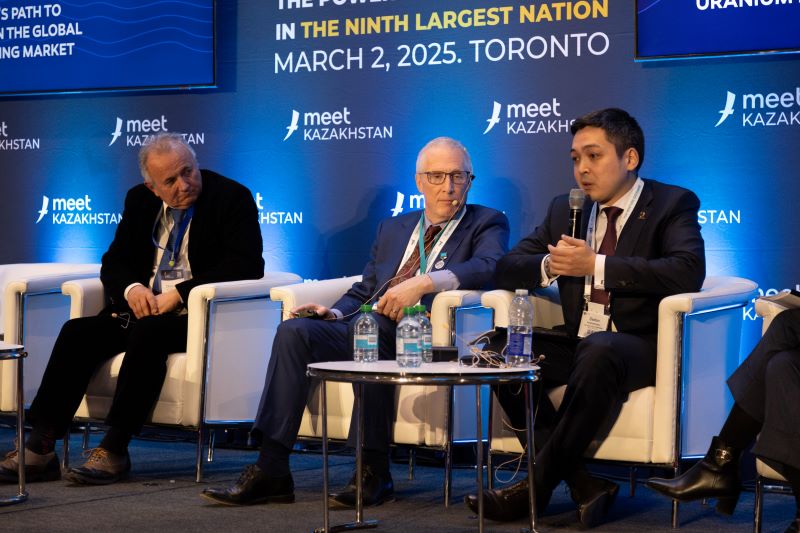
During a panel discussion at the MeetKazakhstan conference held on 2 March 2025 at the 93rd PDAC‘2025 Convention in Toronto, key players from Kazatomprom, Cameco, and Orano shared insights into Kazakhstan’s remarkable journey to becoming the world’s leading uranium producer and discussed the future landscape of the industry.
Kazatomprom: Strategic Vision and Market Discipline
Dastan Kosherbayev, Chief Director for Strategy and International Development at Kazatomprom, emphasized the company’s multi-vector policy that mirrors Kazakhstan’s broader approach to international relations. “We pursue no geopolitical ambition and we’re driven strictly by business or commercial interests,” Kosherbayev stated, highlighting the company’s long-standing partnerships with major industry players.
Kazatomprom became the world’s number one uranium producer in 2011 and the top seller in 2018, maintaining what Kosherbayev described as an “impeccable record” of delivering on all obligations since the company’s establishment in 1997.
The company’s competitive advantage lies in its geology and mining methods. Kazakhstan’s uranium deposits allow for cost-efficient extraction using in-situ recovery (ISR), which Kosherbayev noted is “the most environmentally friendly method that enables us to produce uranium without disrupting any other activities.”
Market Discipline and Global Presence
A key factor in the uranium market’s recovery has been Kazatomprom’s commitment to market discipline. Since 2017, the company has implemented production cuts that removed 48,000 tons of uranium from the market, helping eliminate surplus and revitalize the industry.
Kazatomprom maintains a diverse sales portfolio, with transportation routes through both the Northern route via St. Petersburg and the Trans-Caspian International Transport Route, providing logistical flexibility for deliveries to Western markets.
Updated Strategic Direction
Kosherbayev revealed that Kazatomprom has recently updated its long-term strategy, focusing on five major strategic goals:
Replenishing the resource base to address the upcoming structural uranium deficit expected at the beginning of the next decade
Exploring potential opportunities in conversion and enrichment, though “not at any cost”
Investigating possible expansion into rare earth metals, leveraging existing capabilities at their Ulba Metallurgical Plant
Enhancing trading functions through Kazatomprom’s Swiss trading facility
Continuing commitment to ESG principles
When asked about international expansion, Kosherbayev indicated that Kazatomprom is open to opportunities but prioritizes securing guaranteed demand. “A lot of behind-the-scenes work is carried out currently, and should something arise, we’re going to notify the general public in due course,” he explained.
Partnerships: Keys to Success in Kazakhstan
Cameco’s Long-Term Perspective
Sean Quinn, Senior Vice-President and Chief Legal Officer at Cameco, shared insights from his company’s nearly three-decade involvement in Kazakhstan. Cameco’s interest dates back to 1992, shortly after Kazakhstan declared independence, with JV Inkai being formed in 1998 and beginning production in 2008.
Quinn attributed their success to several factors: “We’ve taken a very long-term view… geographical diversity is important to Cameco… and we’ve had a patient, long-term focus.” He added that having significant operating assets in different jurisdictions, particularly in Northern Saskatchewan, has allowed the company to weather industry ups and downs.
Orano’s Evolution from Exploration to Innovation
Christian Polak, Senior Advisor for Strategy and Partnership at Orano Mining, traced his company’s journey in Kazakhstan back to the 1990s. “In 1996, we signed an agreement with Kazatomprom. We set up the company KATCO where Orano is 51% and Kazatomprom is 49%,” Polak explained.
He emphasized the importance of the initial decade spent building relationships and understanding the country before beginning production in 2006. KATCO now employs approximately 1,200 people.
The partnership has evolved beyond commercial relationships to include scientific collaboration. In 2022, Orano signed a memorandum of understanding with Kazatomprom during the Kazakh president’s visit to France, establishing around 20 scientific projects focused on geology, processing, mining, and environment.
Sustainable Development and Future Outlook
Polak highlighted Orano’s commitment to sustainable mining practices in Kazakhstan. “Even as we continue to produce, we have to think about the future of the country and the future of deposits,” he stated. Orano works closely with Kazatomprom to develop technologies that predict environmental conditions after production ends.
Building positive relationships with local communities is equally important: “We have to share very closely with the populations… to restitute what we found before we arrived.”
Looking ahead, all three companies see opportunities for growth as nuclear energy gains renewed support globally. Quinn mentioned Cameco’s investments in Westinghouse and other fuel cycle opportunities like Global Laser Enrichment (GLE) as providing “even greater exposure to some of that untapped demand.”
Kosherbayev noted that while uranium accounts for 90% of Kazatomprom’s revenue, the company is exploring opportunities to extract valuable by-products such as rare earth elements, beryllium, tantalum, and niobium from its mining operations.
A United Industry
Despite being competitors, the panel emphasized the collaborative nature of the uranium industry. As Kosherbayev concluded, “We may have our differences, but we are like a family… siblings may have their own differences internally, but externally we all come as a big family.”
This spirit of cooperation, combined with strategic vision and sustainable practices, positions Kazakhstan and its international partners to continue leading the global uranium market as nuclear energy plays an increasingly important role in the world’s energy transition.
During an official visit by Kazakhstan’s President Kassym-Jomart Tokayev to Jordan, Kazakhstan’s national atomic company, Kazatomprom, and Jordan Uranium Mining Company (JUMCO) signed a memorandum of understanding to explore joint uranium mining projects. The agreement aims to assess the feasibility of uranium extraction in Jordan and strengthen Kazakhstan’s role in the global uranium industry.
Kazatomprom CEO Meirzhan Yussupov emphasized that the partnership with JUMCO opens new opportunities for international cooperation and enhances Kazakhstan’s strategic expansion efforts. He noted that potential projects outside Kazakhstan would allow for knowledge exchange and contribute to sustainable development.
The memorandum outlines plans to evaluate uranium deposits in Jordan, focusing on refining geological characteristics and implementing heap leaching mining technology. Environmental sustainability and economic viability will be key factors in determining the project’s future.
JUMCO’s General Manager Mohammad Al-Shannag highlighted that the agreement will accelerate Jordan’s commercial uranium production, enabling technology sharing and market insights from Kazatomprom, the world’s leading uranium producer.
Beyond mining, the partnership is expected to boost Jordan’s nuclear industry, create jobs, enhance infrastructure, and engage local contractors. For Kazakhstan, entry into a new market represents a strategic move to solidify its global influence and strengthen bilateral economic ties with Jordan.
Both companies have committed to long-term cooperation based on safety, efficiency, and environmental responsibility. They plan to exchange expertise, adopt new technologies, and improve industry standards, laying the foundation for a sustainable uranium sector in both nations.
Meanwhile, on December 6, 2024, international rating agency S&P Global assigned Kazatomprom a Corporate Sustainability Assessment (CSA) score of 48/100, with an overall ESG rating of 50/100, reflecting the company’s environmental, social, and governance performance.
The Inkai joint venture, a partnership between Kazatomprom (60%) and Canada’s Cameco (40%), produced approximately 3,000 tons of uranium in 2024, according to its CEO, Birzhan Zhylkaidarov. This figure falls short of the 3,200-ton annual target stipulated in the company’s subsoil use contract. Final production data for 2024 will be released later, but preliminary estimates indicate a decline compared to the 3,201 tons produced in 2023.
The contract allows for a 20% deviation from the annual target of 4,000 tons, meaning production between 3,200 and 4,800 tons is acceptable. However, if the final 2024 output remains below 3,200 tons, it would constitute a breach of contractual obligations. While regulators typically issue a warning for first-time violations, repeated failures could result in fines or contract termination.
Zhylkaidarov attributed the shortfall to supply chain disruptions, particularly irregular deliveries of sulfuric acid, a critical reagent used in the in-situ leaching (ISL) method of uranium extraction. The ISL process, which involves injecting a solution of sulfuric acid and water into underground uranium deposits, is highly sensitive to reagent availability. Delays in acid deliveries from mid-April to mid-May 2024 disrupted production schedules, leading to a 20% drop in output compared to contractual targets.
The Inkai venture sources sulfuric acid from KAP Logistics, a subsidiary of Kazatomprom, which transports the reagent from domestic producers like KAZ Minerals, Kazzinc, and Kazphosphate. However, operational halts at supplier plants, including a week-long stoppage at Kazphosphate last fall, exacerbated the challenges.
Looking ahead, Inkai plans to produce 3,200 tons of uranium in 2025. The company is also exploring long-term solutions, including the construction of a sulfuric acid plant in Taykonur, expected to launch in 2027. This facility, with an annual capacity of 800,000 tons, could fully meet Inkai’s sulfuric acid needs.
Since commencing operations in 2002, Inkai has extracted 39,476.2 tons of uranium from the Inkai-1deposit, one of Kazakhstan’s richest uranium reserves. The venture’s final product, yellowcake, is processed into uranium oxide (U3O8), which is sold to shareholders Kazatomprom and Cameco for distribution to global markets, including France, a leading consumer of nuclear energy in Europe.
Kazatomprom JSC held a press tour at the Inkai uranium deposit, operated by Inkai LLP, located in the Turkestan region. Journalists were shown the company’s uranium extraction and processing technologies, as well as its environmental safety measures and social responsibility initiatives.
Kazakhstan remains the world’s leader in uranium production, supplying about 40% of the global nuclear energy market. Inkai is one of the country’s key deposits, known for its low extraction costs. Kazatomprom owns 60% of the joint venture’s shares, while Canada’s Cameco holds the remaining 40%.
Technology and Safety Stepan Tretyakov, Head of Mining, highlighted the use of in-situ recovery (ISR) technology, which is considered the safest and most environmentally friendly method of uranium extraction. “We conduct a five-year monitoring program after extraction is complete, ensuring the ore horizons return to their natural state,” he explained.
At the “Satellite-2” processing facility, Aybek Aidymbekov, Head of Processing, outlined the uranium processing stages, including clarification, sorption using special resin, extraction, and packaging into barrels. Annually, 30 million cubic meters of solution are processed, producing over 11,000 barrels of uranium peroxide.
Operator Beksyltan Ilyas emphasized the importance of radiation protection and automated monitoring at all stages. Meanwhile, Evgeniy Madzhara, Head of the Laboratory, noted that 24/7 quality control ensures no deviations from the technology and guarantees product quality.
Social Support and Employee Comfort The company is actively investing in regional development, allocating 475.4 million tenge in 2024 for social needs in the Turkestan region. Acting Akim Bolat Esenkabyl shared that the company has lit streets, built sports fields, supported schools, and provided internet access in the village of Taykonur.
Comfortable conditions have been created for employees in the rotational camp, including a multifunctional sports complex, gym facilities, and recreational zones with entertainment options like billiards, table tennis, and PlayStation consoles.
Environmental Initiatives The press tour concluded with an elm tree planting initiative. Inkai actively supports environmental projects and provides assistance to veterans, children, and low-income families.
The press tour demonstrated that Kazakhstan’s uranium industry is a high-tech, safe, and socially responsible sector.