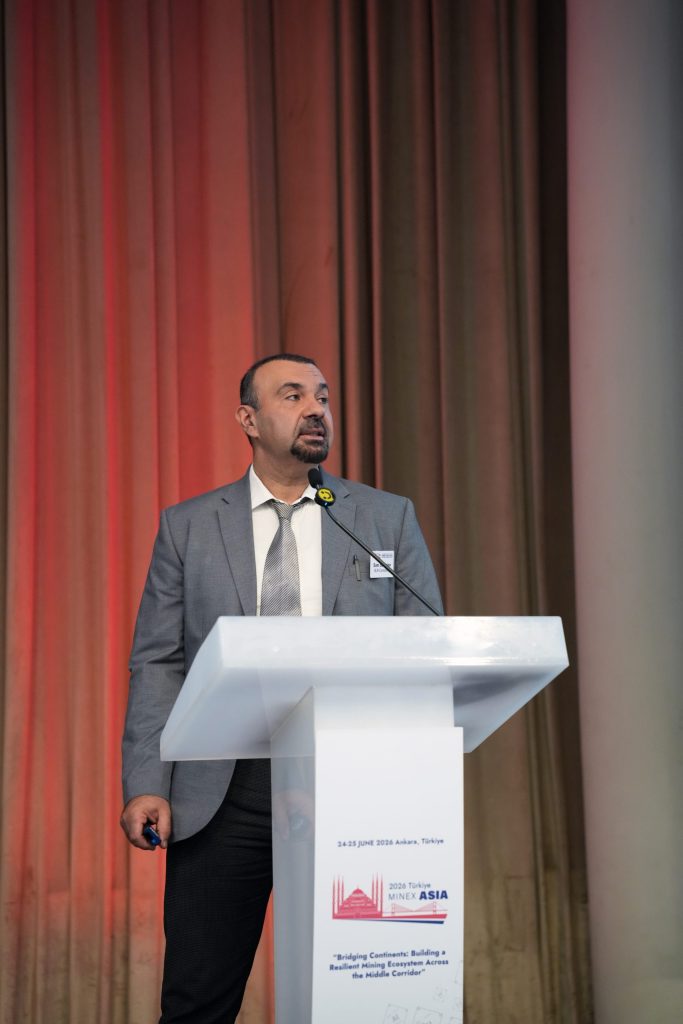
Safavian opened by contrasting the previous day’s discussions of production figures and market demand with the more sobering task of protecting business, society, and environment. His presentation centered on risk-based safety reviews for tailings dams, illustrated through a detailed case study.
He began with the 2019 Brumadinho disaster in Brazil, which killed around 270 people and led to the creation of the Global Industry Standard on Tailings Management (GISTM). Despite this milestone, he noted that major tailings failures have continued to occur since, prompting his central question: could the industry do better? His answer was an unequivocal yes — through systematic identification of credible failure modes, followed by rigorous analysis and mitigation of intolerable risks.
He argued that tailings safety deserves board-level priority because a single incident can destroy the value that production creates, resulting in loss of life, environmental damage, shutdowns, regulatory intervention, loss of license, remediation costs, and lasting reputational harm. He referenced Bulletin 121, an ICOLD resource cataloging historical dam failures, noting principal causes have historically included inadequate water balance control, poor construction oversight, and insufficient understanding of safe operation — issues that modern risk assessment can anticipate.
He distinguished between standard-based assessment (a checklist-style “health checkup”) and risk-based assessment, using a health analogy: when multiple problems exist simultaneously, they can’t all be fixed at once, so prioritization matters. Risk-based assessment builds on standard-based data rather than replacing it. He outlined the full process: gap analysis, failure mode and effects analysis (FMEA) via expert workshops, probability estimation, risk analysis and evaluation, and iterative mitigation until acceptable risk thresholds are met.
He explained that tailings failures are rarely caused by a single defect, but rather by system-level interactions between physical components, failure mechanisms, operational factors, and governance. He illustrated this with two historical examples: Brumadinho (internal piping leading to static liquefaction and slope failure) and Mount Polley in Canada (foundation weakness leading to overtopping and breach).
The core of his talk was a case study of the Essakane gold mine in Burkina Faso, an open-pit operation producing roughly 350,000 ounces of gold annually. He detailed the facility’s construction phases, materials, and staged embankment raises, then described a 2023 failure mode assessment that identified six credible failure modes, including seismic liquefaction-induced slope instability, overtopping, and piping through weak layers. Using flood and seismic frequency curves, his team calculated an estimated total annual probability of failure of 7.6×10⁻⁷, with post-seismic liquefaction accounting for roughly 45% of that risk and piping accounting for about 37%.
Critically, he noted that routine “normal sunny day” conditions contributed about 75% of total annual risk — indicating that everyday operational conditions, not extreme events, dominate the risk profile. The resulting societal risk fell more than two orders of magnitude below regulatory tolerability thresholds, demonstrating the facility’s overall safety while still identifying specific vulnerabilities warranting monitoring and mitigation.