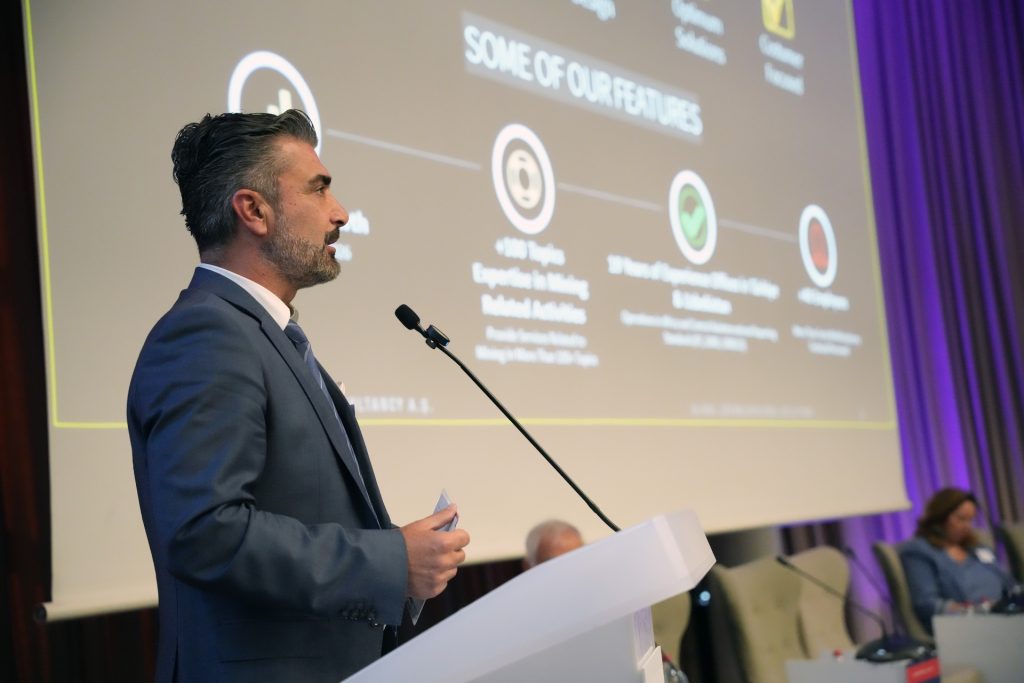
Şahin Özdemir — Chairman, MITTO Consultancy
Özdemir, whose firm MITTO Consultancy conducts environmental and social due diligence for mining investments (over 1,000 projects, 100+ clients, more than 20 years of operation, now expanding into Uzbekistan with a local office), opens with a reframe: the hardest part of a mining project isn’t finding the ore — it’s proving the project is sustainable and socially acceptable. Before selecting a site, he argues, developers must first ask whether there’s any barrier to building there at all; answering that early resolves both investment and sustainability questions simultaneously.
He walks through why disciplines that seem separate — social impact assessment, mine planning, geotechnical and hydrogeological studies — are in fact deeply interlinked. Skip geotechnical assessment and you undermine long-term project viability; skip hydrogeological assessment and you risk damaging local water sources and livelihoods; site a tailings dam purely on cost grounds and you risk permitting failure. He credits the emergence of standards like the IFC/Equator Principles’ ten performance requirements with formalizing this: after confirming a resource, project sponsors must now demonstrate social risk management, sustainability planning, workforce impact, and community benefit before earning creditworthiness. He notes Turkey’s own credit history here is recent — the first EBRD-linked mining loans arrived only around 2014–2016, following the Ivrindi and Lapseki gold projects — after years of failing to communicate cyanide risk credibly to government and communities alike.
He’s frank about Turkey’s own costly mistakes: a 2007-era regulatory loophole allowed environmental assessments under 25 hectares to be prepared without a licensed environmental firm — sometimes by just two engineers — a gap he believes contributed directly to public distrust that has, at times, set the mining and geology professions back. He draws a contrast with Uzbekistan, which he describes as resource-rich with notably higher-grade, more compact deposits than Turkey (citing a single Uzbek gold mine producing roughly 70 tons in a year, versus Turkey’s total national output of about 32.5 tons across 18 mines) and genuinely open to investment. He closes by arguing that credit access follows disciplined process, not urgency — a four-year permitting runway is reasonable, not an obstacle — and that Turkish engineers, having learned these lessons the hard way, are now well positioned to help Uzbekistan and other regional partners avoid repeating them. He lists reference projects (including TÜMAD, CVK, Etibakır, and others) as examples of mining done to modern environmental and social standards, and closes with the line: sustainable development starts with the mine.