Month: March 2024

  • Казахстан готовится к влиянию европейских углеродных регулирований на экспортные отрасли

    Казахстан готовится к влиянию европейских углеродных регулирований на экспортные отрасли

    Представители государственного сектора, бизнеса и эксперты собрались на семинаре для промышленных экспортеров в Казахстане, организованном ОЭСР- SIPA и QazTrade, чтобы обсудить международный опыт в области декарбонизации экономики. С 2026 года европейские страны внедрят трансграничное углеродное регулирование, распространяя новый углеродный налог на казахстанские экспортные товары. С 1 января 2024 года для бизнеса начинается переходный период, после которого увеличенные экологические платежи за выбросы затронут шесть отраслей промышленности, включая производство черных металлов и алюминия, цемента, удобрений, водорода и электроэнергии.

    Вице-министр экологии и природных ресурсов Мансур Ошурбаев заявил, что внедрение пограничного углеродного механизма требует значительной совместной работы с соответствующими министерствами и промышленниками. Уже сформирована межведомственная рабочая группа, которая должна оперативно разработать предложения и определить риски для казахстанских предприятий.

    Нурлан Кулбатыров, заместитель генерального директора QazTrade, подчеркнул актуальность “Зеленого курса” ЕС и введение пограничного корректирующего углеродного налога для Казахстана. Существующее Соглашение о расширенном партнерстве и сотрудничестве между сторонами охватывает широкий спектр инициатив, и QazTrade уже проводит информационные мероприятия по углеродному налогообложению для экспортоориентированных компаний совместно с Министерством торговли и интеграции.

    С учетом поддержки устойчивого развития и декарбонизации ЕС, Кулбатыров отметил необходимость избежать препятствий для международной торговли. В настоящее время доля экспорта Казахстана в ЕС составляет 39%, включая нефть, нефтепродукты, ферросплавы, уголь, уран, пшеницу и другие товары.

    По словам Делфина Саларда, старшего эксперта Генерального управления по вопросам налогообложения и таможенного союза Европейской комиссии, трансграничные регулирования прежде всего затронут черную металлургию и алюминиевые отрасли Казахстана. Постепенно регулирование будет расширяться на другие отрасли, подверженные риску утечки углерода.

    Родриго Пизарро, руководитель Международной программы действий по климату ОЭСР, объяснил формирование цены на углеродные квоты и торговую систему выбросами, отметив, что введение пограничного корректирующего механизма направлено на решение глобальных экологических проблем.

    Целью Казахстана является сокращение чистых выбросов до 328,4 млн тонн углерода к 2030 году и уменьшение выбросов на 25% по сравнению с показателями 1990 года при международной поддержке. Это требует снижения доли угольной генерации с 65% до 40% и увеличения доли возобновляемых источников энергии с 10% до 24% к 2030 году, по словам экспертов ОЭСР.

    На семинаре Айнур Амирбекова, директор департамента международной интеграции в QazTrade, перечислила вызовы и риски, с которыми столкнутся казахстанские промышленники в ближайшие годы. Внедрение углеродного налога ЕС непосредственно отразится на стоимости экспортных товаров и их конкурентоспособности, что может закрыть некоторые рынки для отечественных товаров. Поэтому компаниям следует начать работы по декарбонизации и переходу к альтернативным технологиям.

    Эксперты Европейской комиссии, совместно с QazTrade, готовы продолжить обучение экспортеров, предоставлять аналитическую поддержку, облегчать переговоры и адаптировать стратегии экспорта с учетом экологических мер.


  • Kazakhstan Prepares for EU Carbon Regulations Impact on Export Industries

    Kazakhstan Prepares for EU Carbon Regulations Impact on Export Industries

    Representatives from the public sector, businesses, and experts gathered at a seminar for industrial exporters in Kazakhstan, organized by the OECD-SIPA and QazTrade, to discuss international experiences in decarbonizing the economy. From 2026, European countries will adopt transboundary carbon regulations, extending the new carbon tax to Kazakhstani export goods. As of January 1, 2024, a transitional period for businesses is in effect, after which increased environmental levies on emissions will affect six industrial sectors, including the production of ferrous metals, aluminum, cement, fertilizers, hydrogen, and electricity.

    Vice Minister of Ecology and Natural Resources Mansur Oshurbayev stated that the introduction of the border carbon mechanism entails significant collaborative work with relevant ministries and industrialists. An interdepartmental working group has already been established to swiftly develop proposals and identify risks for Kazakhstani enterprises.

    Nurlan Kulbatyrov, Deputy CEO of QazTrade, emphasized the relevance of the EU’s “Green Deal” and the introduction of the border carbon adjustment tax to Kazakhstan. With the existing Enhanced Partnership and Cooperation Agreement between the two parties, covering a wide range of initiatives, QazTrade has been conducting informational events on carbon taxation for export-oriented companies in collaboration with the Ministry of Trade and Integration since last year.

    While supporting the EU’s sustainable development and decarbonization goals, Kulbatyrov emphasized the need to ensure they don’t hinder international trade. Currently, the EU accounts for 39% of Kazakhstan’s exports, including oil, petroleum products, ferroalloys, coal, uranium, wheat, and other goods, with a positive trend in trade volumes. In 2023, Kazakhstan exported $41.4 billion worth of products to the EU, including $388.7 million worth of carbon-intensive goods.

    According to Delfin Salard, Senior Expert at the Directorate-General for Taxation and Customs Union of the European Commission, transboundary regulations will primarily affect Kazakhstan’s black metallurgy and aluminum sectors, which accounted for about 0.9% and 0.8% of Kazakhstan’s total exports to the EU in 2022. European experts anticipate increased shipments of Kazakhstani products with a high carbon content.

    Industrial enterprises will be required to submit quarterly reports to the European Commission, detailing export volumes, greenhouse gas emissions associated with production, and quota utilization. Amendments to reports can be made within two months after the reporting quarter.

    Post-2025, carbon regulation will come into effect, gradually phasing out free quotas. Initially targeting direct emissions, the scope may later expand to other sectors at risk of carbon leakage, such as oil refining and chemical industries.

    Rodrigo Pizarro, Head of the OECD Climate Action Programme, explained the formation of carbon quotas pricing and emissions trading systems, highlighting that the introduction of the border carbon adjustment mechanism aims to address global environmental challenges.

    Kazakhstan aims to reduce net emissions to 328.4 million tons of carbon by 2030 and cut emissions by 25% compared to 1990 levels with international support. This necessitates reducing the share of coal generation from 65% to 40% and increasing the share of renewable energy sources from 10% to 24% by 2030, according to OECD experts.

    During the seminar, Ainur Amirbekova, Director of the International Integration Department at QazTrade, outlined the challenges and risks facing Kazakhstani industrialists in the coming years. The introduction of the EU carbon tax will directly impact the cost of export goods and their competitiveness, potentially closing off certain markets. Thus, companies should begin decarbonization efforts and transition to alternative technologies promptly.

    European Commission experts, in collaboration with QazTrade, are prepared to continue training exporters, provide analytical support, facilitate negotiations, and adapt export strategies considering ecological measures.

  • Ferronickel temporarily stops production

    Ferronickel temporarily stops production

    NewCo Ferronikeli has decided to temporarily halt production due to high production costs resulting from low prices in the global nickel market and the anticipated recession for commodities in 2024. The company aims to resume production once a more favourable climate for the industry is established.

    In 2013, NewCo Ferronikeli produced 7,700 tons of nickel. The company has demonstrated a long-term commitment to sustainable development through its activities in previous years.

    During this production hiatus, NewCo Ferronikeli will focus on developing projects to reduce production costs and update technology to increase efficiency, ensuring readiness for the future restart of production. The company is working with its employees to navigate this challenging period and prevent negative impacts on its 1,000 employees.

    The nickel industry, including NewCo Ferronikeli, has faced severe challenges due to high production costs and significant discounts in the metal market. However, the company remains optimistic about the prospects of nickel and is committed to resuming production when conditions improve.

    In the past, the company monitored energy and nickel prices to make production decisions. NewCo Ferronikeli will likely continue this practice to determine the best time to restart production.

  • PM Fiala Vows To Review Impact of Polish Turow Lignite Mine

    PM Fiala Vows To Review Impact of Polish Turow Lignite Mine

    Prime Minister Petr Fiala (ODS) promised during a visit to Jablonec nad Nisou yesterday that he would review the impact of mining in the Turow lignite mine in Poland, situated near the Czech border.

    He was reacting to a court decision in Warsaw that invalidated the environmental impact assessment (EIA) of the Turow mine, which had allowed the operation of the mine to be extended.

    The current Czech-Polish treaty is not working, said Milan Starec of the Uhelna association, who asked the prime minister before the cabinet meeting to reopen the issue during the talks with his Polish counterpart.

    Residents on the Czech side are mainly worried about groundwater loss.

    “We who live in the immediate vicinity know that the agreement is not working,” said Starec. “There will definitely have to be one. We have never said that the mine should be closed overnight, but there definitely has to be a final agreement. It should be on the basis of some compromises over timing and territory, not that the Polish government will just send some money and mining will continue indefinitely.”

    At the same time, he handed the prime minister a document detailing the fate of people living close to the mine on the Czech, Polish and German sides of the border.

    The agreement on measures responding to the impact of lignite mining in the Turow mine was signed by the prime ministers of the Czech Republic and Poland in February 2022. Poland and PGE, which owns the mine and the neighbouring power plant, then paid 45 million euros (roughly CZK 1.14 billion) in compensation for the damage, of which 35 million euros went into the transparent account of the Turow Fund, managed by the Liberec Region. This account currently contains over CZK 917 million after interest.

    According to Fiala, all expert opinions indicated that the agreement was desirable, which is why he did everything he could to unblock negotiations with Poland after taking office. “We agree that the deal is correct. If the court rules so, we will look at the results and continue to discuss it,” Fiala promised.

    According to Liberec Region Governor Martin Puta (Mayors for Liberec), the court ruled on a lawsuit filed by the German town of Zittau claiming the Polish side did not take their comments into account when preparing the assessment.

    “I welcome the decision, I think that in such a sensitive place, where the mining does not concern only one state, but the inhabitants of three countries, it is important to address the legitimate objections that have been raised,” Puta said.

    The Turow mine near the Czech-Polish border supplies coal mainly to the neighbouring power plant. PGE Group, which owns the mine and the power plant, plans to mine there until 2044. The mine is to be gradually expanded to 30 square kilometres along the road from Zittau to Bogatynia.

    Residents on the Czech side of the border are particularly worried about the loss of groundwater and increased dust and subsidence.

    Starec, who lives in the settlement closest to the mine, welcomed the court’s decision to cancel the EIA. “The court has de facto given us the benefit of the doubt,” he said.

    However, the Polish administrative court also said its decision was not a reason to stop mining, the PAP Polish news agency reported.

  • Metinvest on the use of AI in green metallurgy

    Metinvest on the use of AI in green metallurgy

    Metinvest, a Ukrainian metallurgical company, has been utilizing artificial intelligence (AI) and analytics to improve its processes and become more environmentally friendly. In 2021, Azovstal Iron & Steel Works, a subsidiary of Metinvest, outperformed its competitors in terms of process efficiency thanks to AI. Ukrainian specialists were also able to perform maintenance twice as fast as their counterparts in neighbouring countries using augmented reality. The company has implemented a computer vision system that has improved the quality of its products. Metinvest’s CEO, Yuriy Ryzhenkov, stated that the company is undergoing a “green” and digital transition and that IT specialists are needed to implement these changes. The company plans to invest $9 billion in its green transformation, which includes modernizing its factories to produce low-carbon steel and building a new rolling plant in Italy. The green transformation of Metinvest’s Ukrainian assets could cost about $9 billion, according to Ryzhenkov. The company is also planning to replace four coal-fired blast furnaces with new equipment to cut carbon emissions, which will require an investment of $20-30 billion in the coming years. Metinvest aims to cut greenhouse gas emissions by 15% by 2030 and by 40% by 2040.

  • EU policies on critical raw materials: Evolution and action plan

    EU policies on critical raw materials: Evolution and action plan

    In 2008, the European Commission initiated the Raw Materials Initiative, marking the inception of a comprehensive strategy aimed at securing access to raw materials on equal footing with global competitors. This initiative laid the groundwork for subsequent policy measures focused specifically on critical raw materials (CRMs) and the circular economy.

    The journey evolved with the publication of the first CRM list in 2011, followed by refinements in assessment methodologies in 2014 and 2017. Over time, the number of assessed materials increased, underscoring the growing recognition of their strategic importance. The 2020 EU CRM action plan outlined a holistic strategy to bolster the resilience, sustainability, and security of the CRM value chain, emphasizing supply diversification, demand reduction, and enhanced circularity.

    A significant milestone came with the introduction of the EU Critical Raw Materials Act (CRMA) in 2023. This legislation introduced a new list of strategic raw materials, elevating the focus on materials crucial for advancing key sectors like energy transition. The CRMA set ambitious targets for domestic production, processing, and recycling capacities, alongside measures to ensure supply diversification and streamline permit processes.

    To support these objectives, substantial investments are proposed in research, innovation, and circularity initiatives. Circularity Hubs, coupled with revisions to directives like the End-of-Life Vehicles Directive, aim to accelerate CRM recovery and recycling efforts, reinforcing sustainability goals.

    The CRMA represents a pivotal step towards achieving strategic autonomy and sustainability in CRM supply chains. By fostering strategic partnerships, enhancing circularity, and investing in innovation, the EU aims to navigate challenges and seize opportunities in the dynamic landscape of raw materials governance.

  • Uzbekistan’s Uranium Deposits Attract Foreign Investors

    Uzbekistan’s Uranium Deposits Attract Foreign Investors

    Representatives of the China Nuclear Uranium Corporation (CNUC) met with the general director of state company Navoiuran, Jamal Faizullaev, to discuss the possibility of mining black shale uranium at the Jantuar and Ma’danli deposits in the Navoi region of Uzbekistan. Samples have already been taken from the deposits to complete geological studies.

    According to the International Atomic Energy Agency (IAEA), Uzbekistan ranks seventh in the world in terms of uranium reserves, and fifth in terms of uranium production. Until 1991, all uranium mined and processed in Uzbekistan was shipped to Russia, but since 1992, virtually all Uzbek uranium has been exported to the U.S. and other countries through Nukem Inc. In 2008, South Korea’s Kepco signed agreements to purchase 2,600 tons of uranium over six years through 2015 for about $400 million. In May 2014, China’s CGN agreed to purchase $800 million worth of uranium through 2021.

    In November 2023, state-owned Navoiuran and China National Nuclear Corporation (CNNC) signed a memorandum of cooperation on uranium mining and processing. CNNC is the main investor in Chinese nuclear power plants. The company currently has 22 operating units, six units under construction, and is the largest uranium producer in China.

    Besides Chinese investors, Uzbek uranium reserves continue to attract other major market players. In January 2006, Russia’s Techsnabexport, a subsidiary of JSC Atomredmetzoloto, signed a memorandum of understanding with Navoi Mining and Metallurgical Combine (NMMC) and the State Committee on Geology (Goskomgeologiya) to establish a joint venture for uranium mining at the (JV) Aktau deposit. The JV was originally scheduled to begin operations in late 2006, but after four years of negotiations, no agreement was reached, and Russia withdrew in mid-2010.

    In October 2007, Japan’s Itochu Corporation agreed with NMMC to develop technology for the extraction and processing of black shale uranium at the Rudnoye deposit. In mid-2008, Mitsui & Co. signed a basic agreement with Goskomgeologiya to establish a JV for geological research in the development of black shale uranium resources at the Zapadno-Kokpatasskaya mine, 300 km northwest of Navoi. Then, in mid-2009, Goskomgeologiya and the Japan Oil, Gas and Metals National Corporation (JOGMEC) signed an agreement on exploration for uranium and rare-earth metals in the Navoi region with the stipulation that JOGMEC receive 50% of the extracted raw materials. In August 2013, JOGMEC received a license for uranium exploration at two sandstone deposits for five years.

    During the November 2023 state visit by French President Emmanuel Macron to Uzbekistan, President Shavkat Mirziyoyev held a meeting with Orano Chairman, Claude Imoven. The meeting discussed the prospects of cooperation with the French company in the field of geological exploration and uranium mining in Uzbekistan. France’s Orano is the world’s largest producer of uranium and nuclear fuel, with assets totalling 29 billion.

    Uzbekistan’s uranium production increased to 3,560 tons in 2022 from 2,385 tons in 2015. Furthermore, President Mirziyoyev has approved an ambitious uranium production target of 7,100 tons in 2030.

  • Unlocking Serbia’s gold reserves: Surge in mining exploration

    Unlocking Serbia’s gold reserves: Surge in mining exploration

    Data from the World Gold Council reveals that approximately 210,000 tons of gold have been extracted globally thus far, with a significant portion, around a quarter, still lying undiscovered beneath the Earth’s surface. It’s estimated that within Serbian mines alone, there are roughly 700 tons of gold yet to be unearthed.

    This surge in gold prospecting is evidenced by the Ministry of Mining and Energy’s report, indicating that currently, 31 companies are actively engaged in geological explorations for gold and associated metals across Serbia. This marks a nearly twofold increase in gold exploration endeavours compared to just a year ago.

    According to ministry officials, gold is commonly found in association with copper, and the exploitation of ore, which yields gold among other metals, is predominantly carried out by three key companies. The Geological Survey of Serbia’s mineral reserve balance, as of the end of 2022, estimates proven reserves of copper, gold, and related metals ores to total around 1.7 billion tons, similar to neighbouring countries.

    Professor Dr Rade Jelenković from the Faculty of Mining and Geology in Belgrade attests to Serbia’s gold wealth, stating it’s on par with countries like Bulgaria and Romania.

    The quantity of estimated gold mineral resources in Serbia varies, ranging from 625 to over 750 tons. However, only a fraction of these resources have been tapped into due to various factors, including mining challenges, limited ore reserves, and other operational considerations.

    Notably, significant quantities of gold are being extracted from copper deposits in eastern Serbia, with prominent sites like Majdanpek, Bor, and the recently discovered Čukaru Peki deposit leading the charge. These deposits hold proven reserves, making them economically viable for extraction.

    Professor Jelenković explains that while Serbia’s annual gold production from copper deposits currently stands at 1.2 to two tons, historical figures indicate it once reached up to five tons annually. In comparison, other countries like Turkey, Bulgaria, Finland, and Sweden boast larger mineral gold resources and higher production volumes.

    Georgi Hristov, CEO of “Tavex Serbia,” underscores China’s dominance as the world’s largest gold producer, followed closely by Australia and Russia. Together, they contribute a substantial portion of the global gold supply.

    Of the gold in circulation worldwide, a significant portion is allocated to various purposes: jewellery (approximately 96,000 tons), investment gold (around 47,000 tons), central bank reserves (approximately 36,000 tons), and industrial and medical applications (the remaining 30,000 tons).

    In essence, Serbia’s burgeoning gold exploration activities reflect the ongoing global pursuit of this precious metal, highlighting its significance in both economic and industrial contexts.

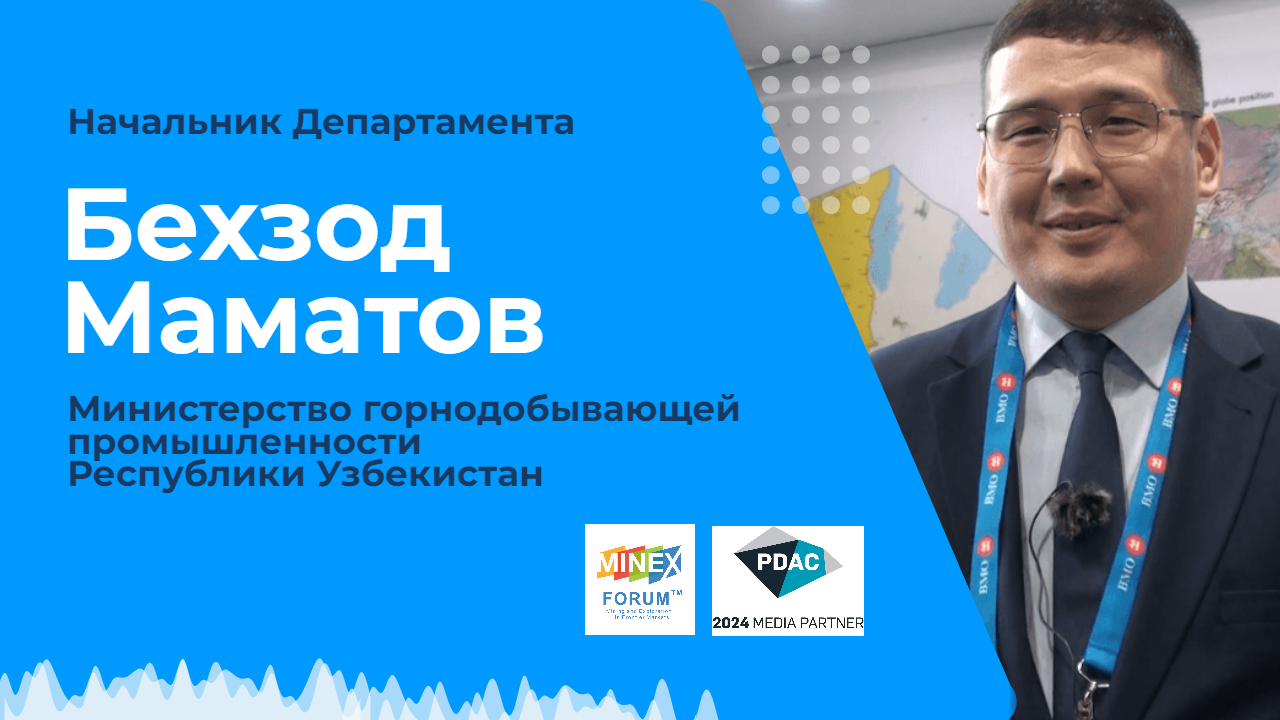
  • Интервью с Бехзодом Маматовым, Министерство горнодобывающей промышленности и геологии Республики Узбекистан

    Интервью с Бехзодом Маматовым, Министерство горнодобывающей промышленности и геологии Республики Узбекистан

    4 марта 2024 – Торонто, Канада

    Официальная делегации Республики Узбекистан впервые принимала участие в PDAC (Конвенции поисковых и горнодобывающих компаний Канады). Основанная в 1932 году Конвенция ежегодно собирает в Торонто около 30 000 участников и свыше 1000 экспонентов из более чем 100 стран мира.  MINEX Forum традиционно участвует в PDAC в роли информационного партнера в странах Европы и Центральной Азии.

    MINEX Forum подготовил интервью с руководителями и представителями узбекской делегации, принимавшей участие в PDAC 2024. Представляем вашему вниманию интервью с Бехзодом Маматовым, начальником департамента Министерства горнодобывающей промышленности и геологии Республики Узбекистан.

    MINEX Forum (далее MF). Прежде всего, расскажите, пожалуйста, с какими задачами вы приехали на PDAC? Почему вы здесь?

    Бехзод Маматов (далее БМ). Здравствуйте! Присутствие на площадке PDAC имеет важное значение для экономики нашей страны, ориентированной на открытость и расширение международного сотрудничества. Мы хотим показать наши намерения и  планы по открытию нашего рынка для мира.

    MF. Что вы представляете на стенде Узбекистана? Вы можете подробней об этом рассказать?

    БМ. Как вы заметили, наша делегация впервые присутствует на PDAС. Это наши первые шаги в ознакомлении международных инвесторов с нашим потенциалом. Мы хотим показать миру, какая в Узбекистане геология, какие территории, какие процедуры по получению разрешений, преимущества системы налогообложения и многое другое.

    MF. Площадка PDAС исторически связана с юниорами, то есть компаниями, которые занимаются геолого-поисковыми проектами. Для Узбекистана какова аудитория является ключевой – юниорные компании, которые могут прийти на ваш рынок для активизации геолого-поисковых работ? Или вы ориентированы на крупные добывающие компании, которые зайдут в Узбекистан на какие-то большие проекты?

    БМ. Во-первых, я должен отметить, что мы открыты для всех – и для юниоров, и для крупных компаний. Мы знаем как работает международный рынок в горной отрасли. Было бы хорошо, если бы к нам приходили юниоры с международным опытом и привлекали бы в нашу страну крупных инвесторов. Мы сейчас осуществляем подготовку законодательной базы для привлечения юниоров и тем самым привлечения крупных инвесторов. У нас сейчас внедряется новый подход в геологоразведочном процессе, который будет осуществляться за счёт инвесторов с минимальным участием государства.

    MF. Есть ли какие-то конкретные инвестиционные проекты и новые механизмы работы с инвесторами?

    БМ. Сейчас мы находимся в подготовительной стадии. У нас разработан проект закона о недропользовании. В нем предусмотрено получение разрешения на геологоразведку и отчуждение этих прав. Право отчуждения — это новое в нашей практике.
    В настоящий момент в горнодобывающей отрасли Узбекистана присутствует более десяти зарубежных инвесторов.

    MF. Недавно президент страны Шавкат Мирзиёев озвучил новую экономическую программу. Какие основные параметры этой программы и какую роль в ней отведена горнодобывающей отрасли?

    БМ. У нас принята стратегия развития Узбекистана до 2030 года. Перед горнодобывающей отраслью стоят конкретные задачи: увеличить до 2030 года производство золота в полтора раза, меди – в три с половиной раза, серебра тоже в три раза и урана в три с половиной раза. Мы ожидаем, что все эти показатели будут достигнуты не только за счёт собственных средств, но и за счёт привлечения международных инвесторов.

    MF. Давайте поговорим о модернизации предприятий горнодобывающей отрасли. В настоящий момент в Узбекистане создаются кластеры по производству меди, золота и других металлов. Как вы видите стратегическое развитие отрасли? Будет ли сделан акцент на повышение изученности природных ресурсов и на рост добычи? Или акцент делается на создании производств глубокой переработки на базе существующих предприятий? Во втором сценарии, кто будет потребителем продукции с высоким содержанием металлов и минералов?

    БМ. В первую очередь я хочу отметить, что сейчас мы перерабатываем более 100 млн тонн руды для производства золота, более 40 млн тонн руды для производства меди.
    Общий объем инвестиционных проектов в горнодобывающий Узбекистана превышает 23 миллиарда долларов США. В результате инвестиционных вложений мы ожидаем повысить переработку медной руды до 200 млн в год. Это означает, что в горнодобывающем секторе вырастет потребление продукции машиностроения и химреагентов.

    Кроме этого, у нас активно развивается производство меди. В 2021 году было принято Постановление Президента по созданию медного кластера. В этом кластере предусмотрены проекты по локализации продукции машиностроения и химреагентов, а также производство и переработка меди. В 2022 году переработка меди составляла 57 тысяч тонн. А в этом году переработка меди превысит 100 тысяч тонн.

    Кроме этого, мы активно работаем над привлечением иностранных инвесторов в геологоразведку. Что даёт инвестору вложение в геологоразведку? У нас в законодательстве есть важный момент. При получении разрешения на геологоразведку инвестор получает исключительное право на дальнейшую разработку месторождений, если там, конечно, есть металл. Благодаря привлечению инвесторов в разведку и разработку новых месторождений мы будем увеличивать производство не только золота и меди, но и так называемых критических металлов. Переработка меди позволяет развивать в нашей стране производство электротехнической продукции, которая требует и редкие и технологические металлы.

    Мы ожидаем инвесторов для разработки месторождений критических металлов не только из соседних стран, таких как Казахстан, Китай или Россия. Мы также ведём работу по привлечению инвесторов из Канады, США и европейских стран.

    Видеозапись интервью 


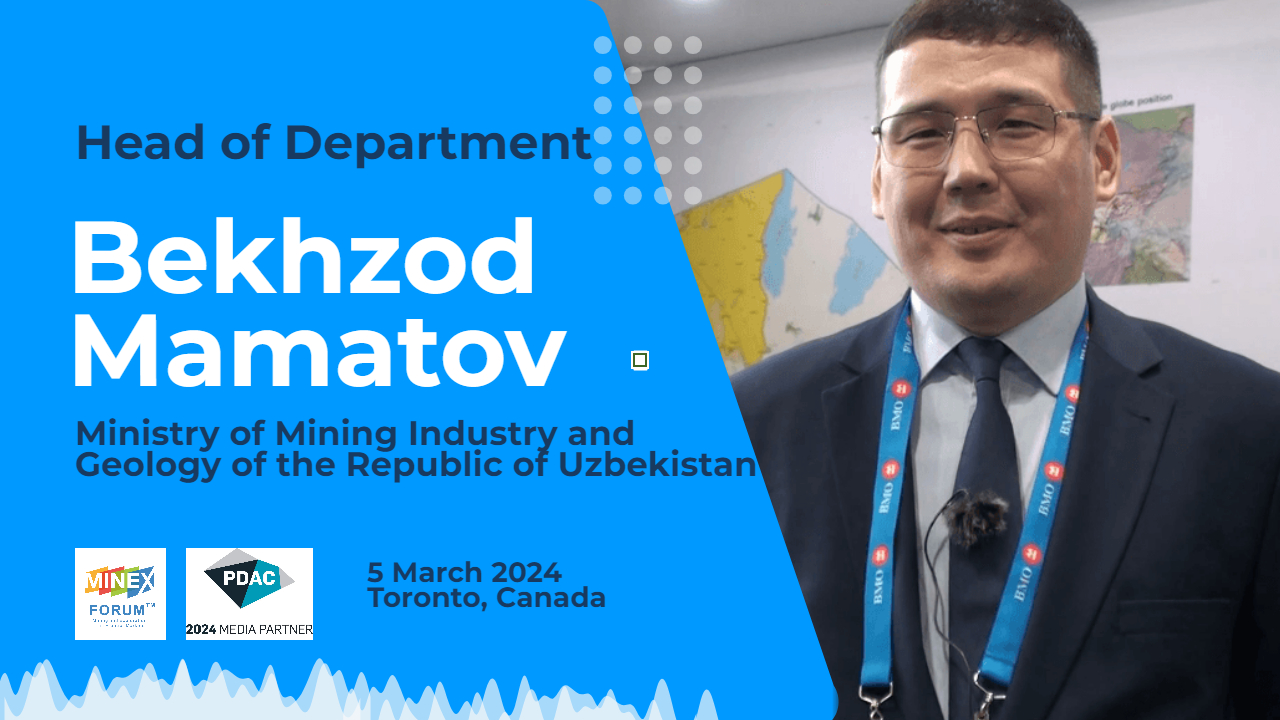
  • Interview with Bekhzod Mamatov, Head of Department of Uzbekistan’s Mining and Geology Ministry

    Interview with Bekhzod Mamatov, Head of Department of Uzbekistan’s Mining and Geology Ministry

    4 March 2024 – Toronto, Canada 

    The Republic of Uzbekistan’s official delegation made its debut at the PDAC  (The World’s Premier Mineral Exploration and Mining Convention in Toronto, Canada, marking a significant step towards international engagement. With over 30,000 participants and 1,000+ exhibitors from 100+ countries annually attending the event since its establishment in 1932, the Convention serves as a global platform for industry collaboration. MINEX Forum, a key information partner in Europe and Central Asia, traditionally participates in PDAC.

    MINEX Forum conducted interviews with leaders and representatives of the Uzbek delegation at PDAC 2024. One such interview was with Bekhzod Mamatov Head of Department of the Ministry of Mining and Geology of the Republic of Uzbekistan, shedding light on Uzbekistan’s objectives and initiatives at the convention.

    MINEX Forum (MF): What objectives brought the Ministry to PDAC, and what are you hoping to achieve?

    Bekhzod Mamatov (BM): Greetings! Our participation at PDAC is crucial for our nation’s economic strategy, which emphasises openness and international collaboration. We aim to showcase our market’s openness and our plans to the global community.

    MF: What is Uzbekistan presenting at its pavilion? Could you elaborate?

    BM: This marks our debut at PDAC, signalling our initial steps towards presenting our country’s geological potential to global investors. We’re here to highlight Uzbekistan’s geology, available territories, permit acquisition processes, tax benefits, and much more.

    MF: Given PDAC’s historical association with junior companies involved in exploration projects, who is your target audience here? Are you aiming to attract junior companies for exploration or larger corporations for significant mining projects?

    BM: We welcome all, from junior companies to major corporations. Understanding the global mining market dynamics, we believe it’s beneficial for juniors with international experience to enter our market, potentially bringing in larger investors. We’re currently developing a legislative framework to attract junior companies, which, in turn, should help in attracting major investors. This includes a new approach to exploration, primarily funded by investors with minimal state involvement.

    MF: Are there any specific investment projects and new mechanisms for engaging with investors?

    BM: We’re in the preparatory phase, drafting a subsoil use law that outlines the process for obtaining exploration permits and the novel concept of rights alienation. Currently, over ten foreign investors are involved in Uzbekistan’s mining sector.

    MF: Can you discuss the new economic program announced by President Shavkat Mirziyoyev and the mining industry’s role within it?

    BM: Our development strategy up to 2030 sets clear goals for the mining sector: to increase gold production by 1.5 times, copper by 3.5 times, silver by 3 times, and uranium by 3.5 times. These targets are expected to be met through both domestic funding and international investment.

    MF: Regarding the modernisation of mining enterprises and the creation of production clusters, what is the strategic vision for the industry? Is there a focus on developing natural resources and production increase, or on establishing processing facilities?

    BM: Currently, we process annually over 100 million tons of gold ore and 40 million tons of copper ore. The mining sector’s total investment projects exceed 23 billion US dollars. With these investments, we aim to boost copper ore processing capacity to 200 million tons per year, increasing the demand for engineering products and chemicals in the sector.

    In 2021, a Presidential Decree initiated the creation of a copper cluster, encompassing engineering product localisation and copper production and processing projects. Last year, copper processing reached 57 thousand tons, and we anticipate surpassing 100 thousand tons this year.

    Moreover, we’re keen on attracting foreign investment in geological exploration. Investors obtaining exploration permits gain exclusive rights to develop any discovered deposits. This strategy not only aims to enhance gold and copper production but also to explore critical metals, supporting the development of electrical product manufacturing in Uzbekistan.

    We’re looking to attract investors for critical metal deposits from neighbouring countries and beyond, including Canada, the United States, and European nations.

    Interview video recording