Website: Kazakhstan.com

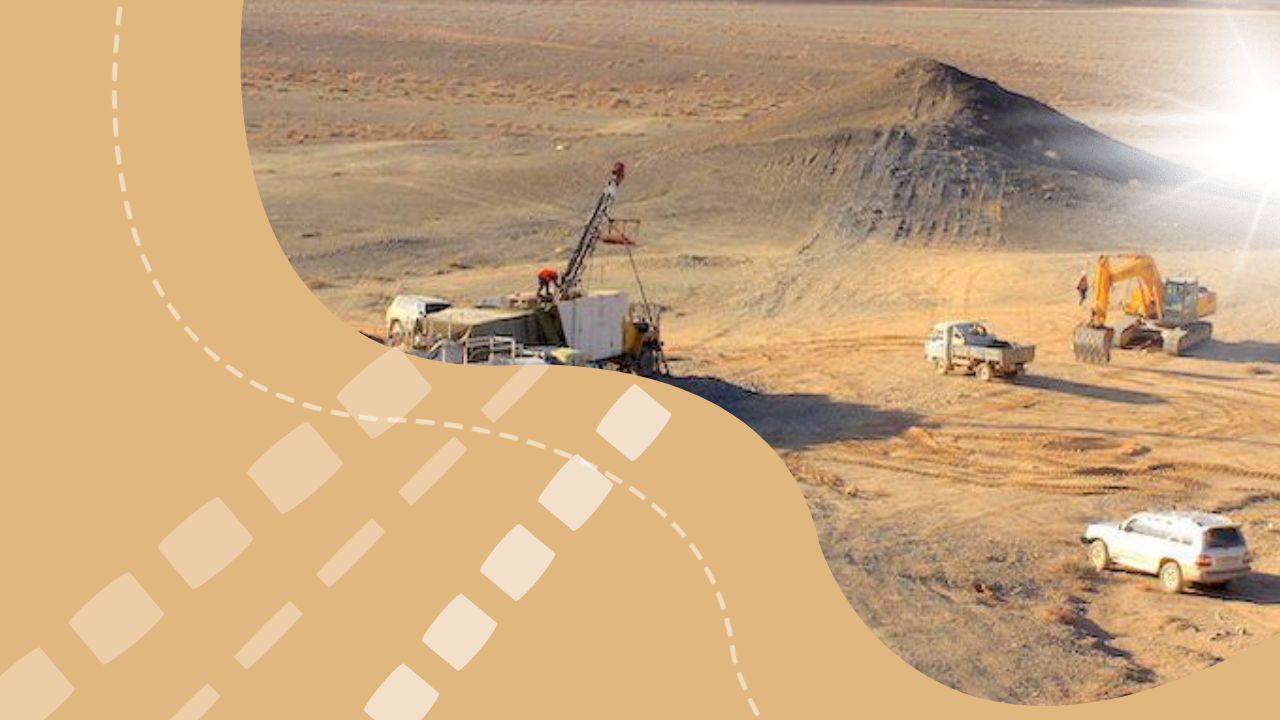
  • Aurora Geophysics completed a vector induced polarization survey in Aktobe region.

    Aurora Geophysics completed a vector induced polarization survey in Aktobe region.

    The survey took place in the Aktobe Region, where Aurora Geophysics measured the horizontal components of the electric field (Ex and Ey) induced by a dipole source.

    These measurements were utilized to calculate the chargeability vector and the apparent electrical resistivity vector, affirming the method’s effectiveness in detecting mineralization zones even in challenging geological conditions.

    The field survey system included measurement lines arranged orthogonally in a checkerboard pattern, with current lines positioned at an angle to the measurement lines.

    The fieldwork technology developed by Aurora Geophysics ensured high productivity. On average, 16 square kilometers of observation were conducted per working shift. The research results encompass detailed maps of geoelectrical parameters, including apparent chargeability, apparent electrical resistivity, and metal factor.

    Using this data, a generalized model of the distribution of geoelectrical parameters in the investigated area was created. This model reflects the geometry and relative position of the main structural and geological elements, indicating prospective zones of mineralization and ore-controlling structures.

    The induced polarization survey technique with vector measurements has confirmed its effectiveness both in theory and practice. This method allows for the precise identification of locations of presumed mineralization zones in complex geological conditions through the measurement of two horizontal components of the electric field and the optimization of the observation system.

    Aurora Geophysics Limited adheres to safe work practices in exploration. As part of the ongoing improvement of process management policies, HSE advisors work in constant supervision with the team. All personnel receive regular training in the following disciplines:

    1. Fire Safety Basics;
    2. Electric safety;
    3. Occupational safety and health;
    4. First aid.

    Aurora Geophysics demonstrates the ability to provide reliable data and results in geophysical research, along with the readiness to employ the full spectrum of modern geophysical methods, including the vector modification of the induced polarization method, for objects of any degree of geological complexity.

  • In Kazakhstan, a number of companies have been given the exclusive right to export certain types of coal

    In Kazakhstan, a number of companies have been given the exclusive right to export certain types of coal

    The Government of Kazakhstan adopted a resolution dated November 17, 2023 “On some issues of granting the exclusive right to export certain types of coal,” Zakon.kz reports.

    The list of individual types of coal that can be exported includes:

    • hard coal; briquettes, pellets and similar types of solid fuels obtained from coal;
    • lignite or brown coal, whether or not agglomerated, other than jet.

    The list of participants in foreign trade activities that have been granted the exclusive right to export certain types of coal includes 33 companies, including:

    • JSC “Mining Company “SatKomir” (SatKomir).
    • JSC ArcelorMittal Temirtau.
    • Branch of JSC “Eurasian Energy Corporation” – “Open Mine “Vostochny”.
    • JSC “Karazhyra”
    • JSC “Maikuben-West”
    • JSC “Shubarkol Komir” and “Shubarkol Premium”.
    • Kazakhmys Coal LLP (Kazakhmys Coal).
    • “Sherubai Komir” LLP.
    • LLP “Trade and industrial company “BAS”.
    • LLP “Bogatyr Komir” 

    The Rules for the suspension or termination of an exclusive license for the export of certain types of coal have also been approved.

    Thus, the licensor may suspend the exclusive license in the following cases:

    • voluntary application of the licensee;
    • suspension of one or more documents on the basis of which the exclusive license was issued;
    • failure by licensees to submit quarterly, before the fifteenth day of the month following the reporting quarter, a report on the progress of execution of the exclusive license to the licensor;
    • indications by licensees of false information in quarterly reports on the progress of execution of the exclusive license;
    • presence of a judicial act. 

    The resolution will come into force on December 1, 2023.

    Earlier it was reported that Kazakhstan extended the ban on the export of certain types of coal from November 21, 2023 for a period of six months.

  • The transfer of ArcelorMittal Temirtau to the Kazakh investor will be completed by the end of November – Smailov

    The transfer of ArcelorMittal Temirtau to the Kazakh investor will be completed by the end of November – Smailov

    The Kazakh government is committed to completing the transfer of ArcelorMittal Temirtau to the Kazakh investor by the end of November, Prime Minister Alikhan Smailov said. He hopes that no force majeure will happen and the deal will be officially announced next week.

    “We are now specifically working on this (on the transfer – V.). And we set ourselves a deadline – to complete this deal and legalize this deal by the end of November. We are heading towards this. God grant that nothing force majeure happens, and next week, I think, we will complete it,” Smailov told reporters on Thursday on the sidelines of the Senate.

    He once again emphasized that budget funds will not be used to buy out the enterprise; it is planned to attract money from a Kazakh investor.

    The prime minister recalled that the preliminary purchase and sale agreement was signed a month ago, and the final one is scheduled to be signed next week.

    Earlier, Minister of Industry and Construction Kanat Sharlapaev said that the issue of attracting a new foreign investor for the ArcelorMittal Temirtau company, which becomes the property of the government, is not being considered. He also assured that all the current conditions of the enterprise, based on collective agreements with trade unions, wages, and the number of employees will remain unchanged when a new investor arrives. At the same time, Sharlapaev refused to announce the terms of the deal for ArcelorMittal Temirtau, but named preliminary dates – the end of November. He also said that the issue of appointing former Prime Minister Serik Akhmetov as head of the company “was not discussed.”

  • Refinery “Tau-Ken Altyn” launched a new workshop for processing industrial waste

    Refinery “Tau-Ken Altyn” launched a new workshop for processing industrial waste

    At the Tau-Ken Altyn refinery they learned how to extract gold from their own production waste. The new workshop will be able to process up to 15 tons of solid industrial waste, including slag and heat treatment waste.

    The workshop’s products are concentrates with a high content of gold and silver. The unique technological model required technical refurbishment, but at the same time, it was possible to make maximum use of the equipment and reagents available at the enterprise.

    Arnur Aydarkhanov, technical director of Tau-Ken Altyn LLP:

    “The main difficulty associated with commissioning the processing workshop was the heterogeneity of the waste and the difference in its physical and chemical properties. During R&D, we needed to approach the issue comprehensively, while achieving maximum extraction of precious metals”

    The new workshop will process waste from current production, as well as those that were stored from previous years. In the future, it is possible to provide services for the comprehensive processing of industrial waste to other enterprises.

  • ERG does not yet plan to buy ArcelorMittal Temirtau

    ERG does not yet plan to buy ArcelorMittal Temirtau

    ERG does not yet plan to participate in the purchase of ArcelorMittal Temirtau, to which it supplies its products, said Serik Shakhazhanov, chairman of the board of the Eurasian Group company (part of ERG ) .

    “Of course, this is a question for the board of managers, but in general today we are aimed at developing our existing production enterprises (ERG. – “Italics”). We are now focusing more on the ERG business. Not yet (they do not plan to participate in the purchase of AMT. – “Italics”),” he told reporters.

    At the same time, Shakhazhanov clarified that the Sokolovsko-Sarbai Mining and Processing Enterprise (SSGPO is part of the ERG structure) continues to supply iron ore raw materials to AMT in previously planned volumes.

    The new investor of ArcelorMittal Temirtau will be a Kazakh businessman not connected with Russia, First Deputy Prime Minister Roman Sklyar said at a briefing on November 4 . According to him, ownership of AMT will be transferred to a domestic investor, “who will buy the enterprise at market value.”

    “A foreign investor who has owned this enterprise for a long time will sell its assets to a domestic investor. Now we cannot say the name of this company, but you will find out in due time, because negotiations are currently underway between them,” Sklyar noted.

    The First Deputy Prime Minister said that the new investor is not connected with Russian President Vladimir Putin and Russian dollar billionaires.

    “I responsibly declare to you that this is nothing more than speculation and fake news, that some foreign companies or people from other countries will come and own the enterprise. Either themselves or through some dummies. My opinion is that in the age of digitalization, any figurehead will emerge sooner or later. Therefore, this makes no sense,” Sklyar replied.

    After completion of the purchase and sale transaction, the investor must invest more than $1 billion over the next year and $3 billion over 3-5 years, fulfill the schedule for investing in industrial safety, and also expand the range of products (currently it is represented by two types of products).

    “He has a clear business plan, he has a model, he has sources of funds, so I ask you to be a little patient. Investors themselves will tell you,” Sklyar noted.

    The Deputy Prime Minister said that the new investor was present at a meeting between President Kassym-Jomart Tokayev and businessmen in September.

    “Kursiv” previously  wrote  about which investor will replace Mittal in Temirtau, and  explained how ArcelorMittal’s business works. 

    SSGPO produced 5 million tons of iron ore concentrate and pellets in the first half of the year, compared to 6.2 million tons in the same period in 2022, ERG told Kursiv. SSGPO managed to resume supplies to some Russian enterprises, including the Chelyabinsk Metallurgical Plant and the West Siberian Metallurgical Plant. However, total supply volumes to the Russian Federation decreased by approximately 500 thousand tons due to the cessation of exports to the Magnitogorsk Iron and Steel Works, which, before being included in Western sanctions lists, was historically the largest importer of SSGPO products.

    The ultimate owners of ERG are the Ministry of Finance – 40%,  Alexander Mashkevich  and the Ibragimov family – 20.7% each,  Patokh Shodiev  – 18.6%. Alexander Mashkevich, Patokh Shodiev and the family of the late  Alidzhan Ibragimov  (wife Mukadaskhan Ibragimov and four sons (Dostan, Davron, Shukhrat and Furkhat) became the first dollar billionaires according to Forbes in Kazakhstan in 2005 with a capital of $1 billion each. Later Alexander Mashkevich and Patokh Chodiev changed their citizenship from Kazakh to Israeli and Belgian, respectively.The chairman of the board of directors and major shareholder of the Eurasian Resources Group, Alexander Mashkevich, was ranked  sixth among the richest Israelis  in the Forbes ranking last year  – $3.7 billion.

  • Kazatomprom will supply uranium to China

    Kazatomprom will supply uranium to China

    National Atomic Company Kazatomprom has signed a contract for the supply of Kazakh natural uranium concentrate with China National Uranium Corporation Limited – CNUC (a subsidiary of China National Nuclear Corporation – CNNC), the company’s press service reports.

    This contract with a Chinese energy company will help meet China’s growing need for clean, carbon-free electricity and strengthen the historically long-standing nuclear relationship between the two countries.

    “Kazatomprom’s market-driven strategy aims to produce, process and sell natural uranium concentrates to create long-term value for all stakeholders. Close cooperation with one of the large Chinese energy companies, like CNUC, testifies to Kazatomprom’s strong reputation as a reliable and preferred supplier in the global nuclear fuel market,” added Seitzhan ZHANYBEKOV, Managing Director for Strategy and Marketing of NAC Kazatomprom JSC .

  • ERG intends to increase the share of Kazakhstani content to 80%

    ERG intends to increase the share of Kazakhstani content to 80%

    At the end of 2022, the share of ERG consumption volume within the country is 62%, or 1 trillion 67 billion tenge.

    Increasing the volume of domestic goods in procurement, the full launch of the offtake system and the maximum use of its own raw materials, personnel and goods is a priority task of the state, voiced by Kassym-Jomart Tokayev. In this regard, the Eurasian Resources Group (ERG) intends to increase the share of Kazakhstani content to 80%. The General Director of ERG in Kazakhstan, Serik Shakhazhanov, spoke about this at the international forum “Kazcontent 2.0: result-oriented”, held on November 16, 2023 in Astana.

    Every year the company purchases more than 15 thousand items of goods from Kazakhstani manufacturers  – from raw materials and fuels and lubricants to finished products. At the end of 2022, the share of ERG consumption volume within the country is 62%, or 1 trillion 67 billion tenge , and over the past three years, the amount of purchases from domestic manufacturers has doubled . The planned increase in 2023 will be 10%.

    As Serik Shakhazhanov noted, an open-ended import substitution program has been operating in ERG since 2020.

    “A potential Kazakh manufacturer has the opportunity to submit an application for a product or group of goods of interest, the production of which can be developed on the territory of Kazakhstan in accordance with technical requirements. Upon positive consideration of the application, ERG enters into a long-term agreement or an offtake contract with the supplier and is ready to provide deep advance payments for critical us to supply positions ,” he said.

    At the moment, 30 offtake/long-term contracts and more than 20 memoranda with domestic producers have been concluded. In 2023, the list of product ranges was increased by 3.5 times and includes more than 11 thousand items. Next year, ERG plans to invest more than 400 billion tenge in investment projects and increase the share of domestic suppliers and contractors.

    The second direction for the development of in-country value within the framework of creating high value-added clusters in ERG is the localization of production around the group’s enterprises , especially where they are city-forming. We are talking, in particular, about the aluminum cluster, which includes JSC Aluminum of Kazakhstan and the Kazakhstan Electrolysis Plant.

    Thus, aluminum supplies to domestic producers in 2023 increased by 20% , the planned increase in 2024 is by 30% (or 70 thousand tons of total production). Among the partners are small and medium-sized enterprises that sell products of subsequent processing of wire rod, wires, aluminum profiles, light alloy wheels, and others.

    “We sell them aluminum at a preferential price, due to which ERG has invested more than 3 billion tenge in the development of domestic producers; by 2027, the amount will increase to 22 billion tenge,” noted the General Director of ERG in the Republic of Kazakhstan.

    Taking into account the need to increase the share of localization, which will reduce dependence on import supplies, ERG also focused on creating higher value-added goods within its own range of manufactured products . Serik Shakhazhanov said that this year the construction of a plant for the production of special coke with a capacity of 400 thousand tons per year was completed at the site of Shubarkol Komir JSC. At the forum, in a teleconference mode with the participation of the Minister of Industry and Construction Kanat Sharlapaev, the technological launch of a new enterprise was carried out.

    “Special coke is a product of the second stage, which is used for the production of ferroalloys. The new plant will eliminate a significant share of imports of reducing agents and increase the percentage of Kazakhstani content in ferroalloys produced by ERG,” he noted.

    Investments in the project amounted to 60 billion tenge. The plant will create 184 jobs and use modern technological solutions and automation.
    At the same time, the General Director of ERG in Kazakhstan, Serik Shakhazhanov, mentioned the obstacles and barriers to the implementation of intra-price value creation: the lack of necessary technologies, products of certain stages, raw materials and the complexity or lack of production  – and proposed to combine the efforts of the state and subsoil users (in particular, to introduce temporary tax holidays for newly created PSCs, forming a belt for import substitution of SMEs around large mining and metals industry enterprises).

    “This will facilitate the opening of new production facilities and reduce the threat of their closure in the first years of operation. And with a gradual transition to Kazakh raw materials and components, we will get cheaper products,” he clarified. “For its part, ERG is ready to ensure the demand for domestic products in sufficient volume and at reasonable prices.”

    Directly at the forum itself, ERG signed memorandums of cooperation with Kazakh producers and supply agreements. The company plans to purchase high-pressure hoses, pumps and spare parts for them, bearings, hydrocyclones, lime, as well as metal supports and components from domestic enterprises. Previously, goods were purchased from dealers and intermediaries.
  • Kazzinc is considering the development of the Shalkiya field

    Kazzinc is considering the development of the Shalkiya field

    Kazzinc is studying technological and economic options for developing the Shalkiya zinc deposit in the Kyzylorda region. The company’s general director, Alexander Khmelev, shared this information in a conversation with an inbusiness.kz correspondent on the sidelines of the capital’s “Kazcontent 2.0” forum.

    “It’s not a very simple deposit, and at the moment we are simply looking for both a technological and economic scheme of work that would be cost-effective. It has its own difficulties, a very interesting deposit, but very difficult to develop. We are right now at in fact, we look at what is out there in the world, as well as our thoughts and suggestions. Two or three weeks ago, in my opinion, we were there, we looked at everything, we passed through. And if we look at what we will go into, roughly speaking, in this maybe we won’t make it this year, but next year, because we have to start from the very beginning, because those approaches that provide profitability, economic efficiency of developing a deposit – you can’t wait for the completion of the construction of a factory there, or anything. there will be changes in the technological scheme, production, processing, enrichment. Accordingly, this needs to be done now, until construction is completed,” the top manager said, commenting on the question of whether the company will enter the mining project  already after the construction of a processing plant there by the national mining company Tau-Ken Samruk.

    In August, inbusiness.kz wrote that the Anglo-Swiss trader Glencore could buy the Kazakh Shalkiya mine. He is a shareholder of Kazzinc for almost 70%, the rest of the stake mostly belongs to Tau-Ken Samruk. The state-owned company is currently constructing a mine and processing plant, which was planned to be built in 2025. Previously, the total cost of the project was calculated at $691 million, a loan from the European Bank for Reconstruction and Development (EBRD) was attracted for $175 million, and co-financing was to be provided by Samruk-Kazyna.

    “Initially it was estimated to be more than 600 million (dollars – approx.) , but we are now trying to facilitate as much as possible, I can’t say yet, that is, we are in the process of searching. The last meeting was held literally last week, meaning with manufacturers various types of equipment to see how to put the factory together more correctly. Therefore, it is difficult to say yet, everything is in a living process,” added the head of Kazzinc.

    According to him, for now the project contractors continue to work on the construction of the mine.   

    “They are still continuing to do the work, we also looked at everything, how they work, what they do, we looked at all these things, but there are a lot of options, there is no final one yet. We don’t even know until the end whether there will be open-pit mining or underground… If If there is open-pit mining, then there will be a different technology, plus if it is underground, then we will also look at which mining scheme will be better. The layout changes every week. We are calculating a lot of different options, we are looking this way, that is, how it will be more efficient to mine there,” he  noted in the conversation.

    Let us remember that they tried to develop the Shalkiya zinc deposit back in the days of the Soviet Union, but due to its content, its development was then in question. Now it remains one of the few sources of significant zinc reserves in the country. In the meantime, Kazzinc has not yet made any truly significant geological discoveries for this metal, despite the presence of promising areas. At the same time, the company has questions about the possibilities of importing third-party raw materials from the Russian Federation.

    “Zinc (raw materials from Russia – approx.) can still be transported, we take some volumes from there, but not so significant, this year, of course, the volume has decreased very much, but not even so much for zinc – that is, problems with zinc we had last year – we resolved them, determined a mechanism with the London Precious Metals Association, those issues were resolved, but this year we lost a very large flow due to the fact that the Russian Polymetal came under sanctions, and, accordingly, the entire the flow that we had from Polymetal was quite significant, all of it, naturally, came under sanctions and stopped… Roughly speaking, all gold-containing products there, by and large, not only gold – silver, gold, copper products were – naturally, everything stopped,” said  Khmelev.

    Now Kazzinc is shipping its products in the Chinese and Caspian directions, and more exotic routes are also being explored, he specified.

    According to him, the mining and metallurgical company continues to work on the implementation of the best available technologies (BAT), according to a memorandum from the Ministry of Ecology, some of the work should be completed in 2025. The largest projects in this area are related to the transition from pyrometallurgy to hydrometallurgy and the reconstruction of sulfuric acid production to reduce CO2 emissions, Khmelev said, answering a question from inbusiness.kz.  

    Commenting on the progress of the implementation of the Railveyor ore transportation system to the surface of the East Kazakhstan Dolinny mine, which reduces underground emissions, the head of Kazzinc noted that this is happening with gradual improvement.

    “Railveyor is used in much simpler versions wherever it is used. We have a very complex version. To be honest, for the first year, even more, we suffered a lot and there were a lot of problems, but now little by little, in principle, I can no longer say , which works ideally, but at least it works, that is, there are no longer such super-emergency situations, production stoppages,” he  stated.

    By the way, a pilot project to implement the Railveyor system was also tested at the Varvara hub of the gold mining company Polymetal in the Kostanay region.

  • A new plant for the production of special coke was presented in Kazakhstan

    A new plant for the production of special coke was presented in Kazakhstan

    As part of the 1st International Forum “KAZSODERZHANIE 2.0”, Eurasian Resources Group ERG ) carried out a technological launch of a special coke production plant via teleconferenceThe new production, after reaching its design capacity, will allow us to abandon a significant part of the import of reducing agents and will increase the percentage of Kazakhstani content in the domestic ferrochrome produced by ERG.

    The plant is located on the territory of the coal enterprise Shubarkol Komir JSC in the Karaganda region. Its capacity is 400 thousand tons of special coke per year. Investments in the project amounted to 60 billion tenge. The plant will create 184 jobs. The production uses the most modern technological solutions and automation.

    Also at the forum, ERG signed memorandums of cooperation with domestic producers and supply agreements. Documents signed with companiesTPB AGROMIR LLP, Kazakhstan Industrial Enterprise LLP, Zhaik Electric LLP, Machine-Building Plant named after S.M. Kirov”, LLP “Caspian Plus”, LLP “Saryopan Operating”.

    For Kazakhstan ERG enterprises, it is planned to purchase high-pressure hoses, spare parts for pumps, bearings, pumps, hydrocyclones, lime, as well as metal supports and components.

    – Today we have concluded long-term agreements and memorandums. An off-take contract was also signed with TPB AGROMIR LLP. This provides great business opportunities,” said Serik Shakhazhanov, General Director of ERG in Kazakhstan. – The counterparty will supply high-pressure hoses; previously we purchased these spare parts from dealers and intermediaries. We are glad that the quality of goods and services from domestic producers is growing and becoming competitive in comparison with foreign analogues. All this leads us to a mutually beneficial and long-term partnership.
    ERG purposefully, systematically and effectively participates in the implementation of the state policy for the development of local content. The Group is expanding its interaction with domestic manufacturers and demonstrating a steady increase in the purchase of goods, works and services from them from 51% in 2018 to 62.05% in 2022.

    Every year the company purchases more than 15,000 goods from Kazakhstani manufacturers – from raw materials fuels and lubricants to finished products.

    The Group pays special attention to supporting domestic small and medium-sized businesses. In 2022, ERG purchased goods, works and services worth more than 518 billion tenge from 2,794 domestic manufacturers.

    Procurement procedures in ERG are carried out on two main platforms: Electronic trading platform, synchronized with the NADLoC Register, where procurement is carried out according to the rules of subsoil use and natural monopolies (www.e-port.kz) and the ERG Procurement Portal ( www.torgi.erg.kz ), where all other purchases are made.

  • The search for lithium is being intensified in three regions of Kazakhstan

    The search for lithium is being intensified in three regions of Kazakhstan

    Geological exploration companies in Kazakhstan will study the lithium potential of three regions of the republic to meet the growing demand for the rare metal. This statement was made by the head of the National Geological Service JSC Erlan Galiev during the EU-ROK partnership forum held in Belgium.

    The press service of the Ministry of Industry of the Republic of Kazakhstan reports that the state balance already includes six promising deposits where lithium can be extracted: Bakenny, Akhmirovskoye, Verkhne-Baymurzinskoye, Medvedka, Akhmetkino and Yubileinoye.

    The National Geological Survey expects to discover primary deposits of a rare metal in the southeast of Kazakhstan. According to Mr. Galiev, a significant amount of the fossil may be concentrated in the mineralized brines of the Aral sedimentary basin. In terms of its geological conditions, the object is similar to the Chilean Atacama salt marsh, which contains about 30% of the world’s metal reserves.

    They are also going to look for lithium and other rare and rare earth metals in Northern and Western Kazakhstan. In addition to new sites, the National Geological Service is interested in dumps and tailings from processing plants in the central and southern regions of the republic. Industrial waste also contains components that are valuable for extraction.