Industrial enterprises in Kazakhstan are increasingly deploying artificial intelligence systems to improve operational safety and efficiency, according to the Ministry of Industry and Construction.
Several large digital initiatives are currently being implemented at facilities operated by Solidcore Resources. Four major projects aimed at automating safety and production processes are underway across the company’s mining and processing sites.
At the Bakyrchik mining operation in the Abai region, an automated employee health monitoring system has already been launched. The system uses AI algorithms to assess workers’ physical condition before each shift.
If the system detects high blood pressure, signs of fatigue or alcohol intoxication, the employee is automatically prevented from performing hazardous tasks.
Solidcore Resources plans to expand the use of intelligent technologies at its other facilities, including the Varvarinskoye hub in Kostanay region and the Ertis Hydrometallurgical Plant in Pavlodar region.
One of the upcoming systems will provide real-time personnel positioning, allowing the company to track the location of employees across industrial sites. Workers entering hazardous zones will receive automatic alerts warning them about potential risks.
Another tool under development is a digital operator assistant designed to support personnel in making operational decisions. The system will recommend optimal technological parameters and help prevent equipment failures.
By the end of the year, the company also plans to introduce an AI-based flotation monitoring system. The technology is expected to reduce reagent consumption and minimize metal losses during processing.
Artificial intelligence is also being adopted by other companies within the sovereign wealth fund Samruk-Kazyna.
The national mining company Tau-Ken Samruk is using an intelligent core analysis system that automatically identifies signs of mineralization from photographs of drill core samples.
Meanwhile, Samruk-Kazyna Ondeu is developing a digital twin of its sulfuric acid plant in Stepnogorsk. The virtual model will simulate equipment performance and is expected to reduce operating costs by 5–8%, lower downtime by about 5%, and decrease accident rates by 2–3%.
KazMunayGas is also expanding the use of AI technologies through its ABAI digital platform. The company reported that an AI-based waterflood management module helped generate an additional 12000 tonnes of oil production in 2025, delivering an economic benefit of approximately 1.5 billion tenge.
Officials say the growing use of artificial intelligence across Kazakhstan’s mining, metallurgy and energy sectors is part of a broader push to modernize industrial operations and improve productivity.
Uzbekistan’s copper processing capacity is expected to reach 240000 tonnes this year, President Shavkat Mirziyoyev announced during the inauguration of Copper Processing Plant No. 3 at the Almalyk Mining and Metallurgical Complex (AGMK).
According to the president, processing volumes are set to continue growing over the next two to three years as new investment projects in the mining and metallurgical sector are implemented.
Mirziyoyev emphasised that global demand for copper is increasing rapidly as the metal becomes increasingly important for modern industry. Copper plays a critical role in sectors such as energy, electrical engineering, digital technologies, artificial intelligence and the development of green energy systems.
“Those who create a high value-added chain in the copper industry will effectively create the industry of the future,” the president said.
As an example of the country’s expanding mining potential, Mirziyoyev highlighted the Yoshlik-1 deposit. The project was previously considered technically complex and difficult to develop, but production is now rapidly ramping up.
The president said the mine is expected to produce around 20 million tonnes of ore this year. Over the next two years, output from the deposit is planned to increase to approximately 60 million tonnes.
The expansion of processing capacity at AGMK forms part of Uzbekistan’s broader strategy to strengthen its position as a major producer of copper and other strategic metals, while building higher value-added industrial supply chains.
Earlier, Kursiv Uzbekistan reported that Mirziyoyev officially launched the new copper processing plant at AGMK as part of the country’s industrial development programme.
Engineering and project delivery firm Ausenco has been awarded a contract to lead the feasibility study for the Ikkari gold project in northern Finland, owned by Rupert Exploration Finland Oy.
The project is located about 45 km from Sodankylä in the Lapland region and represents a significant grassroots gold discovery made in 2020. Following the completion of a Pre-Feasibility Study in early 2025, the project is now advancing toward development as a staged 3.5 million tonne per year mining operation with a planned mine life of around 20 years.
The development strategy предусматривает запуск открытой добычи в течение первых десяти лет, после чего проект перейдет на подземную разработку методом long-hole open stoping на оставшийся срок эксплуатации.
Ausenco will deliver a bankable feasibility study from its Perth office, integrating specialists from its teams in Australia and Canada. The company says the collaborative structure will combine global technical expertise with experience designing and delivering gold mining projects in remote and challenging environments.
Rupert Resources CEO Graham Crew said the appointment marks an important step in advancing the project toward development.
“The appointment of Ausenco represents an important milestone in advancing the project towards development,” Crew said. “Their proven ability to integrate teams from Australia and Canada in close collaboration with our project team and local partners ensures the delivery of a world-class study aligned with our strategic objectives.”
The feasibility study will cover value engineering, project implementation planning and detailed design of the processing plant and supporting mine infrastructure.
The study will be prepared to AACE Class 3 standards, providing capital and operating cost estimates with an accuracy of approximately ±15%. Ausenco will also act as the Qualified Person responsible for the NI 43-101 technical report.
The company plans to incorporate energy-efficient technologies and design features aimed at reducing the project’s carbon footprint, supporting Rupert Resources’ broader carbon-neutral targets.
Reuben Joseph, President for APAC and Africa at Ausenco, said the company looks forward to applying its experience in gold recovery technologies and energy-efficient project design.
“We are excited to partner with Rupert Resources on their Ikkari project,” Joseph said. “By leveraging our global gold study and project delivery experience, we are well positioned to deliver a robust study that supports Rupert’s operational, environmental and local community goals.”
Ausenco also emphasised the importance of working with local communities and regional organisations as the feasibility study progresses. The company said it will develop a project delivery framework that incorporates local expertise and aligns with regional standards, aiming to create long-term benefits for the surrounding region.
Uzbekistan has identified major mineral reserves at the Yoshlik-1 and Qalmoqqir deposits, including an estimated 45 million tonnes of copper and more than 5,000 tonnes of gold, President Shavkat Mirziyoyev announced during the launch ceremony of Copper Processing Plant No. 3 at the Almalyk Mining and Metallurgical Complex (AGMK).
According to the president, the scale of these reserves is sufficient to supply Uzbekistan’s industrial sector with raw materials for at least the next 100 years.
In addition to copper and gold, the deposits also contain rare metals such as molybdenum, selenium, tellurium and rhenium, which could support the development of new high-tech and innovative industrial projects.
Mirziyoyev said the commissioning of the new processing facility significantly increases AGMK’s production capacity. Daily output of copper concentrate is expected to rise from 2,400 tonnes to approximately 5,000 tonnes.
The plant incorporates modern technologies supplied by companies from the United States, Germany, Russia, China and Finland. Operations will be managed through an integrated digital control system using artificial intelligence.
According to officials, the use of AI-driven monitoring and optimisation systems will reduce energy consumption by around 10%, lower production costs by 15% and increase labour productivity by roughly 10%.
The expansion of AGMK’s processing capacity forms part of Uzbekistan’s broader strategy to strengthen its mining and metallurgical sector while increasing value-added production from its domestic mineral resources.
Earlier, Kursiv Uzbekistan reported that the country’s gold and foreign exchange reserves recently exceeded $77 billion for the first time.
Ukraine’s Verkhovna Rada Committee on Economic Development has established a working group to address key operational challenges facing mining companies, with the situation at the Poltava Mining and Processing Plant — part of the Ferrexpo group — becoming the first issue under review.
According to Member of Parliament Oleksiy Movchan, the group held its initial meeting online with participation from representatives of the Ministry of Economy, the National Bank of Ukraine, the Ministry of Justice, the State Tax Service, industry associations, and management of the Poltava and Yeristovo mining and processing plants.
Several major issues affecting the Poltava operation were discussed, including electricity shortages and high power costs, blocked VAT refunds, and outstanding foreign currency payments owed by the parent company.
One of the most pressing challenges is the non-refund of value-added tax due to sanctions imposed on the company’s ultimate beneficiary, businessman Kostyantyn Zhevago.
Dmytro Mospan, manager of legal support for financial activities at Poltava Mining and Processing Plant, said more than UAH 3 billion in VAT refunds remains blocked for the company.
According to Mospan, the lack of access to these funds has forced the company to reduce the working week, cut social programmes, lower maintenance spending and scale back mining operations.
The State Tax Service said the situation is governed strictly by the Tax Code of Ukraine. Under Article 200.4, VAT refunds cannot be issued to taxpayers whose ownership structure includes individuals under sanctions.
Even in cases where courts have ruled in favour of the company, payments remain blocked. Funds are currently held by the State Treasury pending enforcement of court decisions but cannot be transferred due to provisions under Article 200.12 of the tax code.
One court ruling alone has frozen approximately UAH 230 million related to the plant.
The working group plans to further examine the company’s ownership structure at future meetings following additional reports from tax authorities.
Energy supply is another major challenge for the enterprise. Company representatives said limited availability of electricity and high power prices are making operations increasingly unprofitable. However, officials noted that electricity costs are a broader issue affecting Ukraine’s entire mining and metallurgical sector.
The matter is expected to be discussed further with the Ministry of Energy during upcoming sessions of the working group.
Movchan also said Ferrexpo AG owes the Poltava operation more than $500 million in unpaid foreign currency proceeds.
“This debt has been confirmed by international arbitration decisions and the figures have been verified by representatives of the National Bank,” he said.
The issue will also be examined in subsequent meetings.
Earlier this month, Ferrexpo announced it had restarted pellet production at the Poltava Mining and Processing Plant after suspending operations in January 2026. The restart was made possible by improvements in electricity supply and lower energy costs.
According to GMK Center, Ukraine’s iron ore exports fell by 8% in 2025 compared with the previous year, totaling 30.99 million tonnes. In January–February 2026 exports declined even further, dropping 40.9% year-on-year to 3.31 million tonnes, the lowest level recorded since 2023.
The United States, Japan and the European Union are preparing to announce plans for a new trade framework aimed at strengthening supply chains for critical minerals and reducing dependence on China, according to people familiar with the discussions.
The initiative is expected to lay the groundwork for a broader plurilateral trade agreement covering key minerals used in electric vehicles, clean energy technologies and advanced manufacturing. Negotiations are being led by the Office of the US Trade Representative (USTR) in coordination with officials in Brussels and Tokyo.
Officials involved in the talks say the framework may include coordinated trade policies such as price floors, tariffs and other market mechanisms designed to counter price distortions linked to Chinese supply. A price floor would establish a minimum market price for selected minerals, encouraging investment in mining and processing projects while preventing cheaper imports from undercutting producers participating in the agreement.
The Defense Advanced Research Projects Agency (DARPA) is reportedly assisting US trade officials in developing pricing models for the mechanism.
Global efforts to diversify critical mineral supply chains intensified after China introduced export controls on several rare earth elements and strategic minerals last year. The restrictions were widely seen as a response to sweeping tariffs imposed by the United States on imported goods.
Although supply pressures have eased since their peak last year, manufacturers in Europe, the United States and Japan continue to report shortages and delays in receiving critical mineral shipments from Chinese suppliers.
USTR is expected to begin formal negotiations with the European Union and Japan in April, shortly after the close of a public consultation period for industry stakeholders on March 19.
The announcement may coincide with Japanese Prime Minister Sanae Takaichi’s visit to the White House scheduled for March 19. European officials are also coordinating closely with Washington and Tokyo on the initiative, although the timing of Brussels’ announcement has not yet been finalized.
The concept is also expected to feature prominently at the upcoming Group of Seven summit.
Earlier this year, the United States signed a similar action plan with Mexico aimed at coordinating policies on critical mineral supply chains. The agreement includes provisions to examine border-adjusted price floors for mineral imports and to explore joint trade policies supporting secure supply.
Officials say the proposed framework between the US, EU and Japan will likely mirror many elements of the US–Mexico agreement. Potential areas of cooperation include investment screening, research and development in mineral processing technologies, coordinated stockpiling strategies and support for downstream supply chains.
While the exact list of minerals covered has not yet been finalized, officials are considering starting with a limited group of strategic materials before expanding the agreement to include a broader range of critical minerals.
The initiative reflects growing concern among Western economies about supply concentration in global mineral markets. China currently dominates the processing and refining of many critical materials, including rare earth elements, graphite and several battery metals.
Recent drilling results from the Korsnäs rare earth project in Finland are drawing attention to Europe’s geological potential in critical minerals, but they also highlight a deeper challenge for the continent: the lack of domestic processing capacity.
Exploration company European Resources reported its strongest rare earth intercept to date at the project, including a 31.5-metre interval averaging 4,902 parts per million total rare earth oxides (TREO). The mineralisation also contains a relatively high proportion of neodymium and praseodymium (NdPr), accounting for roughly 28–30% of the rare earth mix.
While encouraging, the results represent only an early stage of resource development. The next phase will require additional drilling and modelling to confirm the continuity and scale of the deposit.
NdPr is particularly important because it forms the foundation of permanent magnets used in electric vehicles, wind turbines, defence systems and other advanced technologies. These magnet rare earth elements are considered among the most strategically important minerals for Europe’s industrial and energy transition.
However, experts note that discovering deposits alone does not guarantee supply security. In the rare earth sector, the most complex and capital-intensive stage of development typically occurs after mining, during chemical processing, separation and waste management.
The Korsnäs project benefits from its location in Finland, a country with strong mining institutions, established infrastructure and relatively stable regulatory systems. This reduces certain development risks compared with projects in more uncertain jurisdictions.
Early mineralogical studies suggest the deposit contains monazite and apatite minerals, which can support certain processing routes. However, monazite often contains trace amounts of thorium or uranium, which can introduce stricter regulatory requirements related to residue handling and environmental protection.
Industry analysts say processing plants typically account for the largest share of capital expenditure in rare earth projects, often exceeding the cost of the mining operation itself. Complex processing flowsheets and environmental permitting requirements can significantly affect project economics and timelines.
European Resources has already begun metallurgical testing and downstream processing studies with the Australian Nuclear Science and Technology Organisation (ANSTO) to evaluate potential separation technologies and processing pathways.
Another notable feature of the Korsnäs results is the relatively high proportion of NdPr within the deposit. While TREO measures total rare earth content, economic value is usually concentrated in magnet elements such as neodymium and praseodymium, with smaller contributions from dysprosium and terbium. Deposits dominated by cerium and lanthanum, which are more abundant but less valuable, often face weaker economics.
The development of projects such as Korsnäs also intersects with broader European industrial policy. Under the EU’s Critical Raw Materials Act, the bloc aims by 2030 to extract at least 10% of its annual demand for strategic minerals domestically, process 40% within the EU and source 25% from recycling.
Achieving those targets will require major investment not only in mining but also in separation facilities, refining plants and downstream manufacturing. At present, China dominates the global rare earth processing sector, giving it significant influence over supply chains.
Analysts say that even if Europe develops new mines, the continent will remain vulnerable to supply disruptions unless it builds domestic separation and refining capacity.
The Korsnäs discovery therefore represents more than a geological milestone. It highlights Europe’s growing recognition that securing critical mineral supply will depend not only on discovering deposits, but also on developing the industrial infrastructure needed to process them.
Kazakhstan’s gold mining company Altynalmas plans to develop the Karierny deposit in the Karaganda region over the next 19 years, according to an updated mine closure plan submitted for public review.
Under the revised mining plan, operations at the Karierny site are scheduled to run from 2026 to 2044. The project is designed to process an average of about 3 million tonnes of gold-bearing ore per year. The deposit covers an area of approximately 4.3 square kilometres and will be mined to a depth of around 200 metres.
The Karierny site is located in the Aktogay district of the Karaganda region, roughly 100 kilometres east of the city of Balkhash. Infrastructure near the project includes the Balkhash–Aktogay railway line, a 110 kV power transmission line and the Tokrau–Sayak water pipeline. Nearby deposits operated by Altynalmas include the Dolinnoye and Pustynnoye gold fields.
According to the company’s documentation, all approved reserves at the Karierny deposit will be mined during the project’s lifetime. The mine is expected to produce approximately 43.7 million tonnes of ore with an average gold grade of about 0.9 grams per tonne.
Based on these figures, the total gold output from the project is estimated at roughly 39.3 tonnes over the life of the mine. At current market prices, this volume would be valued at around $6.4 billion.
Altynalmas originally received the licence to develop the Karierny deposit in 2011, with the initial contract set to expire in 2026. The revised closure plan likely reflects a renewal or extension of subsoil use rights.
The project also outlines environmental and post-mining land management measures. Since backfilling the open pit with waste rock is considered economically unfeasible, the site will be fenced to prevent accidents, reduce dust dispersion and stop animals or waste from entering the pit.
After mine closure, the area could potentially be converted into a recreational water reservoir. Land disturbed during operations will also be rehabilitated to support pasture use, with soil preparation and seeding of perennial grasses planned to restore grazing land for livestock.
Closure activities are scheduled to begin in 2045, in accordance with Kazakhstan’s legislation requiring reclamation work to start within eight months after the expiration of a mining licence. The company estimates the cost of these activities at approximately $1.8 million.
Altynalmas currently operates nine gold deposits across Kazakhstan and remains one of the country’s largest gold producers.
MINEX Forum Spotlights nGRND’s Vision for Sustainable Mining Finance at PDAC 2026
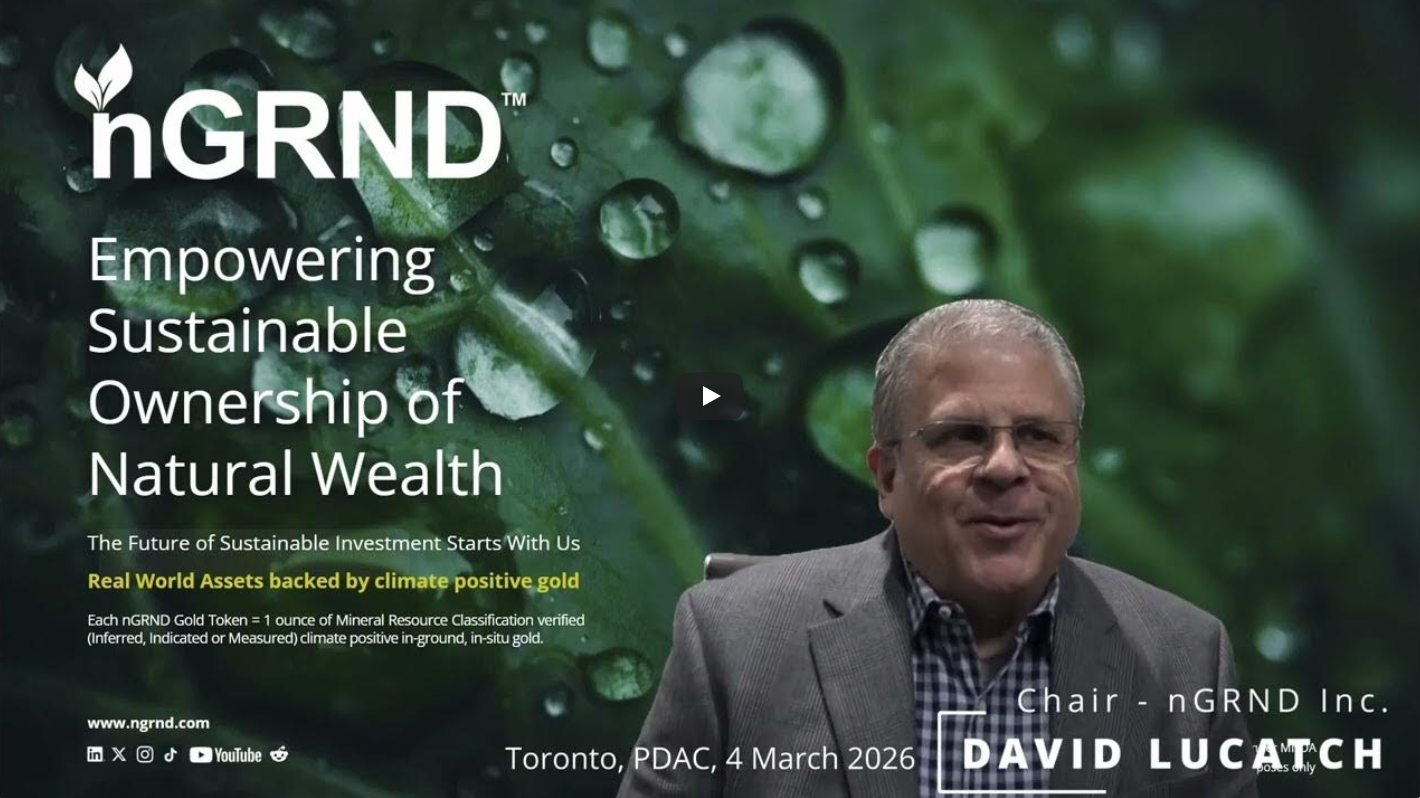
As a PDAC media partner for Europe and Central Asia, MINEX Forum continued to highlight innovations that can attract investment and accelerate the adoption of best-in-class technologies for sustainable mining. In its recent interview with David Lucatch, Chair of nGRND Inc., MINEX Forum explored a business model that challenges one of mining’s oldest assumptions: that value can only be unlocked by extracting metal from the ground.
nGRND, short for “in-Ground,” is advancing a novel concept built around the securitisation and tokenisation of verified in-ground gold reserves. The company’s vision is bold and deliberately provocative: to become “the world’s biggest resource company that doesn’t mine.”
A new way to unlock mineral value
In the interview, David Lucatch explained that nGRND is a land management and sustainability company working with gold discovery and exploration firms to monetise verified in-ground gold resources without physically mining them.
The company uses recognised technical documentation, such as NI 43-101 reports and other verified geological reports, to confirm the existence of gold resources. It then purchases those verified in-ground ounces from site owners and transforms them into a digital asset proposition for investors.
What makes the model distinctive is that it does not stop at the mineral resource itself. nGRND also seeks to integrate carbon, ESG and avoided mining programmes, creating an additional sustainability layer around the asset. In effect, the company aims to combine the enduring value of gold with the measurable benefits of reduced environmental disturbance, carbon impact mitigation and biodiversity protection.
This approach positions nGRND at the intersection of mining, environmental finance and blockchain-enabled asset structuring.
“We don’t just digitise gold — we redefine it”
nGRND describes itself as a company that is redefining how the world perceives, values and provides democratised access to natural wealth. Its proposition is centred on tokenising verified climate-positive in-ground gold reserves while integrating benefits from avoided mining and environmental restoration frameworks.
The company’s message is clear: gold can be reframed not merely as a mined commodity, but as a climate-positive, real-world asset. That framing is captured in its positioning:
Responsible innovation – Real-world value – Climate positive verified impact
This is a significant departure from the traditional mining investment thesis. Rather than focus solely on extraction, production growth and commodity cycles, nGRND is attempting to create value from preservation, optionality and sustainability.
Why gold, and why now?
David Lucatch made the case that gold is the ideal starting point for this model. He noted that roughly 93% of all gold is ultimately used as stored value—whether in jewellery, coins, bullion or central bank holdings—while only a small proportion is consumed for industrial or trade purposes. In his view, this makes gold uniquely suited to a system where the asset’s value can be recognised and monetised without immediate extraction.
For nGRND, the long-term opportunity is substantial. Lucatch said the company’s ambition is to monetise nearly 250 million ounces over the next decade.
That ambition reflects broader shifts in the global mining and investment landscape. Juniors and mid-tier explorers often hold significant resource inventories but struggle to convert those ounces into market value. Many trade at a fraction of the implied value of their resources, and raising capital to advance projects often leads to repeated equity dilution. nGRND’s model is designed to address precisely that problem.
Non-dilutive capital for explorers and developers
One of the strongest themes in the interview was the potential for nGRND to provide non-dilutive capital to exploration and mining companies.
Mr. Lucatch pointed out that many public companies may hold large resource bases while trading at only a few dollars per ounce in the ground. The more they raise through conventional financing, the more dilution they create for existing shareholders. By contrast, nGRND’s programme is intended to generate revenue by purchasing in-ground ounces and layering in future carbon and ESG value, thereby placing revenue on a company’s books without altering its capital structure.
That could be especially relevant for:
discovery and exploration companies
brownfield or retired assets
stranded deposits
projects that are currently uneconomic or inaccessible
properties constrained by environmental, geographic or regulatory factors
David Lucatch was clear that nGRND is not trying to interfere with active producers whose business depends on mining and selling gold. Rather, the company sees opportunity in assets where extraction may not make sense now—or for decades.
This opens an intriguing pathway for projects located under sensitive areas, near protected land, or in settings where mining would face high environmental or logistical barriers. In such cases, keeping the gold in the ground may itself become part of the value proposition.
The importance of jurisdictional stability
The success of such a model depends not only on geology, but also on geopolitics. Since nGRND’s premise is to keep resources in the ground over long time horizons—Lucatch referred to agreements of around 30 years with renewal features—the company must be confident that control over those resources can be maintained.
For that reason, nGRND is prioritising geopolitically stable jurisdictions. He noted that even previously attractive mining regions can become more uncertain over time, citing recent examples of nationalisation risk. For a company whose asset thesis depends on long-term preservation rather than near-term extraction, legal certainty and jurisdictional continuity are essential.
At present, nGRND is looking at opportunities involving Canadian, American, European, Australian, South American and South African companies, while remaining open to additional jurisdictions where the business model can be executed securely.
Global investor access through regulated token issuance
Another key part of the nGRND proposition is access to capital through digital markets. Lucatch said the company plans to launch its in-ground gold token to investors globally, excluding the United States and restricted jurisdictions. The investor base is expected to include both institutional and retail participants.
According to the interview, nGRND’s token issuance and generation partner is regulated in Dubai, and the structure is blockchain-based. The company believes this gives it a compliant route to market while offering broad international reach.
This matters because nGRND is not simply creating a mining finance instrument. It is attempting to build a bridge between real-world mineral assets, sustainability-linked value creation and digital finance infrastructure.
No direct competitor—yet
David Lucatch suggested that nGRND’s model is highly differentiated. While there are already businesses involved in tokenising physical gold, he argued that nGRND has not identified a direct competitor offering the same combination of:
verified in-ground gold monetisation
avoided mining and sustainability integration
compatibility with both private and publicly listed companies
non-dilutive financing potential
That combination could appeal to a market increasingly focused on ESG alignment, capital efficiency and alternative asset structures.
Relevance for Europe and Central Asia
For MINEX Forum audiences across Europe and Central Asia, the concept may be especially timely. The region includes a wide range of mining jurisdictions with large undeveloped or stranded mineral inventories, as well as governments and companies seeking new ways to attract investment while minimising environmental impact.
Lucatch indicated that Central Asia is still a new area for nGRND, but one the company is open to exploring. That leaves the door open for future engagement in a region where resource development, sustainability policy and foreign investment priorities increasingly intersect.
If the model proves scalable, it could offer a new option not only for companies seeking capital, but also for governments interested in balancing resource monetisation, environmental protection and long-term land stewardship.
A different future for mineral wealth
The significance of the MINEX Forum interview lies in the fact that nGRND is not merely proposing another financing instrument. It is proposing a different philosophy of resource ownership and value creation.
Instead of asking how quickly a gold deposit can be extracted, financed and sold, nGRND asks a different question: can the value of that resource be realised while leaving it in the ground?
That idea will undoubtedly attract scrutiny. Questions remain around market adoption, valuation frameworks, regulatory treatment and long-term execution. But the concept is difficult to ignore, particularly at a time when the mining sector is under pressure to decarbonise, reduce land disturbance and find more creative funding pathways.
For MINEX Forum, whose long-term objective is to promote investment and best-in-class technologies for sustainable mining, the conversation with David Lucatch reflects precisely the kind of innovation now reshaping the industry’s horizon.
nGRND’s ambition is striking, but its proposition is simple at its core: natural wealth does not always have to be extracted to be valuable.
If that idea gains traction, “the world’s biggest resource company that doesn’t mine” may become more than a slogan. It may become a new category in global mining finance.
French President Emmanuel Macron has called for Europe to reduce its reliance on Russian uranium supplies and diversify sources of nuclear fuel, pointing to several alternative producers including Uzbekistan.
Speaking at an international nuclear energy summit in Paris, Macron said Europe remains significantly dependent on Russian uranium and must accelerate efforts to diversify supply chains. Among potential alternative suppliers, he mentioned Uzbekistan, Kazakhstan, Mongolia, Canada and Australia.
Macron stressed that nuclear energy remains central to Europe’s long-term strategy for energy independence, economic decarbonisation and sustainable development.
The French president also announced that France will soon hold a meeting of its Nuclear Policy Council in Paris, where new decisions regarding the development of the country’s nuclear energy sector are expected to be adopted.
Uzbekistan has been increasing its uranium production in recent years. According to available data, the country produced about 7 000 tonnes of uranium last year, compared with around 4 000 tonnes in 2024.
The country’s total identified uranium reserves are estimated at approximately 139 000 tonnes. Uzbekistan is also planning to expand production through the development of four additional uranium deposits.
The renewed focus on alternative uranium suppliers comes amid growing concerns in Europe about the security of nuclear fuel supply as geopolitical tensions reshape global energy markets.