Website: Eurasia.com

  • Kazakhstan Considers Mandatory Disclosure Rules for Subsoil Users

    Kazakhstan Considers Mandatory Disclosure Rules for Subsoil Users

    Kazakhstan may introduce new transparency requirements for subsoil users, as lawmakers call for stricter disclosure of financial and production data across the mining and oil and gas sectors.

    Mazhilis deputy Yerlan Barlybayev has proposed legislative changes requiring all major subsoil users to publicly report their revenues and extraction volumes. Citing the constitutional principle that subsoil resources belong to the people, he argued that the state must ensure full transparency in how these resources are utilised and how related revenues are managed.

    Currently, disclosure requirements vary depending on corporate structure. While joint-stock companies are legally required to publish financial statements, many of Kazakhstan’s largest subsoil users, including Tengizchevroil, Kazakhmys Corporation and Kazzinc, operate as limited liability partnerships. As a result, they report only to their founders rather than the public. In addition, some major operators are registered in foreign jurisdictions or within the Astana International Financial Centre, further limiting public access to information.

    Barlybayev noted that this lack of uniform transparency prevents society from objectively assessing how national resources are being exploited. He proposed introducing mandatory public reporting standards for all large subsoil users, aligned with disclosure requirements applied to publicly listed companies under securities market legislation.

    As a longer-term measure, the deputy suggested that new legal entities seeking rights to develop strategic deposits should be required to register exclusively as joint-stock companies. According to him, this approach would not affect existing investors but would gradually improve transparency across the sector.

    At the same time, Barlybayev emphasised that the core issue lies not in corporate structure itself, but in the absence of unified transparency standards for major resource operators.

    The proposal follows the signing of Kazakhstan’s new Constitution on 18 March, which reinforces state ownership of subsoil resources and has prompted renewed debate over governance and accountability in the extractive industries.
  • Kazakhstan Rises to Third Place in Global Tungsten Production Amid Price Surge

    Kazakhstan Rises to Third Place in Global Tungsten Production Amid Price Surge

    Kazakhstan has emerged as the world’s third-largest tungsten producer following the launch of the Bogutinskoye deposit, marking a significant shift in global supply dynamics. The development comes amid a sharp increase in tungsten prices, which surged by 557% by early March 2026 after China imposed export restrictions on the metal in February 2025.

    According to recent analysis by Kursiv Research, tungsten concentrates entered Kazakhstan’s export portfolio for the first time in 2025. The country exported 3.7 thousand tonnes of tungsten ore and concentrates, generating $71 million in revenue, with all shipments directed to China. Despite its relatively modest ranking at 71st place in Kazakhstan’s export structure, tungsten has quickly become a strategically important commodity.

    The Bogutinskoye project, operated by Zhetysu Tungsten and backed by Hong Kong-based Jiaxin International Resources Investment, has played a central role in this development. The processing plant produces a 65% concentrate, with total investment commitments reaching $450 million. Plans are also underway to develop downstream processing capacity, including a $100 million project to produce ammonium paratungstate, a higher-value tungsten product.

    Data from the US Geological Survey confirms Kazakhstan’s rapid ascent in the sector. In 2025, the country produced approximately 2.4 thousand tonnes of tungsten (in metal equivalent), placing it behind China and Vietnam. The expansion of production capacity and ongoing investment projects are expected to further strengthen Kazakhstan’s position in the global market.

    Tungsten’s strategic importance has grown significantly in recent years, particularly in the context of geopolitical tensions. The metal remains on the US list of critical minerals, essential for defence, construction, and high-tech manufacturing. China continues to dominate global supply, accounting for nearly 79% of production in 2025, while also tightening export controls in response to trade measures from the United States.

    In response, the US has intensified efforts to diversify supply chains through international partnerships. A key development is the joint venture between Kazakhstan’s Tau-Ken Samruk and US-based Cove Capital to develop the Upper Kairakty and Northern Katpar deposits. The project, with an estimated investment of $1.1 billion, is expected to significantly boost Kazakhstan’s production of ammonium paratungstate and could position the country as the world’s second-largest producer of this material.

    The agreement reflects broader geopolitical competition over critical minerals, with both Western and Chinese companies seeking access to Kazakhstan’s resource base. Analysts note that rising prices and supply restrictions have accelerated investment activity and heightened strategic interest in the region.

    In parallel, Kazakhstan is strengthening state control over critical mineral resources, with legislative changes expected in 2026 to grant priority extraction rights to the national mining company. Private sector players are also advancing new projects, including the development of the Drozhilovskoye deposit with financing from the US Export-Import Bank.

    As global demand for critical minerals continues to rise, Kazakhstan is positioning itself as a key supplier in an increasingly competitive and politically sensitive market.

  • Kazakhstan at PDAC 2026: The Next Major Frontier for Mineral Discoveries?

    Kazakhstan at PDAC 2026: The Next Major Frontier for Mineral Discoveries?

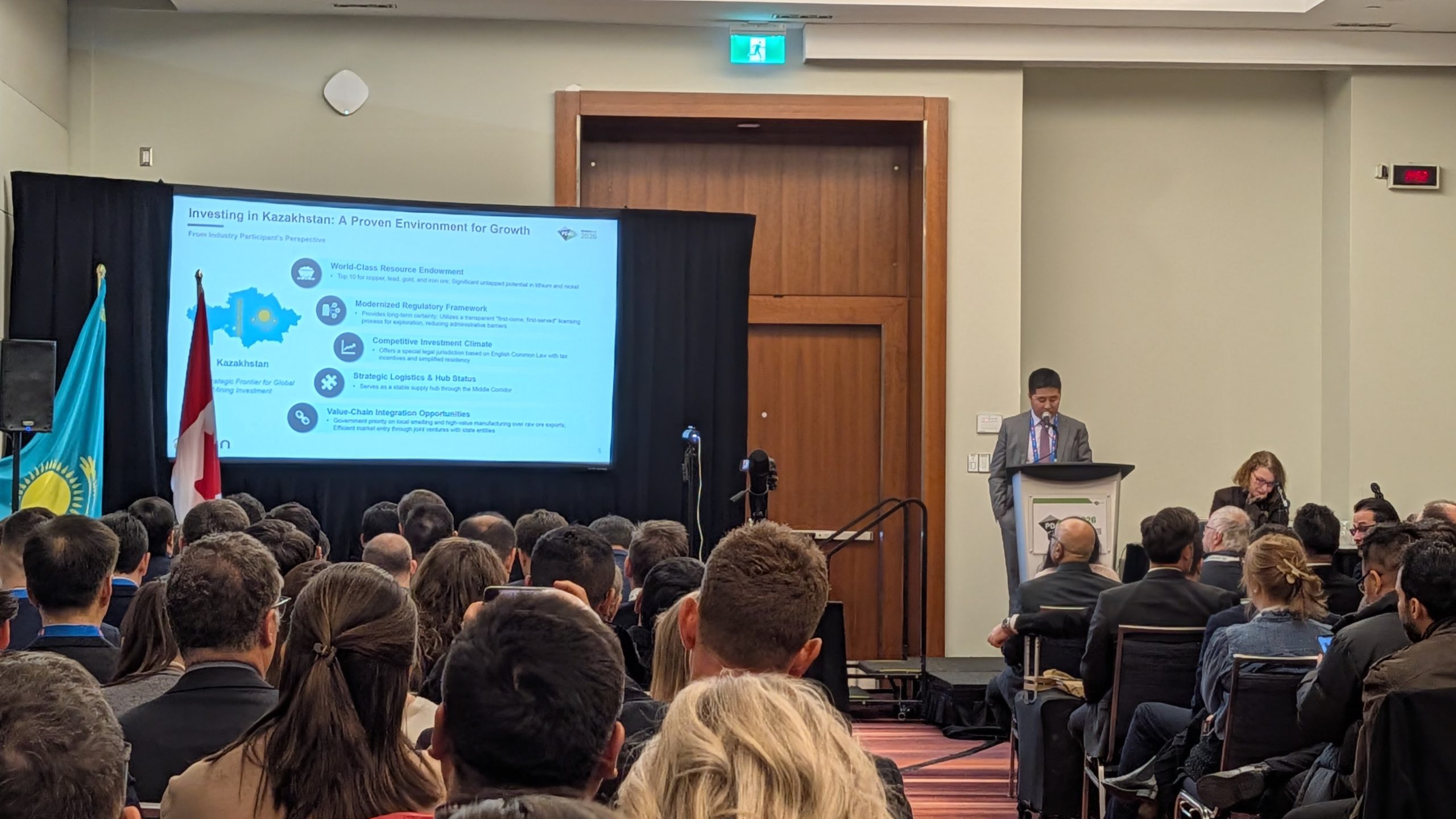
    This year marked a significant milestone as the Kazakhstan Chamber of Mines took the lead as the official organiser of Kazakhstan Day — and what a resounding success the debut turned out to be!

    Despite a packed PDAC schedule, the session drew an impressive crowd of over 130 industry leaders, investors, and exploration experts. The atmosphere in the room confirmed one thing: the global mining community is paying very close attention to Central Asia.

    MINEX Forum was proud to support the event as the Official Media Partner, capturing the insights that are shaping the next wave of exploration in the region.

    Key Highlights from the Plenary Session: The tone was set by Ruslan Baimishev, President of the Kazakhstan Chamber of Mines:

    “Kazakhstan is entering a new era of exploration — driven by robust reforms, international partnerships, and the soaring global demand for copper and critical metals.”

    We also heard high-level perspectives from H.E. Dauletbek Kussainov, Ambassador of Kazakhstan to Canada, and Iran Sharkhan, Vice-Minister of Industry and Construction.

    Expert Insights & Project Showcases: The technical session, “Unlocking New Discovery Potential in Kazakhstan,” featured a stellar line-up including Tim Barry (Arras Minerals), Charlie Liu (Zijin Mining), Simon Cooper (Pallas Resources), and world-renowned experts Anna Fonseca and Professor Jeffrey Hedenquist.

    The afternoon shifted to tangible opportunities, with project presentations from AMG Ltd, Kogadyr Gold, Taskora, and Muzbel. As Tim Barry aptly put it: “Kazakhstan offers unique opportunities for Canadian juniors to enter new jurisdictions — and the future looks bright.”

    Kazakhstan is no longer just a “prospective” jurisdiction; it is rapidly becoming the territory where the next big copper success stories are being written.

    Special thanks to the Kazakhstan Day partners:

    • General Sponsors: Aurora Minerals Group, NAC Kazatomprom, Pallas Resources.

    • Sponsors: Arras Minerals, TauGold Copper.

    Missed the session?  📺 Watch the session recordings and download expert presentations at:

  • Europe Accelerates Lithium Strategy to Reduce Dependence on China

    Europe Accelerates Lithium Strategy to Reduce Dependence on China

    Lithium is increasingly being treated as a strategic resource in Europe, prompting efforts to develop domestic mining and processing capacity and reduce reliance on China’s dominant position in global supply chains.

    China currently accounts for roughly two-thirds of global refined lithium production, a concentration that has raised geopolitical and industrial concerns within the European Union. With demand for lithium expected to grow significantly by 2030, driven by electric vehicles, energy storage and digital technologies, European policymakers are seeking to strengthen supply security.

    Mining companies are advancing lithium projects across several European countries, including Portugal, Germany and Serbia. Portugal’s Barroso project has been designated as “strategic” under the EU’s Critical Raw Materials Act (CRMA), with production potentially starting later this decade. However, the project has faced opposition from local communities and environmental groups.

    Serbia’s Jadar project, located outside the EU but of strategic interest to the bloc, is considered one of the most significant lithium developments in Europe. Industry estimates suggest it could supply a substantial share of regional demand, though progress has been delayed by political uncertainty and environmental concerns.

    Germany is also exploring lithium extraction from geothermal brine resources, which could offer a lower-impact alternative to conventional mining methods. Recent discoveries in Saxony-Anhalt have been described by analysts as potentially significant, though further validation is required.

    In parallel with mining development, European officials are considering broader policy measures, including the potential creation of strategic stockpiles of critical raw materials. The approach mirrors existing systems for oil and gas reserves.

    The Critical Raw Materials Act, adopted in 2024, is central to the EU’s strategy. The legislation aims to accelerate permitting and investment in projects deemed strategic, including mining, processing and recycling. A significant proportion of the projects identified under the framework involve lithium.

    Despite these efforts, industry experts note that Europe’s main challenge lies in building sufficient processing and refining capacity. Without this, domestically mined lithium may still need to be processed abroad, limiting the effectiveness of supply chain diversification.

    Recycling is expected to play an increasingly important role in meeting future demand, particularly as battery waste volumes grow.

    The push to secure lithium reflects broader concerns about supply chain resilience and industrial competitiveness. As global demand for battery materials continues to rise, Europe’s ability to develop a fully integrated lithium value chain will be a key factor in its energy transition and long-term economic strategy.

  • Mercuria and Kazakhmys Form Strategic Partnership to Expand Global Copper Trade

    Mercuria and Kazakhmys Form Strategic Partnership to Expand Global Copper Trade

    In February 2026, Swiss commodity trading group Mercuria Energy Group announced an eight-year strategic partnership with Kazakhstan’s mining and metallurgical company Kazakhmys, marking a shift toward deeper industrial collaboration between global traders and resource producers.

    The agreement goes beyond a traditional financing arrangement and is structured as a long-term partnership combining Kazakhmys’ production capacity with Mercuria’s global trading and logistics infrastructure. The collaboration is expected to enhance access for Kazakh copper to international markets and modern trading mechanisms.

    One of the key outcomes of the partnership is the expansion of Kazakhstan’s copper presence in global supply chains. Mercuria’s international network will facilitate integration of Kazakhmys’ output into long-term contracts with industrial consumers, providing more stable export channels and improving visibility over future demand.

    The cooperation also предусматривает переход к международным механизмам ценообразования, основанным на глобальных товарных индексах. This approach is widely used in developed commodity markets and is expected to improve transparency in export operations, strengthen investor confidence and simplify взаимодействие с финансовыми и торговыми партнёрами.

    As part of the agreement, Mercuria plans to establish a local office and marketing centre in Kazakhstan. The facility will serve as a hub for commercial operations, market analysis and risk management, supporting the development of modern trading infrastructure within the country.

    The partnership is also expected to contribute to technological development in Kazakhstan’s mining and metallurgical sector. Areas of focus include improving processing efficiency, внедрение цифровых систем мониторинга и развитие решений по переработке отходов. In addition, cooperation with an international trading house is likely to facilitate knowledge transfer in areas such as commodities trading, risk management and hedging instruments.

    Economic benefits are expected at both national and regional levels. The expansion of export operations and development of trading infrastructure may create new employment opportunities across logistics, services, analytics and equipment supply. For Kazakhstan’s industrial regions, where mining enterprises play a ключевую роль в занятости, such initiatives are seen as strengthening economic resilience.

    The agreement comes amid rising global demand for copper, driven by electrification, renewable energy and digital technologies. In this context, the partnership between Mercuria and Kazakhmys is expected to strengthen Kazakhstan’s position in global supply chains for strategic metals and further integrate its металлургический сектор into the international trading system.

  • Core Lithium Secures $205M to Restart Finniss Project

    Core Lithium Secures $205M to Restart Finniss Project

    Australia’s Core Lithium has secured approximately $205 million in funding to fully finance the restart of its Finniss lithium project, with the company’s board approving a final investment decision to proceed.

    The funding package comprises a $70 million convertible note from Glencore’s Australian unit and InfraVia, a $50 million senior secured debt facility from Nebari, and an equity raising of A$120 million (approximately $85.3 million) before costs. The placement will be priced at A$0.21 per share, representing a 4.5% discount to the company’s previous closing price.

    Core Lithium stated that the financing will support construction activities and provide working capital during the ramp-up phase. The company is targeting first production of spodumene concentrate from the Finniss project in the September quarter.

    Additional liquidity is expected from a binding agreement signed in February with Glencore International AG for the sale of the project’s remaining spodumene concentrate stockpile at a price of $2023 per tonne. Proceeds from this sale are intended to support the restart and early-stage operations.

    The restart decision comes amid early indications of stabilisation in lithium markets following a prolonged period of price declines driven by weaker-than-expected electric vehicle demand and oversupply.

    Other producers have also signalled potential production increases. Pilbara Minerals has announced plans to restart output at its Western Australia operation, while Liontown Resources is reviewing a possible expansion of its Kathleen Valley project in anticipation of improved market conditions.

    Core Lithium’s decision reflects a broader trend among producers positioning for a potential recovery in lithium demand, particularly in battery and energy storage markets.

  • Uzbekistan Launches Major Copper Plant at AGMK to Boost Industrial Growth

    Uzbekistan Launches Major Copper Plant at AGMK to Boost Industrial Growth

    Uzbekistan has launched Copper Processing Plant No. 3 at the Almalyk Mining and Metallurgical Complex (AGMK), marking one of the largest industrial projects in the country’s mining sector.

    The $2.7 billion facility, built on a 196-hectare site as part of the development of the Yoshlik-1 deposit, is designed to significantly strengthen Uzbekistan’s industrial capacity and deepen domestic processing of mineral resources.

    🏗️ A megaproject in every sense
    The plant is capable of processing 60 million tonnes of ore annually and producing about 900000 tonnes of copper concentrate. This makes it not only one of the largest copper processing facilities in Central Asia, but also among the largest globally.

    The scale is almost cinematic:

    • Steel structures used equal roughly 10 Eiffel Towers

    • Reinforced concrete volume comparable to 2.5 Burj Khalifas

    International engineering leaders including Wood (Italy) and Worley (UK) were involved in the project, while technologies from Metso, FLSmidth, Weir Minerals and Siemens have been implemented.

    ⚙️ Smart factory powered by AI
    The plant is built as a fully digitalised operation:

    • Unified AI-based control system

    • 10% reduction in energy consumption

    • 15% lower production costs

    • 10% increase in labour productivity

    Daily copper concentrate output at AGMK will double from 2400 tonnes to 5000 tonnes once the plant reaches full capacity.

    🌍 Resource base for a century
    Uzbekistan’s leadership highlighted the long-term resource strength underpinning the project. The Yoshlik-1 and Kalmakyr deposits contain:

    • 45 million tonnes of copper

    • Over 5000 tonnes of gold

    These reserves are expected to support the industry for at least 100 years. The deposits also include valuable by-products such as molybdenum, selenium, tellurium and rhenium — metals critical for high-tech and emerging industries.

    📈 From raw materials to value chains
    President Shavkat Mirziyoyev emphasised a strategic shift from exporting raw materials to building full value chains.

    Today, Uzbekistan already processes about 100000 tonnes of copper domestically, with plans to reach 240000 tonnes in the near term and continue expanding through new projects.

    “Whoever builds a high value-added chain in copper will create the industry of the future,” the president said.

    🚀 What comes next
    The project is just one piece of a much larger industrial expansion:

    • A new $2.5 billion copper smelter is under construction

    • Copper cathode production will rise from 148500 to 300000 tonnes per year

    • Gold output will increase from 20 to 33 tonnes

    • Silver from 161 to 203 tonnes

    • Molybdenum from 850 to 1700 tonnes

    A fourth processing plant is already in early planning, which could boost these figures by another 50%.

    By 2030, Uzbekistan aims to reach:

    • 500000 tonnes of copper

    • 175 tonnes of gold

    • 500 tonnes of silver

    • 15000 tonnes of uranium

    💼 Economic and social impact
    The new plant alone will create over 6000 high-paying jobs, while the broader $22 billion pipeline of mining projects is expected to generate nearly 40000 jobs nationwide.

    At the same time, environmental measures such as green landscaping and drip irrigation systems are being implemented under the “Yashil Makon” initiative, aiming to balance industrial growth with sustainability.

    🎯 Big picture
    Uzbekistan is clearly shifting gears from a resource exporter to an industrial powerhouse — turning copper from a rock in the ground into a backbone of future industry, from energy grids to AI infrastructure.

  • Vulcan Energy Secures First Lithium Production Licence for Lionheart Project in Germany

    Vulcan Energy Secures First Lithium Production Licence for Lionheart Project in Germany

    ASX-listed Vulcan Energy has secured a key regulatory milestone for its Lionheart project, receiving a lithium production licence in Germany’s Upper Rhine Valley Brine Field.

    The licence, granted in the state of Rhineland-Palatinate, is the first of its kind issued in the region. Known as LiThermEx, it covers Vulcan’s Insheim geothermal production area, where renewable heat and electricity are already being generated.

    The permit has been awarded for an initial six-year period, with the company planning to extend it in line with the project’s targeted 30-year operational life.

    Lithium meets geothermal power
    Lionheart is not a typical mining project. It blends lithium extraction with geothermal energy production, creating a hybrid model where hot underground brines are used both to generate renewable energy and extract lithium.

    The project is designed to produce around 24000 tonnes per year of lithium hydroxide monohydrate — a key battery material used in electric vehicles — while simultaneously supplying electricity and heat to local communities.

    CEO Cris Moreno described the licence as a major step forward.

    “Securing the first lithium production licence within the Lionheart project marks another important milestone,” he said, adding that the project supports Europe’s ambition to build a fully domestic lithium supply chain powered by renewable energy.

    💶 De-risked and funded
    The licence further de-risks the project, which is already fully financed and under construction following a €2.2 billion funding package completed in December.

    Vulcan expects additional production licences to be granted across the broader project area as development progresses.

    🧭 Strategic timing
    With Europe racing to secure battery raw materials and reduce dependence on external suppliers, projects like Lionheart sit at the crossroads of energy transition and resource security.

    Production is currently targeted to begin in 2028 — when lithium demand is expected to be even more electrified, quite literally.

  • ACG Metals Targets Up to 10 Copper Mine Acquisitions to Scale Production

    ACG Metals Targets Up to 10 Copper Mine Acquisitions to Scale Production

    London-listed ACG Metals is pursuing an ambitious expansion strategy, targeting up to 10 copper mine acquisitions as it seeks to rapidly scale production and position itself as a Western supplier of the strategic metal.

    The company confirmed it is in active discussions over several assets, many of which are located along the Tethyan Copper Belt — a vast mineral-rich corridor stretching from southeastern Europe through Türkiye and into South Asia.

    ACG is focusing on producing or near-production assets, allowing it to accelerate output rather than wait years for greenfield development. The strategy reflects a broader shift across the mining sector toward faster, acquisition-led growth.

    🚀 From gold to copper growth engine
    ACG completed its first major deal in 2024 with the $300 million acquisition of the Gediktepe gold and silver mine in western Türkiye. The company plans to begin copper production at the site this year and is using it as a launchpad for broader expansion.

    Its long-term ambition is bold: scale annual copper output to 300000 tonnes through a series of global acquisitions.

    Founder and CEO Artem Volynets said market volatility could actually support dealmaking.

    “Volatility always presents opportunities,” he noted, adding that while higher spot prices can complicate negotiations, they also create windows for strategic acquisitions.

    📈 Copper’s magnetic pull
    Rising demand for copper — driven by electrification, renewable energy, and the explosive growth of AI data centres — is reshaping the mining landscape and fuelling consolidation.

    Recent industry developments highlight the trend:

    • Ongoing discussions around mega-mergers between major mining players

    • Intensifying competition for high-quality copper assets globally

    Copper prices have already climbed above 13000 per tonne, with long-term expectations pointing toward further increases despite short-term fluctuations.

    Volynets described the outlook as a “stepwise climb,” with prices likely moving in waves toward the 13000–15000 range over time.

    🌍 Geopolitics meets geology
    ACG is positioning itself as a Western-aligned supplier, with copper from its Turkish operations expected to feed European smelters.

    For now, the company is prioritising assets close to its operational base in Türkiye and Eastern Europe — regions offering relatively lower costs and less competition compared to more saturated markets.

    Africa and Latin America remain on the radar for future expansion, though Volynets acknowledged that Africa in particular is becoming a geopolitical battleground for control over critical minerals.

    ⚙️ Cost discipline as survival tool
    Despite bullish long-term fundamentals, ACG is keeping a sharp focus on cost control — the quiet survival skill of mining.

    “Regardless of what prices are doing, miners should focus on cost of production,” Volynets said, noting that ACG’s operations currently sit in the lowest quartile of the global cost curve for gold.

    While copper is the main growth driver, the company continues to produce gold, silver and zinc. Gold, in particular, may remain supported by geopolitical uncertainty, acting as a financial anchor while copper builds momentum.

  • US DOE Launches $500M Push to Strengthen Critical Minerals and Battery Supply Chains

    US DOE Launches $500M Push to Strengthen Critical Minerals and Battery Supply Chains

    The US Department of Energy (DOE) has announced plans to provide up to $500 million in funding to expand domestic processing, recycling and manufacturing capacity for critical minerals and battery materials.

    The funding initiative, led by the DOE’s Office of Critical Minerals and Energy Innovation (CMEI), is aimed at supporting both demonstration and commercial-scale facilities that process and recycle key materials used in batteries and energy technologies.

    The program targets strategic minerals including lithium, graphite, nickel, copper and aluminum, as well as materials recovered from used battery systems.

    US Energy Secretary Chris Wright said the move is intended to reduce reliance on foreign supply chains, particularly those controlled by geopolitical rivals.

    “For too long, the United States has relied on hostile foreign actors to supply and process the critical materials essential for battery manufacturing,” Wright said.

    The DOE emphasized that strengthening domestic supply chains is critical not only for energy security but also for meeting rising electricity demand linked to artificial intelligence, electrification and clean energy systems.

    ⚙️ Where the money goes
    The funding will support projects across three key areas:

    • Processing of critical minerals from raw feedstocks

    • Recycling of critical materials from end-of-life products

    • Manufacturing of battery materials and components

    This reflects a broader strategy to build resilience across both upstream and midstream segments of the supply chain.

    🌐 Global cooperation still in play
    The announcement comes as US officials engage with international partners at the Indo-Pacific Energy Security Ministerial in Japan.

    Assistant Secretary Audrey Robertson highlighted that while domestic capacity is expanding, collaboration with allies remains essential.

    “Boosting domestic production, including through recycling, will bolster national security and ensure the US and its partners are prepared for future energy challenges,” she said.

    🔋 Strategic context
    The initiative marks the third round of DOE funding focused on battery supply chains. It forms part of a wider effort by Washington to counterbalance global supply concentration, particularly in China, which dominates processing and refining of many critical minerals.

    By investing in processing and recycling infrastructure, the US aims to secure the materials needed for electric vehicles, grid storage systems and next-generation energy technologies — turning supply chains from fragile threads into reinforced cables.