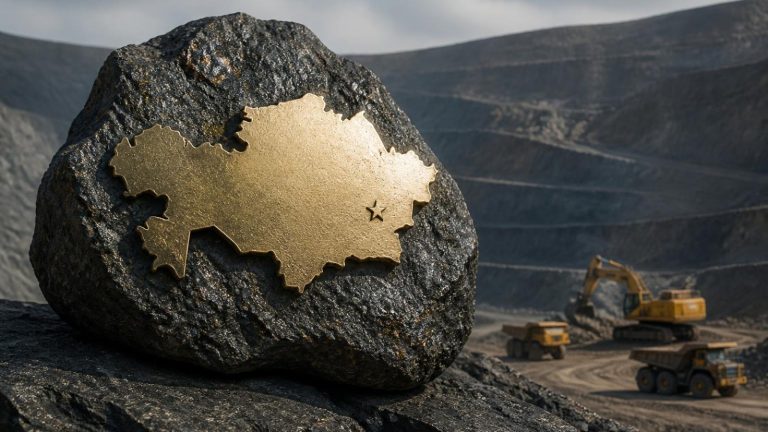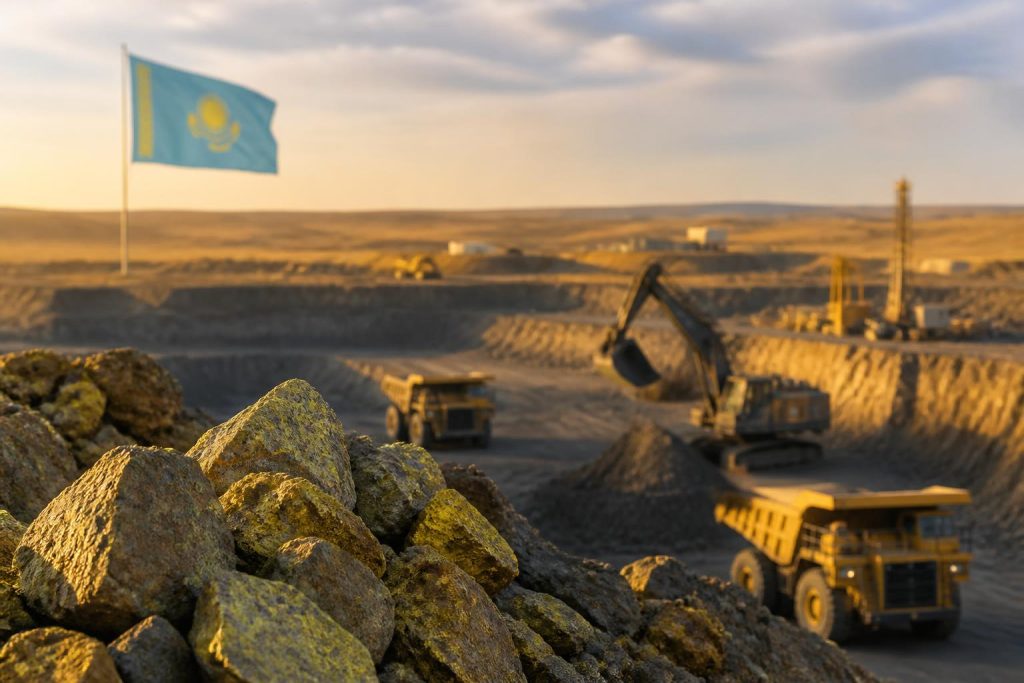
Kazakhstan is undergoing a fundamental repositioning in global resource markets, moving from a country primarily associated with oil, gas and bulk commodities to one increasingly recognised as a strategic supplier of uranium, rare earth elements, tungsten and other critical minerals essential to advanced manufacturing, defence systems and the energy transition.
Three themes dominated Central Asian mining capital markets over the past week: strategic developments at Kazatomprom, shifting ownership dynamics at Eurasian Resources Group, and US government-backed financing for Kazakhstan’s tungsten projects.
Kazatomprom, the world’s largest uranium producer, reinforced investor confidence by announcing the partial redemption of $100 million in long-term bonds — a signal of balance sheet strength during one of the strongest uranium markets in decades. The company’s market value has grown to approximately $19 billion, more than six times its IPO valuation, as nuclear energy regains strategic favour across Europe, North America and Asia. Management expects production growth in 2026 while maintaining a disciplined approach that prioritises value creation over aggressive volume expansion. State ownership through Samruk-Kazyna remains an important factor for investors assessing long-term strategic direction.
ERG, one of the world’s largest producers of ferroalloys, iron ore, aluminium, copper and cobalt, attracted attention following ownership changes involving a significant stake. Investors interpreted the development as part of a broader trend toward greater government influence over strategically important mining assets — a pattern that extends beyond corporate governance given ERG’s critical minerals portfolio. The group previously accounted for approximately 20% of global gallium production, a metal classified as strategic by both the US and EU for its applications in semiconductors, telecommunications equipment and advanced electronics. ERG’s growing importance to global resource security has elevated it from a traditional mining group to a company viewed as critical infrastructure within global supply chains.
On the tungsten front, a company developing the Northern Katpar and Upper Kairakty deposits — among the largest tungsten developments outside China — has reportedly sought an additional $400 million in US government-backed financing, supplementing previous expressions of interest valued at up to $1.6 billion. The scale of international backing reflects how strategic mineral projects are increasingly evaluated through a national security lens rather than as conventional commodity investments.
Both Kazakhstan and Uzbekistan are pursuing policies designed to move beyond raw material exports, attracting investment in processing, refining and downstream industrial operations to capture a greater share of the value chain domestically. This strategic shift mirrors approaches seen in other resource-rich regions seeking long-term economic resilience, and creates new investment opportunities across multiple segments of the mining and industrial ecosystem.