
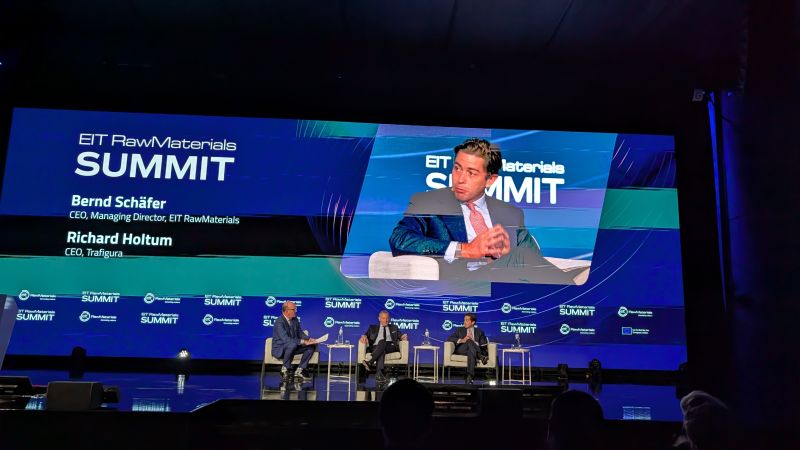
Europe has built the regulatory architecture for critical minerals security — now it must actually build the infrastructure. That was the central message from a RawMaterials Summit session featuring EIT RawMaterials CEO Bernd Schäfer and Trafigura CEO Richard Holtum, who argued that the continent’s critical minerals strategy is approaching a decisive moment in which continued policy discussion without project delivery will itself become a strategic failure.
The sharpest reframing offered at the session concerned smelting. Industry leaders argued that midstream processing capacity — smelting, refining, separation — should now be regarded as a pillar of national security comparable to defence capability, not as a commercial infrastructure question to be resolved by market forces. Relying on foreign powers for processing is no longer sustainable, the discussion concluded, and maintaining existing European capacity on what was described as “life support” is insufficient without a funded, long-term plan covering both capital and operating expenditure.
The discussion pushed back against a tendency to evaluate critical minerals investment through the lens of short-term cost. The true metric, participants argued, is the cost of inaction — the economic and strategic price of failing to build domestic value chains. The American model of socialising capital expenditure to secure strategic advantages was cited as a template Europe needs to study and selectively adopt, prioritising long-term necessity over short-term price volatility.
On execution, the session drew a clear line between the regulatory phase — now largely complete through instruments such as the Critical Raw Materials Act and various industrial accelerators — and the delivery phase that must define the coming year. A pipeline of more than 60 strategic projects has been identified and designated. The priority is now to move those projects beyond memoranda of understanding and into operational reality. The CRMA’s single-point-of-contact mechanism for strategic projects was identified as a genuine competitive advantage, with continued regulatory harmonisation needed to create the stable and predictable investment environment that long-term capital deployment requires.
On international partnerships, the conversation reflected an evolution in European strategy beyond simple resource extraction agreements. The current emphasis is on creating local value in partner countries through infrastructure support, energy access, professional training and job creation — an approach framed as essential not only for ethical reasons but for the practical goal of building supply relationships durable enough to underpin multi-decade industrial planning.
