
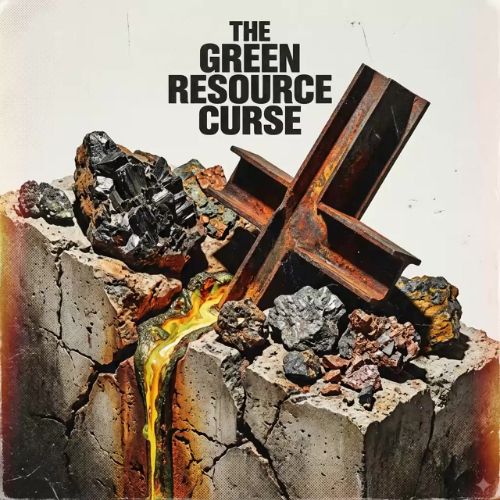
A MINEX Forum Production: Escaping the Green Resource Curse in Central Asia
Welcome to this special deep-dive podcast episode, brought to you by the MINEX Forum. This episode is based on the groundbreaking research article, “Central Asia as New Battle Grounds: Critical Mineral Strategies of Kazakhstan and Uzbekistan,” authored by Younkyoo Kim, Lyailya Ivatova, Sujin Kang, and Yerden Ordabek.
Whether you are driving an electric vehicle in Europe, using a smartphone in the USA, installing solar panels in Australia, or relying on advanced semiconductors in South Korea, your daily life depends on an invisible, highly concentrated global supply chain. This introductory long-read breaks down the complex science and geopolitics of critical minerals, revealing why the true battleground for the future of green technology isn’t in the mines—it’s in the midstream.
The “Hourglass” Supply Chain and the Green Resource Curse
As the world accelerates its transition away from fossil fuels, the demand for critical minerals like lithium, cobalt, nickel, and rare earth elements is skyrocketing. However, a severe structural imbalance threatens the stability of this green revolution.
While the extraction of these minerals happens all over the globe, the capability to refine and process them is heavily monopolized. The global supply chain resembles an “hourglass,” where raw materials from dozens of countries flow into a tiny number of refining bottlenecks—predominantly in China, which controls 85% to 90% of the processing capacity for key elements like rare earths, lithium, and cobalt.
For resource-rich developing nations, this creates a dangerous trap known as the “green resource curse”
. Just as oil and gas historically led to corruption, economic volatility, and environmental damage in some nations, the rush for green minerals risks repeating the cycle
. Developing countries bear the heavy environmental and social burdens of mining, only to export low-value raw ores
. They are entirely excluded from the lucrative “midstream” stages—smelting, refining, and chemical separation—meaning they must ultimately buy back expensive, finished green technologies manufactured elsewhere.
The New Battlegrounds: Kazakhstan and Uzbekistan
Central Asia has emerged as a crucial “third zone” capable of disrupting these bottlenecks and offering a more secure supply chain to the world. But Kazakhstan and Uzbekistan are no longer content to simply dig dirt out of the ground; they are fighting for “midstream sovereignty” to capture the actual value of their natural resources.
Kazakhstan’s “New Oil” Kazakhstan, already a dominant force in global uranium production, is treating its vast rare earth element deposits as its “new oil”. The country holds massive potential, such as the Kuirektykol deposit which holds an estimated 28.2 million tons of rare earths. However, separating rare earth elements into high-purity industrial materials requires incredibly complex precision technology. To bridge this technological gap, Kazakhstan is rapidly attracting Chinese capital—recently launching a $300 million tungsten processing plant—while simultaneously courting Western nations and South Korea to avoid becoming entirely dependent on Beijing’s vertically integrated supply chains. Uzbekistan’s $2.6 Billion Masterplan Uzbekistan is taking a highly centralized, state-driven approach. The government has consolidated its critical mineral assets under a new entity, the Uzbekistan Technological Metals Complex (UzTMK), and launched a massive $2.6 billion investment program covering 76 different projects. Remarkably, Uzbekistan is also building its own domestic electric vehicle manufacturing base, partnering with companies like BYD to ensure that the minerals they extract can be used in factories right at home. To make its products attractive to strict Western markets, Uzbekistan is pioneering eco-friendly processing methods, such as a closed-loop system for molybdenum that slashes chemical emissions.
A New Model for Partnership
As Central Asia attempts to climb the value chain, it faces competing models of global partnership. The Chinese Model offers incredibly fast infrastructure development and capital, but threatens to lock Central Asian processing into China’s broader monopolies, stifling domestic technological independence. The Western Model (US & EU) focuses heavily on environmental, social, and governance (ESG) compliance and supply chain transparency. However, Western initiatives often emphasize financial de-risking over the actual transfer of the complex refining technologies these nations desperately need.
This gap has created an opening for an alternative approach, championed by middle powers like South Korea. Because South Korea is highly reliant on mineral imports (procuring over 82% of key battery minerals from China), it is highly motivated to help Central Asia succeed. Rather than just providing cash or demanding regulatory compliance, South Korea is utilizing a “Process-Embedded Industrial Partnership Model”. Through initiatives like the Uzbek-Korea Rare Metals Center, South Korea is actively transferring laboratory skills, high-purity separation techniques, and process engineering knowledge directly to the local workforce.
Why This Matters to You
The fight for midstream processing in Central Asia is not just a regional economic issue; it is the linchpin of global clean energy security. Escaping the green resource curse is the only way these nations can achieve sustainable industrialization, and diversifying the refining bottlenecks is the only way everyday consumers can rely on a stable, affordable supply of electric vehicles and renewable energy in the decades to come. Hit play on the podcast to listen to our hosts dive deeper into the strategies, the science, and the high-stakes geopolitical chess game defining the future of the global energy transition.
