
In the early 1990s, while the West was celebrating the “End of History” and the triumph of globalized trade, Deng Xiaoping issued a quiet prophecy: “The Middle East has oil; China has rare earths.”
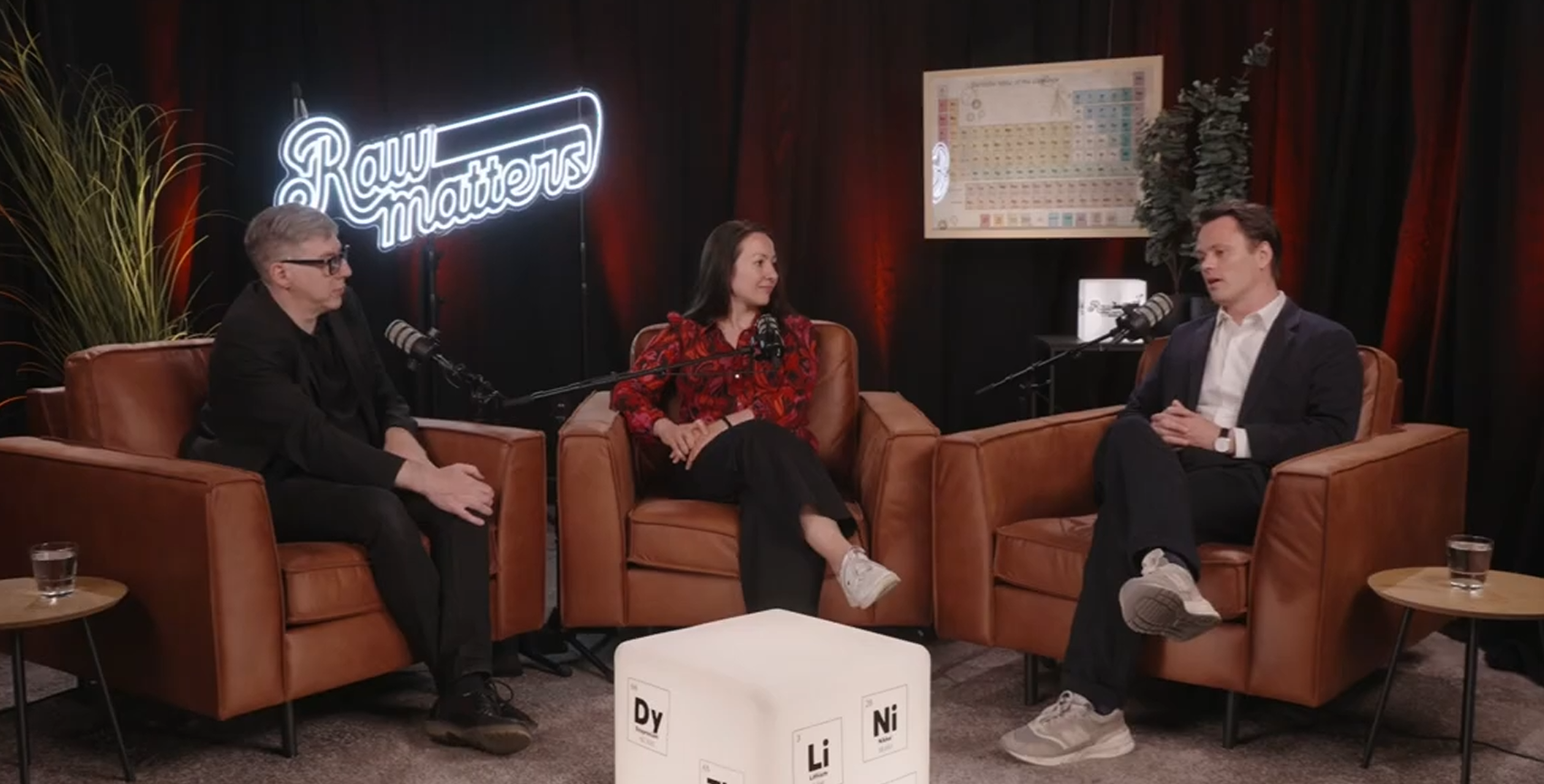
For three decades, that statement was treated as an industrial footnote. Today, it has become the defining thesis of a new, colder era of geopolitics. In the latest episode of the Raw Matters podcast, hosts Peter Tom Jones and Julia Poliscanova sat down with Albéric Mongrenier, Executive Director of the European Initiative for Energy Security (EIES), to peel back the layers of Europe’s strategic “naivety.”
The verdict? Europe’s transition to clean energy isn’t just an environmental project—it is a massive transfer of strategic dependency that could, if left unmanaged, leave the continent’s power grids and military hardware under the remote control of Beijing.
The Cyber Trojan Horse in the Power Grid
The conversation begins with a startling reality check regarding the hardware of the energy transition. We often talk about “critical minerals” as raw commodities—lithium, cobalt, copper. But Mongrenier points to a more immediate, digital threat: the inverter.
Every solar panel, wind turbine, and EV charger requires an inverter to convert DC power to AC. Today, approximately 80% of new solar installations in Europe use Chinese inverters, with a massive share provided by a single company: Huawei.
“These devices are connected to the internet,” Mongrenier warns. “They are entry doors for cyberattacks.” This creates two distinct levels of vulnerability:
-
Intelligence Harvesting: By controlling the inverters, external actors can map Europe’s energy consumption and grid behavior with more granularity than European governments themselves.
-
The “Kill Switch”: Mongrenier references reports from the US and UK regarding hidden “kill switches” discovered in Chinese-made components. In a conflict scenario, the theoretical ability to remotely disable Europe’s energy system—shutting down wind farms and solar arrays at the click of a button—is no longer science fiction.
Dual-Use: The F-35 and the Wind Turbine
One of the most persistent myths of the “Green Deal” is that critical minerals are purely “clean tech” materials. In reality, the minerals powering the energy transition are the exact same materials required for modern warfare.
“NATO came up with its own list of 12 defense-critical minerals late in 2024,” Mongrenier notes. The overlap is nearly total:
-
Rare Earths: Essential for the permanent magnets in EV motors, but also for the guidance systems of missiles and the engines of F-35 fighter jets.
-
Graphite: Used in battery anodes, but also vital for the hulls of submarines.
-
Titanium & Cobalt: The bread and butter of both high-performance turbines and military superalloys.
This dual-use nature has created a “Mineral Security Trap.” If Europe cannot secure its own supply of these minerals, it loses more than just its ability to hit climate targets—it loses the industrial base required to defend itself.
A Tale of Two Strategies: The US Stick vs. The EU Paper
The podcast highlights a widening gap between how Washington and Brussels are reacting to the Chinese monopoly.
The American “All-of-Government” Blitz
Under both the Biden and now the Trump administrations, the US has moved with aggressive speed. The US has set a hard deadline: January 2027. By then, defense contractors must purge Chinese rare earths, titanium, and tantalum from their supply chains.
“The US uses a big stick,” says Mongrenier. They aren’t just asking for change; they are mandating it while simultaneously throwing tens of billions of dollars in subsidies and equity stakes at domestic projects like MP Materials.
The European “Silo” Problem
In contrast, Europe’s response remains “timid.” Poliscanova points out that Europe is still hampered by siloed decision-making. While the US treats mineral security as a singular mission across all departments, the EU is split between various Directorates-General (DGs) that often fail to communicate.
Furthermore, Europe remains obsessed with the “business case.” “Strategic infrastructure does not always have a business case,” Poliscanova argues. “Sometimes you just invest because it’s a critical asset. We need to forget about the short-term profit and think about resilience.”
The Axis of Minerals: Russia, Iran, and China
The discussion takes a darker turn when addressing the current conflict in the Middle East. Mongrenier points out that the “axis” of Russia, Iran, and China is not a loose association—it is a functional industrial alliance.
Take the drones currently saturating battlefields in Ukraine and the Middle East. Whether they are Iranian Shahed drones or Russian variants, their supply chains lead back to China. “90% of these drones are battery-powered,” Mongrenier says. “If we build a ‘European Drone Wall’ for our own defense, but the batteries and minerals come from China, have we actually improved our security?”
The Path Forward: Ending the Naivety
As the episode concludes, the hosts and guest outline a roadmap for a more resilient Europe:
-
Aggregating Demand: Europe must connect the car industry and the defense sector to send a massive, unified “demand signal” to miners and refiners outside of China.
-
The “Carrot and the Stick”: Europe needs to provide the financial “carrots” (subsidies and public procurement) while wielding the “stick” (vetting components for cyber risks and mandating non-Chinese supply chains for critical defense hardware).
-
Industrial Sovereignty: 2026 and 2027 are viewed as the “midterm” years for European leadership to finally treat energy and mineral security as the same issue.
The message is clear: Europe’s “naivety” has been a luxury of a more stable world. In 2026, as missiles fly and megawatts become the new currency of power, that luxury has officially run out. To save its climate, Europe must first secure its minerals—and to secure its minerals, it must finally learn to play the game of “Realpolitik.”
