
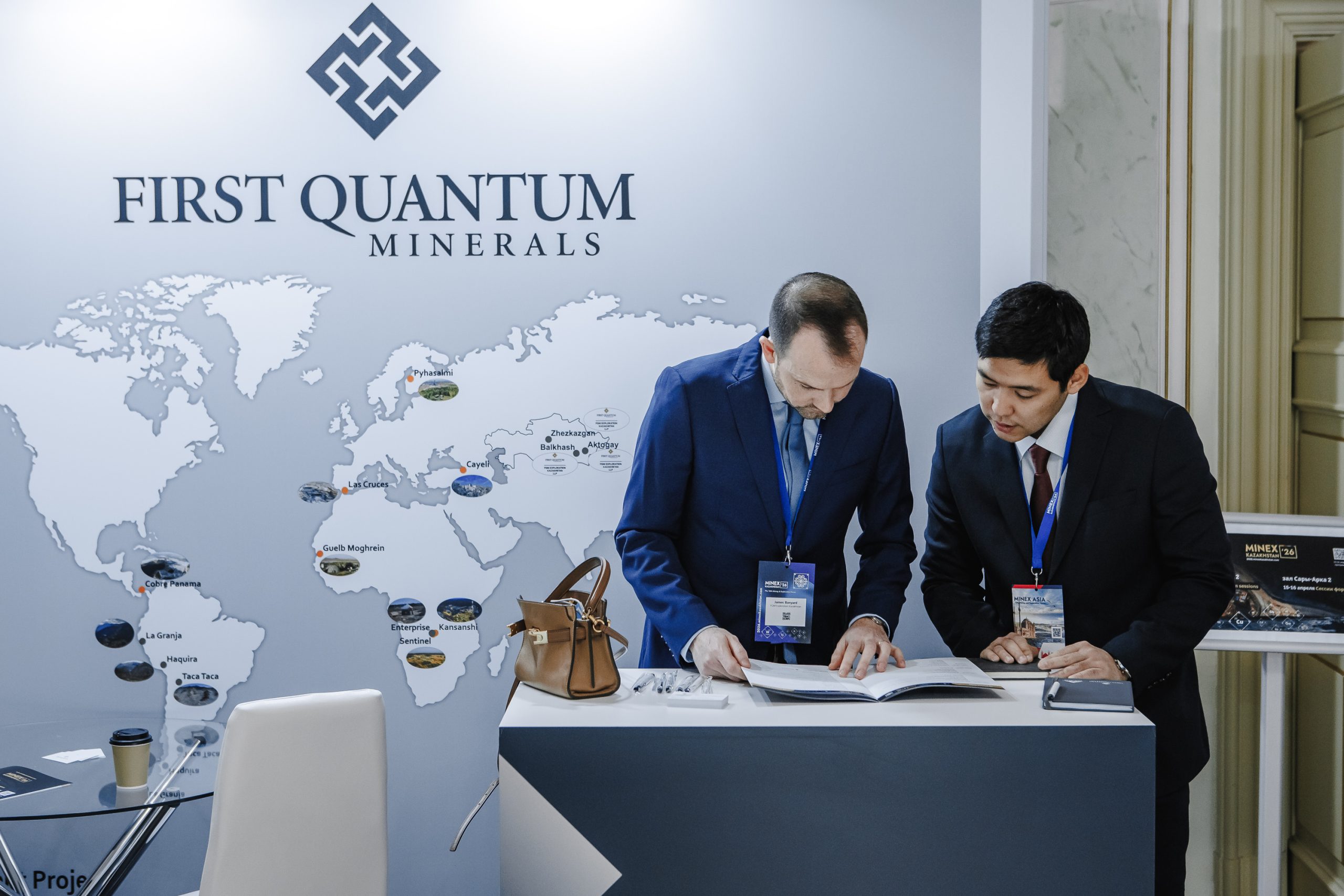
Canadian mining giant First Quantum Minerals is entering its third consecutive year of copper exploration in Kazakhstan, with a planned exploration budget of $4-5 million for 2026 that makes the country the company’s second-largest exploration destination globally after Zambia, a senior company geologist has revealed.
Speaking on the sidelines of the MINEX Kazakhstan 2026 forum in Astana, James Banyard, geology manager of FQM Exploration Kazakhstan, said the company’s outlook for the country remains highly positive. “The prospects in Kazakhstan are still very promising,” he told qazba.kz. “Thanks to the reforms of recent years, the volume of foreign investment attracted and competition are certainly growing. But we still believe there are areas where we, as First Quantum, have a competitive advantage — and our experience from Zambia gives us a different perspective on the Chu-Sarysu basin than other companies have.”
The company has been steadily building its own licence portfolio, moving away from its initial reliance on joint ventures with Pallas Resources. FQM now holds five licences covering approximately 700 square kilometres entirely in its own name, plus one joint venture licence with Pallas covering around 450 square kilometres. Licence areas include two sites near the historic Kounrad mine north of Balkhash, with the remainder concentrated around Zhezkazgan.
Last summer, FQM conducted diamond drilling at three locations in the Chu-Sarysu basin. While results did not indicate economically viable mineralisation, Banyard described the programme as a critical learning exercise — the first time the company had directly encountered the basin’s rock formations. “We learned a great deal about the basin, and it was really the first time we as a foreign company have seen these rocks. It is very important that we learn as quickly as possible, and drilling is the fastest way to learn,” he said. Further target definition and drilling are planned across the full portfolio through 2026.
On uranium — a relevant concern given that discoveries in the Chu-Sarysu basin could trigger competing claims from Kazatomprom under Kazakhstani law — Banyard was reassuring. “We are looking for uranium but have not found any so far. The uranium deposits are further south in the basin, away from our exploration areas. We expect not to find uranium in the northern part of the basin where we are currently working.”
FQM is simultaneously reducing its exposure to peripheral assets elsewhere. The company is selling the Çayeli copper-zinc mine in Türkiye to Cengiz Holding and has disposed of its Las Cruces copper project in Spain — moves consistent with a strategy of concentrating production in Zambia and Latin America while using Kazakhstan as an optionality play to diversify global risk. The company is also watching developments in Mongolia and Uzbekistan, which Banyard noted possess rich porphyry copper deposits, though he said any entry into those jurisdictions would depend on the legal and operating framework meeting FQM’s international standards as a listed company.
On community relations, Banyard said local needs in Kazakhstan broadly align with FQM’s preferred operating approach, which favours in-kind contributions over cash payments. Last year the company drilled several water wells in the village of Aktogai in Karaganda Region to help residents irrigate trees — a model consistent with its community engagement approach in other operating countries.
