Month: March 2024

  • $154.38 Billion Power Play: How Central Asia, Ukraine, and Russia’s Mineral Wealth Shapes Global Geopolitics

    $154.38 Billion Power Play: How Central Asia, Ukraine, and Russia’s Mineral Wealth Shapes Global Geopolitics

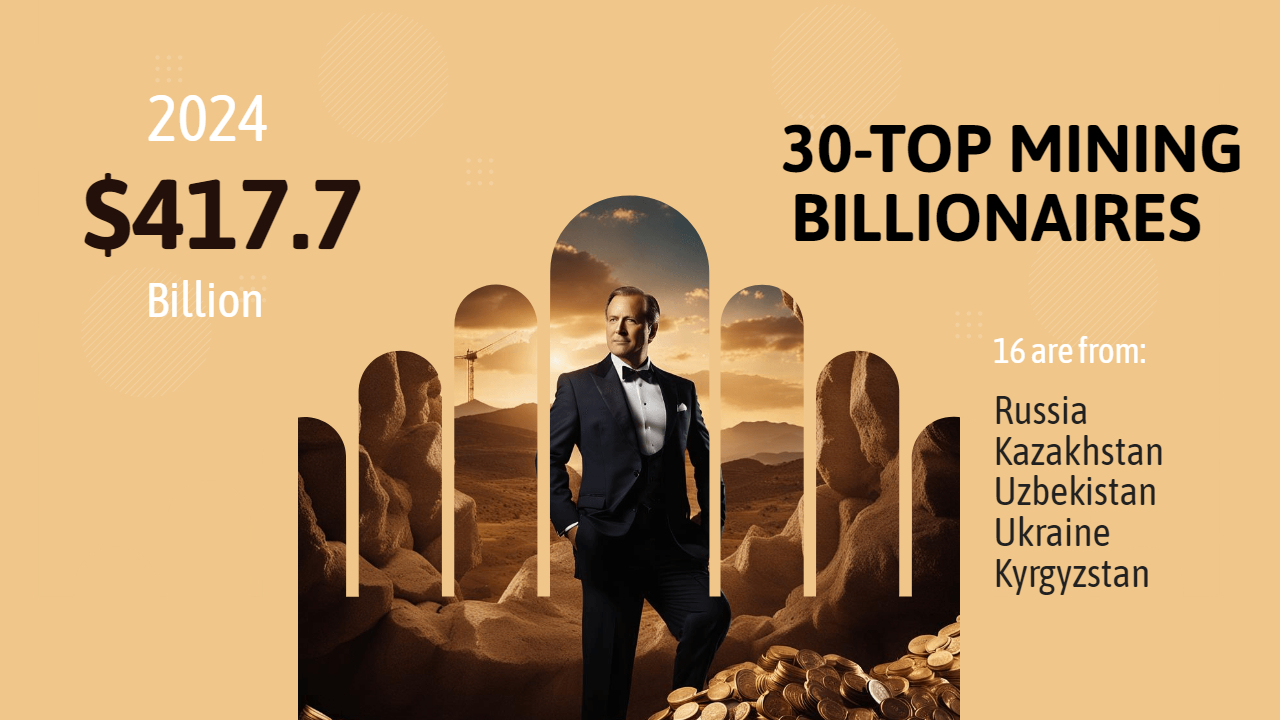
    30-top mining billionaires are worth $417.7 billion in 2024. 16 billionaires own their wealth to the mineral riches of Russia, Kazakhstan, Ukraine, Uzbekistan, and Kyrgyzstan

    Geopolitical Implications of Mining Billionaires’ Wealth in Central Asia, Ukraine, and Russia

    In a striking revelation, more than half of the world’s richest mining billionaires have amassed their wealth from their operations in Central Asia, Ukraine, and Russia. Collectively their net worth is $ 154.38 billion or nearly 37% of the $417.7 billion combined wealth of the world’s 30 top mining billionaires. This concentration of wealth and mineral resources in the region has significant implications for global commodity markets, especially in the current geopolitical climate.

    Amassing billions in the region’s mining and metals industry

    Central Asia, along with Ukraine and Russia, has been for decades a hub for mining activities, with 16 out of 30 billionaires making their fortunes in the sector. Prominent entrepreneurs like Vladimir Lisin, Vladimir Potanin and Alexey Mordashov from Russia, Alisher Usmanov from Uzbekistan, as well as Vladimir Kim from Kazakhstan, are among the top mining billionaires who have amassed substantial wealth from the region’s abundant natural resources. Their influence extends beyond their respective countries, impacting global markets and geopolitical dynamics.

    Impact on Commodity Prices and Supply Chains

    The current geopolitical environment, marked by high uncertainty and risks, has led to volatile commodity prices. The war in Ukraine has disrupted production and trade, causing surges in prices for energy, fertilisers, metals and grains. Russia’s expanding energy ties in Central Asia are part of its strategy to redirect exports from the West to Asia, following sanctions imposed due to its invasion of Ukraine. This redirection is deeply altering global supply chains and commodity prices.

    Geopolitical Implications

    The wealth of the region’s 16 mining billionaires is intertwined with the geopolitical landscape. Russia’s use of energy and transport infrastructure as a tool to enhance its influence in Central Asia has been evident, with the country building generating capacities and increasing supplies to the region. This has implications for energy security and political dynamics within Central Asia and beyond.

    Before the start of the war in Ukraine in 2022, the European Union and other economies were heavily dependent on Russian energy and commodities. Within the last two years, they have become particularly vulnerable to geopolitical shifts. The sanctions against Russia and the subsequent search for alternative markets have led to a complex web of economic and political relationships that is reshaping global commodity markets.

    The concentration of mining wealth in Central Asia, Ukraine, and Russia among a few individuals is not just an economic phenomenon but a factor with profound geopolitical and economic consequences. The current geopolitical tensions, coupled with the strategic manoeuvres of 16 mining billionaires and their home countries, are likely to continue to influence commodity prices and market dynamics for the foreseeable future.

    30 Richest Billionaires in Metals and Mining Industry in 2024

    1. Prajogo Pangestu: $48.5 billion (Indonesia)
    2. Gina Rinehart: $30.4 billion (Australia)
    3. Savitri Jindal & family: $30.3 billion (India)
    4. Germán Larrea Mota Velasco & family: $26.9 billion (Mexico)
    5. Vladimir Lisin: $26.0 billion (Russia)
    6. Iris Fontbona & family: $25.1 billion (Chile)
    7. Andrey Melnichenko & family: $25.0 billion (Russia)
    8. Vladimir Potanin: $23.7 billion (Russia)
    9. Alexey Mordashov & family: $22.9 billion (Russia)
    10. Andrew Forrest & family: $18.8 billion (Australia)
    11. Lakshmi Mittal: $16.4 billion (United Kingdom)
    12. Alisher Usmanov: $14.4 billion (Uzbekistan)
    13. Dang Yanbao: $13.1 billion (China)
    14. Roman Abramovich & family: $9.7B billion (Russia)
    15. Nicky Oppenheimer & family: $9.4 billion (South Africa)
    16. Iskander Makhmudov: $7.9 billion (Russia)
    17. Ivan Glasenberg: $7.8 billion (Switzerland)
    18. Andrei Skoch & family: $7.7 billion. (Russia)
    19. Pavel Tykac: $7.6 billion (Czech Republic)
    20. Zheng Shuliang & family: $7.3 billion (China)
    21. Viktor Vekselberg: $7.0 billion (Russia)
    22. Alexander Abramov: $6.4 billion (Russia)
    23. Wang Wenyin: $5.9 billion (China)
    24. Rinat Akhmetov: $5.7 billion (Ukraine)
    25. Vladimir Kim: $4.6 billion (Kazakhstan)
    26. Oleg Deripaska: $2.98 billion (Russia)
    27. Robert Friedland: $2.9 billion (Singapore)
    28. Alexander Machkevich: $2.4 billion (Kazakhstan)
    29. Patokh Chodiev: $ 2.1 billion (Kazakhstan)
    30. Ömürbek Babanov: $ 1.5 billion (Kyrgyzstan)

    Sources:

    https://ceoworld.biz/2024/02/29/richest-billionaires-in-metals-and-mining-industry-february-29-2024/
    https://www.forbes.com/
    Top 10 Richest People in Indonesia; Forbes December 2023 Version – En.tempo.co
    Ömürbek Babanov – Wikipedia

  • Peninsula seals uranium supply deal with European buyer

    Peninsula seals uranium supply deal with European buyer

    ASX-listed Peninsula Energy has announced a new sales agreement for the supply of 1.2-million pounds uranium yellowcake from its Lance projects, in Wyoming, to European nuclear fuel buyer Synatom.

    The agreement runs over six years, starting in 2028.

    “The strength of the uranium market dynamics in recent months has allowed Peninsula to consider adding sales commitments with improved pricing structures to our sales portfolio,” states MD and CEO Wayne Heili.

    The pricing structure is a blended approach, including both base price and market-priced components. The resulting pricing is projected to be well above the forecast production costs at Lance, as reported in the August 2023 life-of-mine model.

    The new contract is estimated to generate gross revenue of between $88-million and $117-million over the term.

    This new sales agreement brings the company’s total contractual sales obligation over the upcoming ten-year period to six-million pounds. The Lance project is projected to produce about 14.8-million pounds of uranium over the same six-year period

  • Tara Resources disputes a governmental ruling in Montenegro, putting forth arguments supported by evidence

    Tara Resources disputes a governmental ruling in Montenegro, putting forth arguments supported by evidence

    The arguments proposed by the working group for terminating the concession agreement that the state has with the company Brskovo Mine are factually inaccurate, do not correspond with the law, and are inconsistent with the Government’s policy over the past four years, stated Tara Resources.

    The company stated that they were granted the concession rights in 2018 and have since invested significant funds to fulfill all their exploration obligations, which the Government confirmed were met in June 2019.

    “The Government has already twice extended the deadlines in the concession agreement due to delays in completing the spatial planning process, as the concession agreement includes a clause that takes into account administrative delays,” the statement emphasizes.

    Tara Resources stated that the interdepartmental Government working group recommended to the Government to again extend the concession agreement in October of the previous year due to these delays, and to commence the collection of concession fees.

    They mentioned that the Government requested a concession fee of 650 thousand EUR, which the company paid in January, but there was no extension of the deadline.

    Tara Resources stated that the conclusions of the new working group, appointed by the Ministry of Energy and Mining, recommend the termination of the concession agreement, although nothing has changed since the last two extensions approved by the Government due to its own delays.

    “The arguments used are factually inaccurate and contrary to the last two extensions approved by the government and the recommendations of the working group,” said Tara Resources.

    As they stated, this exposes the Government to significant damages for violating the concession agreement, including damage within the bilateral investment treaty between Switzerland and Montenegro.

    “Tara Resources has fulfilled all its obligations and demonstrated the potential for significant new development for Montenegro, with the possibility of employing 550 people from the northern part of Montenegro and bringing significant economic benefits to the region and the country, while respecting the best practices in environmental and health protection in the EU, successfully implemented in other zinc mines in Spain, Portugal, and Sweden,” said Tara Resources.

    They emphasized that they are confident that what the working group suggested will prove to be factually illegal and incorrect, and that the Government will not adopt those conclusions.

    Tara Resources stated that they remain open to constructive dialogue with institutions.

  • Underground gold mining at Kumtor can provide hundreds of millions of additional dollars to the Kyrgyzstan’s budget

    Underground gold mining at Kumtor can provide hundreds of millions of additional dollars to the Kyrgyzstan’s budget

    The Kumtor deposit is one of the ten largest gold deposits in the world. The mine is located in the Issyk-Kol region in the permafrost zone at an altitude of 4,000 meters above sea level. Revenues from Kumtor account for roughly one-third of the state budget in Kyrgyzstan, with the mine producing about 17 tons of gold per year.

    “The feasibility study of the underground gold mining project developed by specialists speaks about its economic efficiency. According to preliminary data, with the help of an underground mining method, it will be possible to get 115 tons of gold. Taking into account the precious metal mined at the [site] by the open-pit method, this is a big step forward,” said Almazbek Baryktabasov, President of the Kumtor Gold Company. Mining underground will help the company reach gold of a higher-grade ore, he said, and as a result, the company will be able to increase its tax payments.

    Until its nationalization in 2021, the Kumtor mine was owned by Canadian company, Centerra Gold. Earlier, the Canadian owners tried to extract gold through shafts. However, gold prices did not render this profitable, as the shaft method is much more expensive than the open-pit mining. Over the past ten years, however, the price of an ounce of gold has risen by more than $700 and is currently trading at just over $2,000. Before Kumtor was expropriated, Centerra Gold spent approximately  $180 million dollars on research related to underground mining.

    Today, the authorities have allocated an additional mining site next to the one where gold ore is already being extracted. According to some reports, the new site contains a denser concentration of the precious metal per unit of ore. Currently, at Kumtor’s open-pit mine, it takes one ton of processed ore and more than 40 tons of extracted waste rock to produce 5-7 grams of gold. Underground mining could double that yield. Furthermore, underground mining is not as environmentally damaging as open-pit mining. For example, one of Kumtor’s main environmental concerns is the destruction of glaciers which literally hang over the edge of the open pit.

  • Baffinland, German firm explore low-carbon steel production

    Baffinland, German firm explore low-carbon steel production

    Baffinland Iron Mines Corp., the largest private-sector employer in the territory, has joined forces with German steelmaker ROGESA Roheisengesellschaft Saar mbH to explore the development and production of low-carbon “green” steel using iron ore extracted in Nunavut.

    The collaboration, formalized through a memorandum of understanding, aims to further investigate the utilization of iron ore sourced from the Mary River Mine, situated on northern Baffin Island, in the steelmaking process, as announced by both companies in a recent news release.

    According to Peter Akman, spokesperson for Baffinland, the ore extracted at the Mary River Mine ranks among the “highest-grade direct shipping iron ore in the world.”

    The partnership aligns with ROGESA’s emissions-reduction initiatives, which necessitate high-quality iron ore, a requirement that Baffinland can fulfill.

    Carbon plays a crucial role in steel production, enhancing its strength and durability. “Green” steel typically refers to steel manufactured with reduced carbon emissions, aiming to mitigate the environmental impact of steel production.

    Steel manufacturing is a significant contributor to global carbon emissions, amounting to eight percent of the total, as reported by the World Economic Forum in 2022.

    According to Akman, the production of low-carbon or green steel is pivotal in the global transition toward reducing the environmental footprint of the steel industry.

    Baffinland’s involvement in low-carbon steel production will primarily focus on its on-site mining operations and shipping processes. Notably, the iron ore extracted at the Mary River Mine undergoes crushing and screening on-site before being directly shipped to markets, eliminating the need for concentration or processing and, consequently, minimizing tailings production.

    Regarding potential job creation at the Mary River Mine resulting from the agreement with ROGESA, Akman stated that as the company gains insights into the process, it may lead to new production developments and, subsequently, employment opportunities.

    This collaboration marks Baffinland’s third initiative to explore the utilization of Nunavut iron ore in low-carbon steel production, following similar memorandums of understanding signed last year with German steel production companies Salzgitter Group and ThyssenKrupp Steel.

  • European Lithium and Sizzle conclude business merger

    European Lithium and Sizzle conclude business merger

    European Lithium has finalized a strategic partnership with Sizzle Acquisition, resulting in the establishment of Critical Metals.

    This collaboration positions the Wolfsberg Lithium Project as the inaugural flagship asset of Critical Metals, with the company’s immediate focus on advancing the mine’s construction and commissioning.

    The successful conclusion of the transaction and subsequent listing of Critical Metals on the Nasdaq represent significant milestones in bolstering the development of this pivotal lithium asset, essential for Europe’s transition to green energy.

    As part of the agreement, European Lithium has received 67,788,383 ordinary shares in Critical Metals, securing the company’s status as the largest shareholder with an 83.03% stake in the issued capital.

    The estimated value of European Lithium’s investment in Critical Metals currently stands at $839 million (A$1.3 billion), based on the closing share price of $12.38 per share as of February 29, 2024.

  • Российские металлурги просят РК отменить запрет на экспорт лома

    Российские металлурги просят РК отменить запрет на экспорт лома

    Полугодовой запрет на вывоз лома чёрных металлов, который ввели в Казахстане в феврале 2024 года, отрицательно повлияет на деятельность российских заводов. Такое заявление поступило от Ассоциации электрометаллургических предприятий, пишет «Коммерсантъ».

    АЭМП просит Министерство экономического развития, Министерство промышленности и торговли РФ, а также Евразийскую экономическую комиссию повлиять на решение властей Казахстана об ограничении поставок. Запрет на экспорт лома ж/д транспортом вводили и раньше, но он не касался российской стороны.

    В прошлом году РФ закупила у соседней республики порядка 1 млн т лома. Сейчас же электрометаллургическим заводам придётся столкнуться с нехваткой сырья. АЭМП предупреждает, что готовая продукция, в частности прокат строительного назначения, подорожает.

    Благодаря эмбарго на вывоз лома чёрных металлов РК рассчитывает увеличить загрузку собственных металлургических предприятий. По оценкам Минпрома республики, потребность внутреннего рынка в сырье доходит до 3,9 млн т.

    По словам председателя Республиканского союза промышленников вторичной металлургии Владимира Дворецкого, после установления запрета стоимость лома в РК снизится на 20–40%, что является лоббизмом со стороны металлургов, в частности компании «АрселорМиттал Темиртау» (теперь Qarmet).

  • Russian metallurgists are asking the Republic of Kazakhstan to lift the ban on scrap metal exports.

    Russian metallurgists are asking the Republic of Kazakhstan to lift the ban on scrap metal exports.

    The six-month ban on the export of ferrous scrap metal imposed by Kazakhstan in February 2024 will negatively impact the operations of Russian plants, according to a statement from the Association of Electrometallurgical Enterprises, as reported by “Kommersant”.

    The association is urging the Ministry of Economic Development, the Ministry of Industry and Trade of the Russian Federation, as well as the Eurasian Economic Commission, to influence the decision of the Kazakh authorities regarding the restriction on shipments. Although bans on exporting scrap metal by rail have been imposed before, they did not affect the Russian side.

    Last year, Russia purchased approximately 1 million tons of scrap metal from its neighboring republic. However, electrometallurgical plants will now face a shortage of raw materials. The Association of Electrometallurgical Enterprises warns that finished products, particularly construction steel, will become more expensive.

    Thanks to the embargo on the export of ferrous scrap metal, Kazakhstan hopes to increase the utilization of its own metallurgical enterprises. According to the Ministry of Industry of the Republic, the domestic market demand for raw materials reaches 3.9 million tons.

    According to Vladimir Dvoretsky, Chairman of the Republican Union of Secondary Metallurgy Industrialists, after the imposition of the ban, the price of scrap metal in Kazakhstan will decrease by 20-40%, which is seen as lobbying by metallurgists, particularly by companies like ArcelorMittal Temirtau (now Qarmet).

  • Встреча Каната Шарлапаева с руководством казахстанско-американского Делового совета в Торговой палате США

    Встреча Каната Шарлапаева с руководством казахстанско-американского Делового совета в Торговой палате США

    В рамках укрепления многоаспектного партнерства между Казахстаном и США министр промышленности и строительства РК Канат Шарлапаев принял участие в круглом столе с членами Казахстанско-американского Делового совета (USKZBC) и представителями американских компаний. Мероприятие состоялось в Торговой Палате США, где собрались ключевые представители бизнес-сообщества, такие, как Bechtel, BHP, Brownstein Hyatt Farber Schreck, Chevron, Morgan Stanley, Turkish Airlines, U.S. Chamber of Commerce,  а также USKZBC.

    Торговая Палата США, ведущая бизнес-ассоциация страны, объединяет более 3 миллионов компаний, представляя интересы американского делового сообщества на национальном и международном уровнях. USKZBC, действуя в рамках Торговой Палаты, способствует развитию торговых и инвестиционных отношений между Казахстаном и США, открывая новые возможности для обеих стран.

    В ходе круглого стола Канат Шарлапаев подчеркнул важность давнего и успешного партнерства между Казахстаном и США, акцентировав внимание на стратегическом потенциале сотрудничества в области добычи редких и редкоземельных металлов, а также на развитии промышленной кооперации. Министр выделил ключевые направления для инвестирования и технологического сотрудничества, подчеркнув значимость создания в Казахстане кластера по производству батарейного сырья, включая никель, кобальт, марганец и литий. Особо отметив ключевые реформы, проводимые в сфере недропользования для привлечения инвестиций, министр пригласил горнорудные компании США участвовать в предстоящих аукционах для недропользования и подчеркнул ключевую роль инвестштаба под председательством первого заместителя Премьер-Министра РК как гарантию сопровождения инвестпроектов.

    Это мероприятие открыло новую страницу в истории двусторонних отношений, подтвердив готовность обеих сторон к глубокому и плодотворному сотрудничеству. Проведенный круглый стол стал ярким свидетельством взаимной заинтересованности в дальнейшем расширении промышленных и торговых связей, что способствует укреплению экономического партнерства между Казахстаном и США.

  • Meeting of Kanat Shralapayev with the leadership of the Kazakhstan-American Business Council at the US Chamber of Commerce

    Meeting of Kanat Shralapayev with the leadership of the Kazakhstan-American Business Council at the US Chamber of Commerce

    As part of strengthening the multifaceted partnership between Kazakhstan and the United States, Minister of Industry and Infrastructure Development of the Republic of Kazakhstan Kanat Shralapayev participated in a roundtable with members of the Kazakhstan-American Business Council (USKZBC) and representatives of American companies. The event took place at the US Chamber of Commerce, where key representatives of the business community gathered, such as Bechtel, BHP, Brownstein Hyatt Farber Schreck, Chevron, Morgan Stanley, Turkish Airlines, the U.S. Chamber of Commerce, as well as USKZBC.

    The US Chamber of Commerce, the leading business association in the country, represents the interests of over 3 million companies, advocating for the American business community at national and international levels. Acting within the framework of the Chamber of Commerce, USKZBC promotes the development of trade and investment relations between Kazakhstan and the United States, opening up new opportunities for both countries.

    During the roundtable, Kanat Shralapayev emphasized the importance of the longstanding and successful partnership between Kazakhstan and the United States, focusing on the strategic potential of cooperation in the field of rare earth metals extraction, as well as industrial cooperation development. The Minister highlighted key areas for investment and technological cooperation, emphasizing the significance of creating a cluster in Kazakhstan for battery raw materials production, including nickel, cobalt, manganese, and lithium. Particularly noting the key reforms in the field of subsoil use aimed at attracting investments, the Minister invited US mining companies to participate in upcoming auctions for subsoil use and emphasized the key role of the Investment Council under the chairmanship of the First Deputy Prime Minister of the Republic of Kazakhstan as a guarantee for project support.

    This event opened a new chapter in the history of bilateral relations, confirming both sides’ readiness for deep and fruitful cooperation. The roundtable served as a vivid testimony to mutual interest in further expanding industrial and trade ties, contributing to the strengthening of economic partnership between Kazakhstan and the United States.