Website: Kazakhstan.com

  • Kazakhmys Launches 2026 Digital Modernisation Programme for Exploration and Geological Operations

    Kazakhmys Launches 2026 Digital Modernisation Programme for Exploration and Geological Operations

    Kazakhmys Corporation has announced a comprehensive modernisation programme for its geological exploration system in 2026, focusing on digital transformation and the development of new geological infrastructure in Zhezkazgan.

    The decision follows an independent audit conducted across five Kazakhmys deposits using Micromine software, which revealed that existing digital tools were not being fully utilised. According to the assessment, geological calculations were frequently performed in two-dimensional formats, limiting the accuracy of modelling and resource forecasting.

    Under the new programme, the company plans to transition to full three-dimensional geological modelling to improve exploration efficiency and decision-making. Around 400 employees will undergo training in Micromine Origin & Beyond, alongside advanced professional courses under the Micromine Advance programme.

    Kazakhmys has already begun developing integrated lithological and hydrological models for its mining operations, incorporating both ore body geometry and complex natural conditions. A centralised geological data storage and analytics platform, Geobank, will also be introduced across company assets to streamline data management and interpretation.

    The digital transformation initiative will be supported by new physical infrastructure in Zhezkazgan, where construction of a geological cluster covering approximately 14,000 square metres is underway. The facility will include a modern core storage centre with capacity of up to 200,000 linear metres, to be operated jointly with Australian laboratory services provider ALS.

    The planned geo-cluster will additionally house geo-mineralogical and geophysical laboratories, training facilities and a museum. The educational component of the project will be developed in cooperation with the Colorado School of Mines, strengthening professional training and technical expertise within Kazakhstan’s mining sector.

  • Kazakhstan Investment Day in Frankfurt

    Kazakhstan Investment Day in Frankfurt

    Analysis of the Germany-Kazakhstan Strategic Partnership

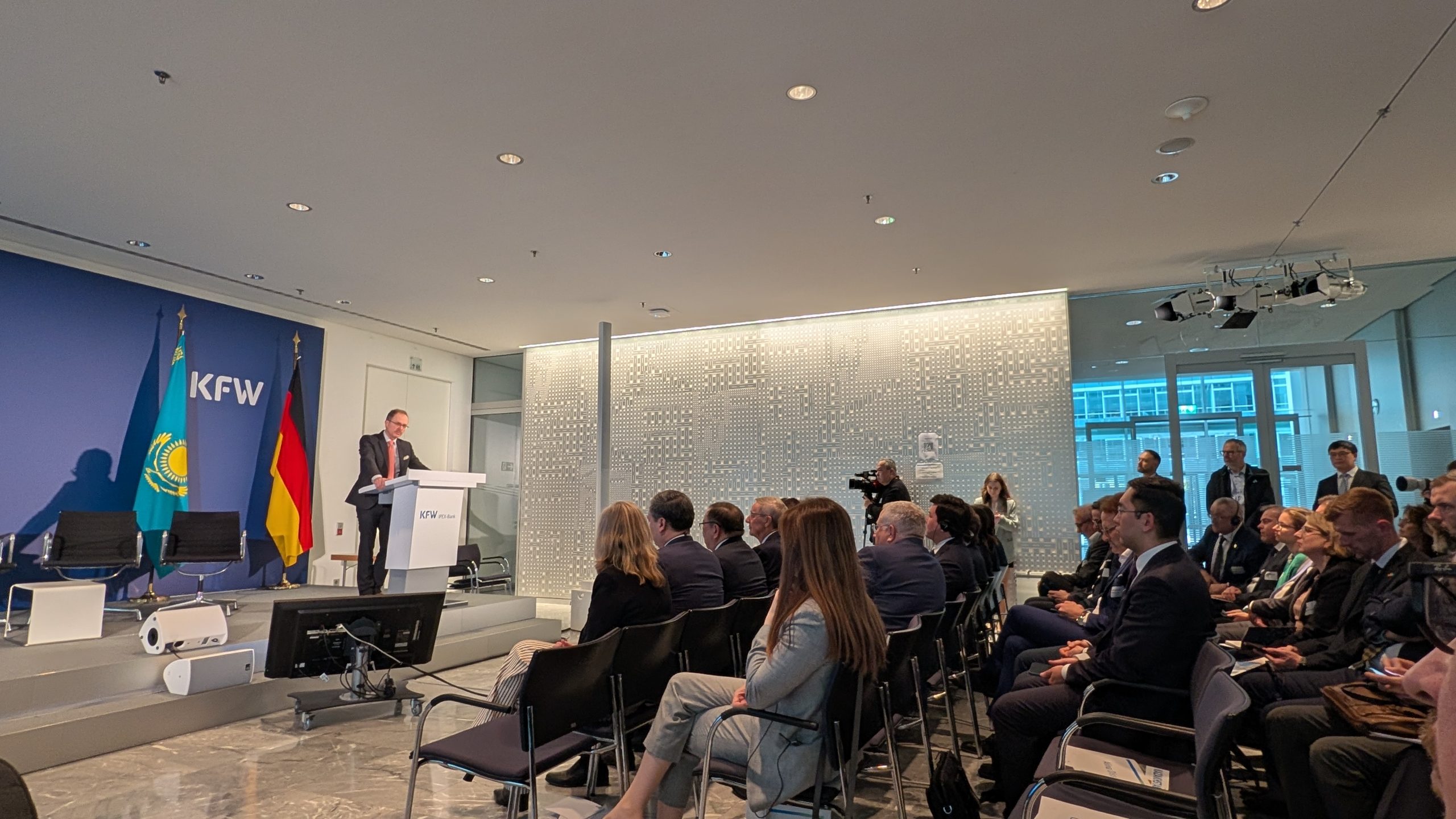
    The Kazakhstan Investment Day, held on 24 February 2026, at the KfW Bankengruppe headquarters in Frankfurt, highlighted a pivotal shift in Eurasian trade dynamics. The event centered on the deepening energy and mining alliance between Germany and Kazakhstan, a relationship that has gained strategic urgency as Kazakhstan effectively replaces Russian oil volumes and leverages deep-rooted cultural ties to strengthen bilateral cooperation.

    Financial and Strategic Framework

    The scale of this partnership is substantial, with bilateral trade recently seeing a 10% increase to reach €4 billion. Kazakhstan is currently positioned to supply 21 of the 34 critical raw materials (CRMs) identified on the EU’s strategic list.

    To facilitate this, several financial and logistical mechanisms have been established:

    • The Development Bank of Kazakhstan (DBK): A $1 billion financing program (2025–2030) has been launched, specifically dedicated to the extraction and processing of rare and critical materials.

    • Foreign Direct Investment (FDI): Kazakhstan aims to attract $400 billion in FDI by 2029, supported by Germany’s raw materials fund and backing from institutions like KfW IPEX and DEG.

    • The Middle Corridor: The Trans-Caspian International Transport Route is being developed as a highly efficient logistical artery connecting Central Asia to Europe, bypassing sanctioned territories.

    Operational Success vs. Bureaucratic Hurdles

    There is a notable contrast between engineering achievements and administrative delays. Industry leaders from Thyssen Schachtbau and Qazaq Kalium have demonstrated successful deep-shaft mining projects, proving that German technology is effectively unlocking Kazakh resources. Furthermore, the German development agency GIZ is pivoting its strategy by forming a dedicated in-country team focused exclusively on CRM partnerships.

    However, several impediments remain:

    • The “Bearocracy”: Despite the strategic need, Kazakh businesses face extreme delays and bureaucratic hurdles regarding German visa regimes, a point acknowledged by German officials.

    • Sanction Compliance: German leadership maintains a hard line, stating there will be zero support for any trade or logistics involving Russia or sanctioned companies.

    • Implementation Lag: While the financial architecture is in place, the actual development of new mining projects remains slowed by EU-wide bureaucratic processes.


    A Shifting Global Context

    The global competition for resources is accelerating. Coinciding with these discussions in Frankfurt, China introduced a supply ban of critical minerals to 40 major Japanese industrial firms over “remilitarisation” concerns. This geopolitical shift forces Japan to seek immediate alternative suppliers, placing Kazakhstan and the broader Central Asian region directly in their sights. The consensus is clear: while the foundations for a Euro-Kazakh partnership are solid, the slow pace of European administration may cause the EU to lose ground in an increasingly aggressive global race for resources.

  • Kazakhstan Centralises 1% R&D Contributions from Subsoil Users Under New 2026 Rules

    Kazakhstan Centralises 1% R&D Contributions from Subsoil Users Under New 2026 Rules

    Kazakhstan has introduced a revised mechanism governing mandatory research and development (R&D) contributions from subsoil users, shifting control over funding allocation to the state and triggering concerns within the mining industry over rising fiscal pressure.

    Although the requirement for subsoil users to allocate 1 percent of revenues toward research and development has long been established under the Code on Subsoil and Subsoil Use, significant changes to its implementation came into force in 2026. Under the updated model, companies are no longer permitted to fulfil R&D obligations independently and must now transfer funds directly to the republican budget in accordance with the Budget Code.

    The Ministry of Industry and Construction stated that the reform aims to improve transparency and centralise funding management. Contribution levels will be calculated based on companies’ actual operational results from the previous year, meaning 2026 payments will reflect 2025 performance indicators. R&D obligations arise from the second year of a mining licence for solid mineral extraction.

    While subsoil users retain the right to propose research programmes, project implementation and financing decisions are now determined by government procedures. The Ministry’s Scientific and Technical Council plays a central role by defining priority research areas, reviewing proposed technical assignments and approving projects before they proceed to competitive selection overseen by the authorised science body.

    Council decisions are adopted through open electronic voting within the National Innovation System’s “Single Window” platform operated via Astana Hub, requiring quorum participation and a two-thirds majority.

    As a result, mining companies no longer directly determine which projects receive funding, with final allocation dependent on state-led approval and budgetary procedures.

    Industry representatives have raised concerns over the practical impact of the reform. Geological and geophysical expert Abzal Kenessary of Qazaq Expert Club noted that while the new rules close a longstanding regulatory gap by establishing clearer financing procedures, the model risks creating structural imbalances.

    According to the expert, subsoil users primarily require applied research in geology, mining, metallurgy and environmental technologies, whereas Astana Hub has traditionally focused on IT startups, digitalisation and fintech initiatives. Businesses are therefore awaiting clarification on project eligibility criteria to ensure R&D funding is not disproportionately directed toward digital projects at the expense of industrial innovation.

    Kenessary added that from a business perspective, the mandatory transfer of 1 percent of annual contract revenue effectively functions as a quasi-tax, representing an additional compulsory payment linked to company income. Companies are likely to factor the obligation into project economics and investment attractiveness assessments.

    Experts suggest the new R&D framework could deliver long-term benefits if several conditions are met, including sector-specific project selection criteria, independent monitoring of technological outcomes rather than financial transfers alone, and structured feedback mechanisms allowing subsoil users to influence priority research areas.

    Without these safeguards, analysts warn the reform risks becoming a redistribution mechanism rather than a driver of technological development in Kazakhstan’s mining sector.

  • Geologist Calls for Market-Based Approach to Processing Kazakhstan’s Technogenic Mineral Waste

    Geologist Calls for Market-Based Approach to Processing Kazakhstan’s Technogenic Mineral Waste

    Kazakhstan has accumulated vast volumes of technogenic mineral formations (TMF) over decades of mining and metallurgical operations, raising renewed debate over how to effectively utilise these surface stockpiles containing valuable metals.

    In an interview, experienced geologist Bolat Kabaziev described TMF as industrial waste generated by mines, processing plants and metallurgical facilities that still contain recoverable metals. Despite increasing public discussion in recent years, he noted that relatively few large-scale projects have been implemented, as metal recovery from waste requires complex and often innovative technologies.

    Currently, both conventional methods such as gravity separation and flotation, as well as hydrometallurgical techniques including leaching, are used to extract metals from TMF. Kabaziev emphasised that while processing such waste can mitigate environmental risks posed by tailings and dumps, proper reclamation and monitoring remain essential.

    He expressed concern over the earlier transfer of Soviet-era TMF into private ownership, arguing that the move was premature and did not accelerate environmental remediation or reprocessing. In his view, placing TMF into an open and competitive market would have encouraged smaller private companies to begin processing operations more actively.

    Access to TMF located on operating mining sites has also become a challenge, particularly after the adoption of the 2018 Subsoil Code. According to Kabaziev, conflicts over ownership and balance separation have slowed reuse efforts.

    Beyond surface waste, he highlighted the potential of recovering metals from previously mined deposits where unextracted reserves remain underground. Advances in technology could make such resources economically viable, particularly amid rising gold and copper prices.

    While tax reductions on TMF have been introduced, Kabaziev believes more systematic action is needed. He proposes establishing a scientific and industrial centre to conduct nationwide monitoring of TMF and reassess regulatory approaches. Determining metal content, he noted, is technically feasible through standard exploration methodologies.

    Kabaziev concluded that reintroducing TMF into active economic circulation could attract new investors without undermining geological exploration efforts. Given declining mineral reserves and slow replenishment, he considers TMF a strategically important resource capable of sustaining metal production for decades if managed responsibly.

  • RG Gold to Launch Development of Sharyk and Novodneprovskoye Gold Deposits

    RG Gold to Launch Development of Sharyk and Novodneprovskoye Gold Deposits

    Kazakhstan-based gold producer RG Gold is set to begin development of two additional deposits — Sharyk and Novodneprovskoye — located in the Burabay district of Akmola region, according to a newly published project disclosure.

    The company plans to implement a mining plan for gold-bearing ores at both sites and construct a mining and hydrometallurgical complex with an annual processing capacity of 600,000 tonnes of ore.

    RG Gold already operates within the Novodneprovskoye contract area, which includes the Novodneprovskoye, North Raigorodok and South Raigorodok deposits. Active production is currently underway at the Raigorodok sites using a gold processing plant with a capacity of 5 million tonnes of ore per year. In 2025, gold output at the facility reached 6.5 tonnes. Until 2021, oxidised ores at Raigorodok were also processed via heap leaching.

    The new deposits — Sharyk and Novodneprovskoye — are expected to be developed through open-pit mining of oxidised ores. Annual production from the two pits is planned to supply at least 600,000 tonnes of ore for heap leaching processing.

    According to project documentation, the planned operational life of Novodneprovskoye is five years, from 2027 to 2031, while Sharyk is expected to operate for one year in 2030. The relatively short timelines reflect the size of reserves. As of the end of 2024, Novodneprovskoye contained 1,246 kg of gold at an average grade of 0.99%, while Sharyk held 142 kg at a grade of 0.43%.

    RG Gold has previously conducted exploration activities at Novodneprovskoye, Sharyk and Central Raigorodok. In 2017, approximately 1 billion tenge was allocated for geological exploration within the Novodneprovskoye contract area.

    In 2025, RG Gold was acquired by China’s Zijin Gold International for approximately $1 billion from businessman Bulat Utemuratov.

  • Kazakhstan Coal Output Declines in January Amid Long-Term Power Expansion Plans

    Kazakhstan Coal Output Declines in January Amid Long-Term Power Expansion Plans

    Coal production in Kazakhstan declined in January 2026 despite the government’s long-term plans to expand coal-fired power generation capacity.

    According to official statistics, output of thermal coal reached 9.92 million tonnes in January, down 1.7% compared to the same period last year. Total coal production, including coking grades, amounted to 10.31 million tonnes, reflecting a year-on-year decrease of 0.7%.

    The modest start to the year comes as the government prepares a coal power development programme through 2030, which предусматривает the commissioning and modernisation of approximately 7.6 GW of thermal power capacity.

    In 2023–2024, Kazakhstan’s thermal power plants consumed around 55 million tonnes of coal annually. With the rollout of new energy projects, additional demand could rise by up to 16 million tonnes per year, requiring increased output and more stable supply chains.

    Bogaty r Komir, the country’s largest private coal producer, plans to raise production to 45.2 million tonnes in 2026 and further expand to 56.5 million tonnes by 2032. The company’s primary resource base is the Ekibastuz deposit, which holds estimated reserves of approximately 2.4 billion tonnes.

    For full-year 2025, Kazakhstan’s total coal production reached 115.9 million tonnes, marking an increase of around 6.5% compared with the previous year.

  • Kazakhmys to Invest Over KZT 20 Billion in Ulytau Region Development

    Kazakhmys to Invest Over KZT 20 Billion in Ulytau Region Development

    Kazakhmys Corporation will invest more than 20 billion tenge in social and infrastructure projects in Kazakhstan’s Ulytau region under a newly signed memorandum of cooperation with the regional akimat.

    The agreement prioritises investments in healthcare, education, infrastructure modernisation and urban development.

    Among the flagship initiatives is the establishment of Ulytau University, as well as the launch of Zhezkazgan’s largest mosque, a trauma care centre in Satpayev and the Namys sports complex with a 150-bed boarding facility.

    Urban improvement projects in Zhezkazgan will include the redevelopment of Zhasar Park, the Gharishkerler Boulevard and the embankment of the Kengir Reservoir. Renovation of the S. Kozhamkulov Theatre is also planned.

    A separate focus of the programme will be the modernisation of water supply, heating and energy infrastructure systems across the region.

  • Tau-Ken Samruk Increases Gold Resources at Zhosabay Deposit in Akmola Region

    Tau-Ken Samruk Increases Gold Resources at Zhosabay Deposit in Akmola Region

    Tau-Ken Samruk has expanded gold resources at the Zhosabay site in Kazakhstan’s Akmola region following the results of its 2025 exploration campaign.

    According to updated geological data, total gold resources at the deposit have increased to 8.2 tonnes, representing a 68% rise compared with previous state balance figures. Of this, 787 kilograms were upgraded to the Measured category, Indicated resources rose by 1,338 kilograms, an increase of 30%, and Inferred resources expanded to 1,677 kilograms, marking a 248% increase.

    During 2025, the company completed 7.3 kilometres of drilling and updated the 3D geological model of the deposit.

    For 2026, Tau-Ken Samruk has planned 8.6 kilometres of additional drilling, of which 1.16 kilometres have already been completed. The exploration licence is held by Akmolit LLP, a subsidiary of Tau-Ken Samruk.

    The company intends to continue further exploration to improve the resource classification and submit updated resource and reserve data for inclusion in the state balance by the end of 2027.

  • White & Case Advises on $1.6 Billion-Backed Tungsten JV Between Cove Kaz and Tau-Ken Samruk

    White & Case Advises on $1.6 Billion-Backed Tungsten JV Between Cove Kaz and Tau-Ken Samruk

    Global law firm White & Case LLP has advised Cove Kaz Capital Group, a portfolio company of Cove Capital LLC, on the signing of definitive agreements with Tau-Ken Samruk National Mining Company to advance the Northern Katpar and Upper Kairakty tungsten projects in Kazakhstan.

    The transaction includes a share purchase agreement and shareholders’ agreement establishing a joint venture structure in which Cove Kaz will hold a 70 percent stake and Tau-Ken Samruk will retain 30 percent ownership in Severniy Katpar LLP.

    The two projects are described as the largest undeveloped tungsten resource globally, with a planned combined annual production target of 12,000 metric tons, equivalent to approximately 15 percent of current global output.

    Following execution of the agreements, Cove Kaz will proceed with a definitive feasibility study and downstream refining plans. The development is expected to create around 2,000 jobs and enhance Kazakhstan’s position in the global critical minerals supply chain.

    The project has received backing from both the US and Kazakh governments. Letters of interest have been issued for up to $1.6 billion in potential financing from the Export-Import Bank of the United States and the US International Development Finance Corporation.

    The White & Case advisory team was led by partners Carolyn Lamm in Washington, DC and Maxim Telemtayev in Astana, alongside partners Martin Menski, John Vetterli, Keith Hallam and Morgan Hollins.

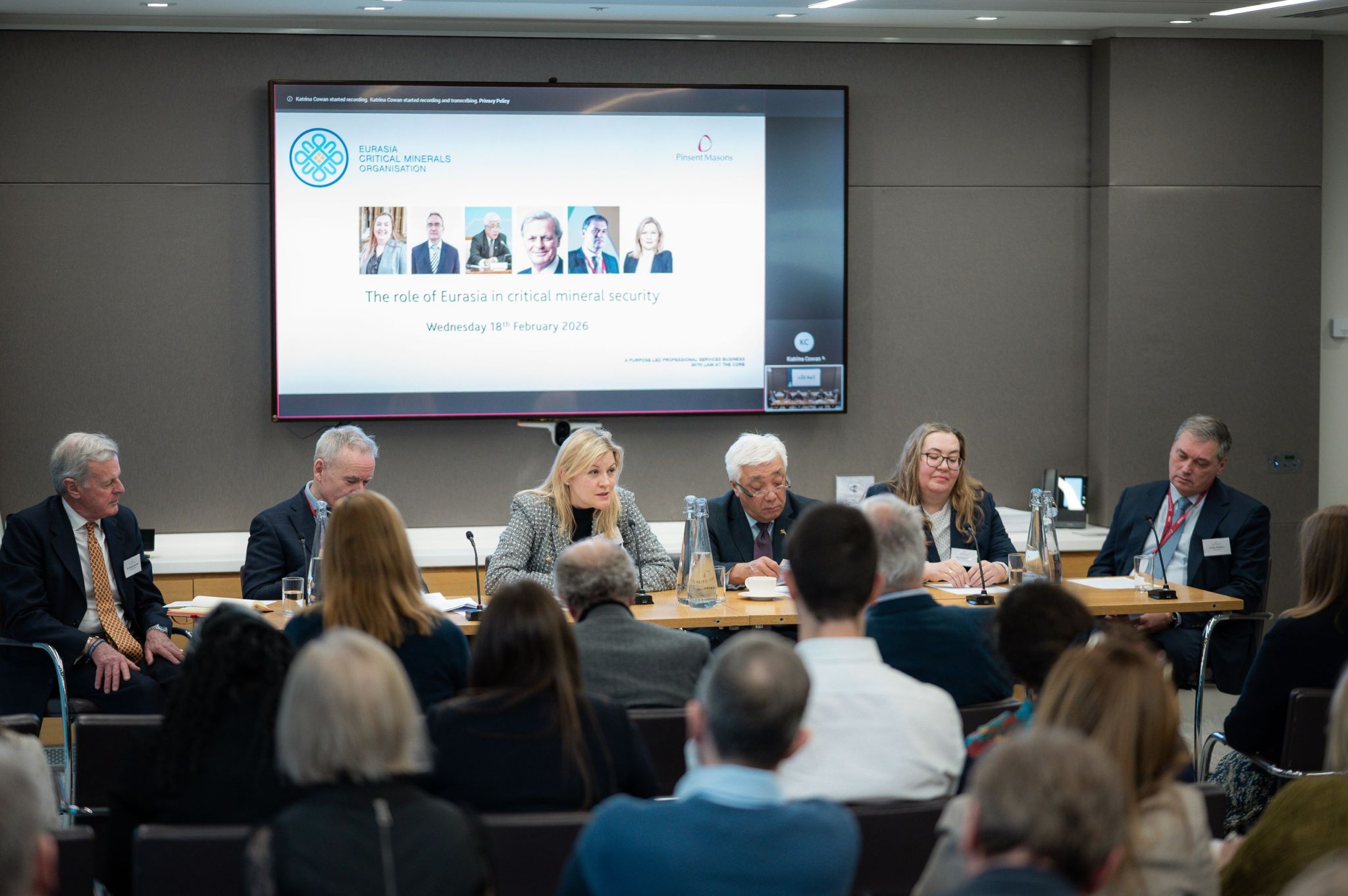
  • First Meeting of the Eurasian Critical Minerals Organisation (ECMO)

    First Meeting of the Eurasian Critical Minerals Organisation (ECMO)

    The panel discussion marked the first public engagement of the Eurasian Critical Minerals Organisation and focused on the growing strategic importance of Eurasia in global critical mineral supply chains. Particular attention was given to Kazakhstan, Uzbekistan, Mongolia, Kyrgyzstan and Tajikistan, set against a backdrop of geopolitical change, supply-chain vulnerability and rising global demand for responsibly sourced critical raw materials.

    Speakers highlighted the diversity of investment environments across the region. Mongolia was cited as a leading example of transparency, due to its publicly accessible national geological database, which provides information on licences, ownership, geological data and environmental conditions. This level of openness was seen as a strong advantage for investors. Other countries in the region were described as having extensive geological data inherited from the Soviet period, much of which has yet to be fully digitised or made widely accessible.
    The panel agreed that improving geological data transparency across the region would significantly strengthen investor confidence and support new exploration.

    Kazakhstan was recognised as the most established mining jurisdiction in the region, with a long history of production and a diverse mineral base. Uzbekistan was described as an increasingly important emerging player, combining significant mineral potential with ongoing economic and regulatory reforms aimed at attracting international investment.

    Kyrgyzstan and Tajikistan were discussed as highly prospective but more constrained environments, where progress on governance, infrastructure and regulatory consistency will be important to unlocking long-term, sustainable investment.

    Mongolia was noted for its openness to mining investment, alongside the need to balance development with environmental and social considerations.

    The discussion also addressed the region’s strategic geography. Positioned between Russia and China, Eurasian countries are increasingly integrated into regional transport and infrastructure corridors, including those associated with China’s Belt and Road Initiative. While such investment was recognised as important, speakers stressed the shared objective among regional governments of diversifying their international partnerships.

    A broad and balanced investor base was described as being firmly in the national interest, strengthening resilience and reducing over-reliance on any single partner.

    Panellists also highlighted the growing link between critical minerals, industrial strategy and security. Recent geopolitical developments, including the war in Ukraine, have sharpened European focus on supply-chain resilience and strategic autonomy. Minerals found across Central Asia and Mongolia were described as essential inputs for clean energy technologies, advanced manufacturing and defence-related applications.

    From a geological perspective, the panel emphasised that large parts of the region remain underexplored, despite extensive historic discoveries. Many critical minerals occur as by-products of major commodities or within historic mine tailings. Advances in extraction and processing technologies, alongside the digitisation of legacy data and the use of modern analytical tools, were identified as key opportunities to unlock this potential.

    The political context was discussed through the lens of expanding C5+1 engagement formats between Central Asia and major global partners, including the EU, the UK, the US and others. These frameworks reflect growing recognition of Central Asia as a coherent region and a constructive partner in global economic and resource security discussions. However, speakers agreed that the priority now is to translate dialogue into practical outcomes and investable projects.

    The role of ECMO


    The panel concluded that ECMO has an important role to play as a practical, delivery-focused platform. Rather than duplicating existing diplomatic initiatives, ECMO aims to support implementation by bringing together governments, state-owned enterprises, investors, technology providers and financial institutions. By promoting transparency, best practice and ESG-aligned development, ECMO can help reduce investment risk, support responsible project development and unlock international capital. In doing so, ECMO seeks to help Kazakhstan, Uzbekistan, Mongolia, Kyrgyzstan and Tajikistan turn their significant mineral endowments into resilient, diversified and sustainable supply chains .