Website: Europe.com

  • KGHM works towards deploying a first NuScale Voygr SMR power plant in Poland

    KGHM works towards deploying a first NuScale Voygr SMR power plant in Poland

    [vc_section][vc_row][vc_column][distance desktop_type=”30″][lvs][distance desktop_type=”30″][vc_btn title=”Source – nucnet.org” color=”sky” i_type=”material” i_icon_material=”vc-material vc-material-perm_device_information” add_icon=”true” link=”url:https%3A%2F%2Fwww.nucnet.org%2Fnews%2Fkghm-becomes-second-company-to-ask-for-nuclear-decision-in-principle-4-3-2023|target:_blank”][distance desktop_type=”30″][vc_column_text]

    Polish copper and silver producer KGHM Polska Miedź SA has submitted an application to the country’s Ministry of Climate for a decision-in-principle on the construction of a small modular reactor (SMR) power plant.

    KGHM lodged the application on 14 April – the same day that Polskie Elektrownie Jądrowe applied for a decision-in-principle on the construction of Poland’s first large-scale nuclear power plant.

    The decision-in-principle is the first decision in the administrative permit process for investments in nuclear power facilities in Poland that an investor can apply for, KGHM noted. It said obtaining the decision-in-principle is “an expression of the state’s support for the implementation of a given project and entitles one to apply for a number of subsequent administrative decisions, such as the siting decision or the construction permit, among others”.

    “Until the completion of the administrative procedure, KGHM will not provide information on the progress of the proceedings and details of the application,” the company added.

    In February 2022, KGHM signed a definitive agreement with NuScale Power of the USA to initiate work towards deploying a first NuScale VOYGR SMR power plant in Poland as early as 2029. In July, KGHM submitted an application to Poland’s National Atomic Energy Agency (NAEA) to evaluate NuScale’s SMR technology and prepare a site study. Under a task order signed in September, NuScale will continue to support KGHM’s application to the NAEA through activities including drafting additional preliminary safety analysis reports and coordinating with the NAEA. The task order also sets the stage for the subsequent tasks in the Early Works Agreement as proposed by NuScale to KGHM.

    The VOYGR nuclear power plant project that Poland will develop, in cooperation with NuScale, will have six modules, each with an installed capacity of 77 MWe. NuScale’s SMR technology is the first to have gained approval from the US Nuclear Regulatory Commission, in August 2020. NuScale offers VOYGR plants in 12, four and six-module configurations.

    KGHM aims to diversify its energy sources. By 2030, 50% of the electricity used by KGHM will come from its own sources, including nuclear and renewables.

    “KGHM is one of the largest Polish companies and at the same time one of the largest energy consumers in the country,” said KGHM President Tomasz Zdzikot. “That is why our involvement in energy projects, among which the nuclear project is of primary importance, is obvious. This is a project which will guarantee the stability of our operations in the future.

    “Taking into account the scale of KGHM’s demand, the company’s energy transformation towards renewable sources and nuclear reactors will also be an important element of the entire Polish energy mix.”

    Government backing for SMRs

    On 17 April, Orlen Synthos Green Energy announced it had shortlisted seven locations in Poland for further geological surveys to host SMR plants based on GE Hitachi Nuclear Energy’s BWRX-300, for which it holds the exclusive right in Poland.

    The announcement was made during a conference organised by the Orlen Group to discuss the implementation of its strategic plans in the area of ​​nuclear energy.

    Speaking at the conference, Polish Prime Minister Mateusz Morawiecki said: “Our future depends on a prudent programme of building nuclear energy in Poland, the future of the energy sector in Poland, but also the future of industry and the future of economic development. The atom, and especially the so-called ‘small atom’, is a very good way to quickly replenish our resources. Poland needs cheap and clean energy sources. We are modernising the Polish energy sector in order to provide such sources in the shortest possible time”.

    He noted that through the installation of one SMR reactor, it will be possible to save EUR100-200 million annually on CO2 emissions by not having to purchase CO2 emission allowances.

    “It also means more income for communes, powiats and local governments, not only in large cities, but also in smaller cities and towns that need it. Not only clean heat energy, clean electricity, but also income for municipalities,” Morawiecki said. “It is also new jobs, hundreds of thousands of jobs, not only in construction, but also the creation of a whole new sector of industrial production in the broader sense of the word. It is a great success because it means new jobs, technology transfer, great development opportunities for small and medium-sized Polish companies”.


    A model of a NuScale SMR (Image: KGHM)[/vc_column_text][distance desktop_type=”30″][/vc_column][/vc_row][/vc_section]

  • Five Polish coal regions to transition from coal

    Five Polish coal regions to transition from coal

    [vc_section][vc_row][vc_column][distance desktop_type=”30″][lvs][distance desktop_type=”30″][vc_btn title=”Source – European Commission ” color=”sky” i_type=”material” i_icon_material=”vc-material vc-material-perm_device_information” add_icon=”true” link=”url:https%3A%2F%2Fec.europa.eu%2Fcommission%2Fpresscorner%2Fdetail%2Fes%2Fip_22_7413|target:_blank”][distance desktop_type=”30″][vc_column_text]Silesia has the largest hard coal mining in the EU and will gradually move away from coal extraction and coal combustion.

    At the end of 2022 Commission has adopted all five Polish Operational Programmes with Territorial Just Transition Plans (TJTPs). These TJTPs are worth more than €3.85 billion under the Just Transition Fund (JTF) to support a just climate transition in the coal regions of Silesia, Małopolska, Wielkopolska, Lower Silesia and Łódzkie.

    €2.4 billion for Silesia and Western Małopolska

    Silesia has the largest hard coal mining in the EU and will gradually move away from coal extraction and coal combustion. This will also have an effect on part of Western Małopolska. These regions will therefore receive the majority of funding through the JTF in Poland. With a budget of around €2.4 billion for Silesia and Western Małopolska, this EU funding will assist the region’s inhabitants and support them during the transition to a green economy, with new job opportunities and cleaner air.

    The Fund will specifically support the local economic diversification by investing in small and medium-sized businesses (SMEs) working on renewable energy, clean mobility and other green sectors.

    To restore environmental damage from the mining activities, the JTF will also invest in rehabilitation and decontamination of 2,800 ha of post mining areas in line with the polluter pays principle.

    To help reduce energy bills and to allow citizens to benefit from stable, ecological, and affordable energy sources, the Fund will invest in Western Małopolska in the energy efficiency of public buildings and of housing, including by supporting home insulation, rooftop solar installations, and heat pumps.

    The JTF will also invest in the training of 100,000 workers many of whom currently work in the fossil fuels sector and equip them with new skills to work in renewable and climate neutral industries. 27,000 new jobs are expected to be created in Silesia directly as a result of the just transition plan measures.

    €415 million for Wielkopolska

    The Konin subregion of Wielkopolska will receive €415 million for its ambitious plan to transition away from its lignite mining industry and lignite power plants.

    Thanks to the help of the EU, Konin will turn the page on lignite extraction. It will decontaminate and reconvert the degraded area to focus on renewable energy production, including the production of green hydrogen. EU grants will also support the development of a circular economy and invest in increasing energy efficiency through building insulation.

    Moreover, the Fund will support training and reskilling activities for 5,500 workers in the lignite industry.

    €581.5 million for Lower Silesia

    In Lower Silesia, the Wałbrzyskie subregion will receive €581.5 million to phase out coal.

    The Fund will invest in the diversification of the local economy with the creation of new SMEs and start-ups especially in green sectors.

    A more diversified economy will help creating 1,000 new green jobs in carbon-neutral sectors and will invest in the local educational infrastructure. Investments will be made in renewable energies such as solar energy, the replacement of obsolete boilers and better insulation of buildings.

    €369.5 million for Łódzkie

    Next to coal mining, the Łódzkie region also hosts the biggest single emitter of CO2 in the EU, the lignite power plant in Bełchatów. Poland has committed to reduce substantially lignite extraction and combustion capacity in the region by 2030.

    €369.5 million of EU funding will be invested in new business infrastructure for local SMEs and in research laboratories, as well as in energy efficiency and renewable energy deployment.

    The Fund will further support workers currently employed in the Bełchatów power plant as well as in mining and related sectors. These workers will be trained with new skills to be ready for new green jobs.

    Finally, the JTF will also support measures to decarbonise the local transport by, for example, by investing in new electric buses.

    Background

    The JTF supports territories that are particularly affected by the transition towards a climate-neutral economy. The Territorial Just Transition Plans (TJTPs) identify these territories with the Commission during the negotiations of the 2021-2027 Partnership Agreements and the associated programmes. The Commission approved the Partnership Agreement with Poland in June 2022.The TJTPs, developed in close consultation with local partners, identify the challenges and development needs in each territory, and the objectives to be met by 2030. They also identify the planned actions with specific governance mechanisms.

    The approval of TJTPs opens the door to dedicated financing under the other two pillars of the Just Transition Mechanism (JTM): a just transition scheme under InvestEU and a Public Sector Loan Facility for Just Transition that combines Commission grants with European Investment Bank loans. The JTM is a key tool to ensure that the transition towards a climate-neutral economy happens in a fair way, leaving no one behind. It provides targeted support to help mobilise around €55 billion over the period 2021-2027 in the most affected regions. Lastly, the Just Transition Platform helps to accelerate the just transition by involving all stakeholders helping them to share experiences and best practices.

    Under the 2021-2027 Common Provisions Regulation, Member States must fulfil so-called horizontal and thematic enabling conditions in the implementation of Cohesion Policy programmes. One of the enabling conditions requires compliance with the EU Charter of Fundamental Rights. When preparing their programmes, Member States have to assess whether the enabling conditions are fulfilled. The Polish authorities have indicated in their self-assessment that they do not currently comply with the enabling condition on the Charter. Therefore, the Commission cannot reimburse expenditure related to the parts of the programme concerned, until the conditions are fulfilled. Member States must ensure that these conditions remain fulfilled during the whole programming period. The Commission is in dialogue with Poland to ensure that the requirements of the enabling conditionality are fully met.[/vc_column_text][distance desktop_type=”30″][/vc_column][/vc_row][/vc_section]
  • Poland becomes the second largest lithium battery producer

    Poland becomes the second largest lithium battery producer

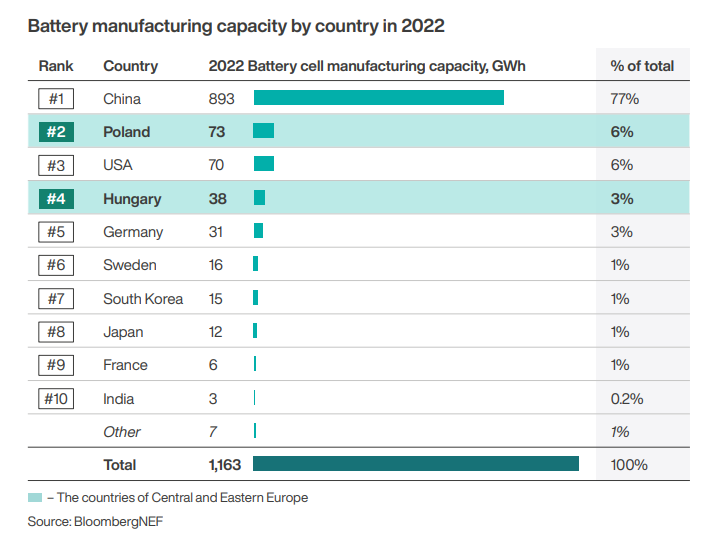
    [vc_section][vc_row][vc_column][distance desktop_type=”30″][lvs][distance desktop_type=”30″][vc_btn title=”Source – notesfrompoland.com” color=”sky” i_type=”material” i_icon_material=”vc-material vc-material-perm_device_information” add_icon=”true” link=”url:https%3A%2F%2Fnotesfrompoland.com%2F2023%2F04%2F06%2Fpoland-overtakes-us-to-have-worlds-second-largest-lithium-ion-battery-production-capacity%2F%23%3A~%3Atext%3DEastern%2520Europe%2520Newsletter-%2CPoland%2520overtakes%2520US%2520to%2520have%2520world’s%2Clithium%252Dion%2520battery%2520production%2520capacity%26text%3DAfter%2520a%2520series%2520of%2520investments%2Cthe%2520world%252C%2520behind%2520only%2520China.|target:_blank”][distance desktop_type=”30″][vc_column_text]After a series of investments in lithium-ion battery manufacturing, Poland’s production capacity rose to 73 GWh in 2022, overtaking the US to become the second largest in the world, behind only China.

    Poland now has 6% of the world’s total production capacity, compared to 14% of all European countries combined, notes the Polish Alternative Fuels Association (PSPA) in a report published this week based on data from BloombergNEF. They are, however, well behind China, which has 77% of global capacity.

    Source: Europe runs on Polish lithium-ion batteries, Polish Alternative Fuels Association

    However, the PSPA warns that, with fierce competition in the sector, Poland is set to fall to sixth place in global manufacturing by 2027 as other countries invest in producing the rechargeable lithium-ion battery that power electric vehicles.

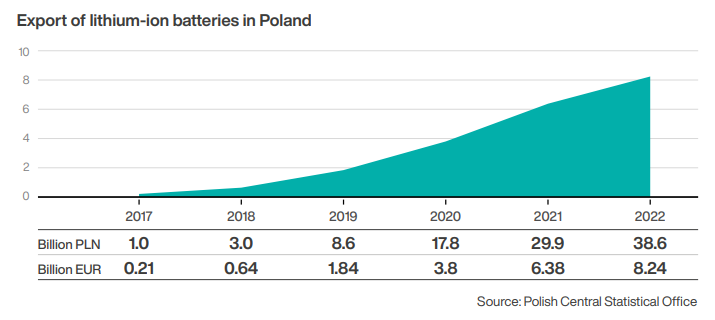
    Recent years have shown, nevertheless, that the sector’s growth in Poland is robust. The value of exports in the battery sector increased 38-fold over the last six years from around 1 billion zloty (€0.21 billion) in 2017 to 38.6 billion zloty (€8.24 billion) in 2022.

    That meant it accounted for 2.4% of all Polish exports, according to data from Statistics Poland (GUS), a state agency.

    Source: Europe runs on Polish lithium-ion batteries, Polish Alternative Fuels Association

    This growth has been achieved thanks to the major investments by foreign companies that have decided to open factories focused on batteries or electromobility in Poland.

    Poland is currently home to the largest car battery factory in Europe, launched by LG Energy Solution in Biskupice Podgórne near Wrocław, and Europe’s largest factory for energy storage systems, launched by Swedish battery manufacturer Northvolt in Gdańsk.

    Other leading companies in the battery sector investing in Poland include Korean SK Nexilis and German Mercedes-Benz. Poland is also Europe’s largest exporter of electric buses.

    As well as manufacturing sites, companies have started to open technology centres in Poland focused on developing electromobility, with Swedish car manufacturer Volvo announcing a new technology hub in Kraków last month.

    According to PSPA, in order to further strengthen the potential of the battery sector in Poland and the region action is needed in three areas: increasing domestic capacity for the necessary raw materials to produce cells and battery components; developing qualified human resources; and increasing innovation in the supply chain.

    The report shows, however, that strengthening the European value chain for lithium is currently a major challenge.

    While Europe has significant lithium resources, “many commercial mining operations are still in the pipeline, including in the Czech Republic, Serbia and Romania”, said Aleksander Rajch of PSPA, one of the report’s co-authors, quoted by the Polish Press Agency (PAP).

    According to Polish Geological Institute (PIG), however, there is “no prospect of finding” lithium reserves in Poland.

    “In order to accelerate the launch of new mining and processing capacities of battery sector raw materials in Poland, it is necessary to simplify administrative procedures,” said Rajch.

    “It is also important to implement incentives for the development of battery reuse and recycling technologies in order to create a closed cycle of production, operation and disposal,” he added.


    Main image credit: LG Energy Solution press pack[/vc_column_text][distance desktop_type=”30″][/vc_column][/vc_row][/vc_section]
  • Czechia-Poland dispute over coal mine settled, but locals still suffer

    Czechia-Poland dispute over coal mine settled, but locals still suffer

    [vc_section][vc_row][vc_column][distance desktop_type=”30″][lvs][distance desktop_type=”30″][vc_btn title=”Source – Euractiv” color=”sky” i_type=”material” i_icon_material=”vc-material vc-material-perm_device_information” add_icon=”true” link=”url:https%3A%2F%2Fwww.euractiv.com%2Fsection%2Fpolitics%2Fnews%2Fczechia-poland-dispute-over-coal-mine-settled-but-locals-still-suffer%2F|target:_blank”][distance desktop_type=”30″][vc_column_text]Czech and Polish political heads have settled the dispute over the coal mine Turow, but inhabitants of villages near the open-pit mine still face problems, EURACTIV.cz reports.

    Czechia and Poland officially settled the long-term dispute by signing an agreement in February 2022. Part of this agreement was the withdrawal of the lawsuit Czechia filed against Poland in reaction to Polish authorities’ decision to expand operations at the massive lignite mine close to the Czech border.

    The issue was politically resolved, even from the point of view of Czech President Petr Pavel, who recently visited Poland.

    “Both sides commented on the dispute over the Turów mine in the sense that it is closed,” the presidential office told EURACTIV.cz.

    The agreement included the construction of an underground barrier, completed in February 2022, which should protect local water sources. However, Czech organisations do not consider the agreement or the constructed barrier as a solution because it does not work well in practice.

    Czech Geological Service, responsible for monitoring the impact of the mine, confirmed to EURACTIV.cz that the barrier had brought no positive effects to the Czech territory so far.

    Another problem is a lack of information. While the agreement should secure Czech authorities access to data about the Turów mine, including its impact on water levels, not all information is available.

    “The problem is that some of the information, the key ones, Poland has labelled as ‘trade secrets’ and banned their publication. Thus, the Czech Environment Ministry refuses to give us this information,” Milan Starec from the local organisation Association Uhelná explained.

    Greenpeace has a similar opinion. “The excuses of trade secrets or even intellectual property are absolutely absurd,” said Greenpeace Czech Republic spokesperson Lukáš Hrábek, adding that local people and environmental organisations are not asking about the economic aspects of coal mining.

    “In this case, the ministry is more friends with the Polish mining company than its own citizens, whom it should be protecting. It’s shameful,” Hrábek added.

    The Czech Environment Ministry told EURACTIV.cz it disagrees with the criticism. The Ministry admits that it cannot publish some of the information demanded; however, it publishes all the information that Czech law allows to be disclosed.

    (Barbora Pištorová, Aneta Zachová | EURACTIV.cz)[/vc_column_text][distance desktop_type=”30″][/vc_column][/vc_row][/vc_section]

  • Polish coal miners protest EU methane reduction regulations

    Polish coal miners protest EU methane reduction regulations

    [vc_section][vc_row][vc_column][distance desktop_type=”30″][lvs][distance desktop_type=”30″][vc_btn title=”Source – apnews” color=”sky” i_type=”material” i_icon_material=”vc-material vc-material-perm_device_information” add_icon=”true” link=”url:https%3A%2F%2Fapnews.com%2Farticle%2Fcoal-miners-poland-protest-eu-4b4d7eb67a66fb393c8bdb14a852430c|target:_blank”][distance desktop_type=”30″][vc_column_text]

    WARSAW, Poland (AP) — Polish coal miners angered by a European Union directive aiming to reduce methane emissions protested noisily Friday before the EU office in Warsaw saying it will deprive them of their jobs.

    Some 300 miners chanted “Thieves” and used smoke flares and sirens to draw attention to their protest in the downtown area of Poland’s capital. Traffic was temporarily closed in the area.

    Protesting miners from the Solidarity 80 union said recent climate recommendations for the 27-member EU that call for a significant reduction of methane, starting in 2027, would force most of the nation’s mines to close, with the loss of tens of thousands of jobs.

    The majority of Poland’s mines have a high presence of methane gas that gets released in the coal extraction process. That also leads to serious mining accidents as methane becomes explosive when mixed in low proportions with oxygen.

    Located in the southern Silesia region, the coal mines are among Poland’s major employers, offering some 77,000 jobs in the nation of 38 million.

    [/vc_column_text][distance desktop_type=”30″][/vc_column][/vc_row][/vc_section]

  • Sinkholes sow fear in former Polish mining town

    Sinkholes sow fear in former Polish mining town

    [vc_section][vc_row][vc_column][distance desktop_type=”30″][lvs][distance desktop_type=”30″][vc_btn title=”Source – the Peninsula” color=”sky” i_type=”material” i_icon_material=”vc-material vc-material-perm_device_information” add_icon=”true” link=”url:https%3A%2F%2Fthepeninsulaqatar.com%2Farticle%2F15%2F02%2F2023%2Fsinkholes-sow-fear-in-former-polish-mining-town|target:_blank”][distance desktop_type=”30″][vc_column_text]Photo by Wojtek RADWANSKI / AFP

    Kazakhstan ranks 108th out of 139 countries in terms of energy intensity of GDP, with its most energy-intensive sector being the mining industry. As the demand for solid minerals grows worldwide, experts predict a further increase in the energy intensity of metal production. This presents an opportunity for the country to capitalize on renewable energy sources (RES), as the mining industry turns to greener energy solutions.

    During the 13th MINEX Kazakhstan Mining and Exploration Forum, environmentalist Elena Borovikova highlighted the potential for alternative energy development in the mining industry. The use of wind, solar, and biomass energy is on the rise, along with emerging green hydrogen projects. The mining industry, being one of the most energy-intensive sectors, can greatly benefit from adopting renewable energy sources.

    Gold production is the most energy-intensive industry, with the highest greenhouse gas emissions per million tons produced. In 2017, over 3.5 tons of gold were produced globally, requiring approximately 250 terawatts of energy and resulting in about 75 million tons of carbon dioxide equivalent emissions. Switching to renewable energy sources can significantly reduce direct and energy emissions from production.

    There are already successful examples of alternative energy development in the global mining industry. Centamin’s Egyptian Sukari mine reduced its direct emissions by commissioning a 26-megawatt solar power plant with a battery system in 2022, saving 70,000 litres of diesel fuel per day. Similarly, Polyus Gold International managed to reduce its energy emissions by almost 100% by switching to hydroelectric power supplied by Russian companies.

    Renewable energy use in mining projects has grown significantly since 2015, with most of the projects launched in 2018-2019 being hybrid, combining solar and wind energy with batteries. Kazakhstan has substantial potential for renewable energy development, with 130 alternative energy facilities already operating in the country by the end of 2022, boasting an installed capacity of 2,400 megawatts.

    The renewable energy sector’s growth will lead to increased demand for metals such as copper, lithium, nickel, and neodymium, which are essential for creating solar and storage batteries and wind turbines. This provides additional opportunities for Kazakhstan, a country rich in mineral resources.

    In 2022, Kazakhstan generated 112.8 billion kWh of electricity, with 4.5 billion kWh coming from renewable energy facilities. The country’s government aims to increase the share of renewable energy in total electricity generation to 5% in 2023. As part of its commitment to achieving carbon neutrality by 2060, Kazakhstan is also considering building a nuclear power plant.

    Kazakhstan has all the prerequisites for developing nuclear power plants, such as significant uranium reserves, processing products, and a strong scientific base. The country is also focusing on cooperation with Total, Masdar, and ACWA Power for implementing joint investment projects in renewable energy.

    By embracing the green economy and focusing on renewable energy, Kazakhstan’s mining industry can greatly benefit from reduced emissions, cost savings, and sustainable growth. This shift will also contribute to the country’s commitment to achieving carbon neutrality by 2060, ensuring a cleaner and more prosperous future for all.[/vc_column_text][distance desktop_type=”30″][/vc_column][/vc_row][/vc_section]

  • Ukraine was poised to become an important rare earths exporter. Then came the invasion

    Ukraine was poised to become an important rare earths exporter. Then came the invasion

    [vc_section][vc_row][vc_column][distance desktop_type=”30″][lvs][distance desktop_type=”30″][vc_btn title=”Source – Coda Story” color=”sky” i_type=”material” i_icon_material=”vc-material vc-material-perm_device_information” add_icon=”true” link=”url:https%3A%2F%2Fwww.codastory.com%2Fwaronscience%2Fukraine-lithium-export%2F|target:_blank”][distance desktop_type=”30″][vc_column_text]Before Russia invaded Ukraine in February 2022, Ukraine, home to approximately 500,000 tons of high-quality lithium and vast quantities of rare earth elements, was poised to be a key player in the global transition to green technology. But as Russia has seized territory in Ukraine’s east and south, the future of the country’s critical raw materials has been thrown into question.

    Even before the war, Ukraine was at least 10 years away from reaping the financial rewards for some of its in-demand raw materials, vital ingredients in many products from iPhones to fighter jets. Most rare earths are, in fact, not all that rare. But extracting and purifying the lightweight elements is expensive, dangerous and environmentally damaging. Almost all of Ukraine’s critical materials and rare earths can be easily found elsewhere. International investors might seek less risky alternatives.

    As the war grinds into its second year, the European Union, the United States and other Western powers are making strategic investments around the world to diversify away from their dependence on Chinese and Russia-sourced critical raw materials — investments that will translate into mines and infrastructure in places other than Ukraine and greatly undermine Ukraine’s ability in the future to compete in the critical raw materials market.

    “Most of the foreign natural resource development is probably off the table,” said Chris Berry, an analyst on critical raw materials at House Mountain Partners in Washington, D.C. Even after the war, investor confidence is likely to be deeply shaken. The demining process alone will take approximately ten years according to Ukrainian officials. Russia has contaminated vast swathes of territory with landmines and other unexploded ordnance.

    The total value of Ukraine’s deposits is believed to be astronomical, a prospective loss to add to the estimated $138 billion worth of damage caused so far by Russian strikes on Ukrainian infrastructure.

    Ukraine and the European Commission had signed a strategic partnership agreement on raw materials in 2021, heralded as a significant step forward for Ukraine in the renewables space. It was an accord that also boosted the confidence of foreign mining companies moving to secure Ukrainian exploration permits, the first step in the mining process.

    The Ukrainian government has not publicly announced how many lithium fields and promising areas are now under Russian occupation. Before the invasion, no lithium was being extracted from Ukraine. But several licenses were in various stages of development, including the Shevchenkivske field in the Donetsk region, the Kruta Balka block in the Zaporizhzhia region and the Dobra block and the Polokhivske field in the Kirovohrad region. Both the Shevchenkivske field and the Kruta Balka have danced along the war’s ever-moving frontlines.

    Despite this, Ukrainian officials have presented an image of a stalwart critical materials partner to the EU, and last month Ukraine and the EU reaffirmed the strategic importance of their alliance. In December, Ukraine’s parliament passed mining reform legislation to increase the attraction of the country’s extraction industries.

    The invasion coincided with the EU’s quest to seek alternatives from China in order to meet its ambitious goal of achieving carbon neutrality by 2050. The pandemic established the need to move away from single suppliers like China, while the Ukraine invasion underscored the geopolitical vulnerabilities for Europe that exist close to home.

    China supplies Brussels with 98% of the EU’s supply of rare earth elements. It’s a supply chain that Olivia Lazard, a fellow at the Carnegie Endowment for International Peace, said needs to be reviewed.

    In fact, the issue of raw materials tops Brussels’ political agenda. Last September, the president of the European Commission, Ursula von der Leyen, announced the European Critical Raw Materials Act. “Lithium and rare earths are already replacing gas and oil at the heart of our economy,” said von der Leyen in a speech, adding that Europe has to “avoid falling into the same dependency as with oil and gas.”

    While Europe has been moving away from reliance on Russian oil and gas, Russia continues to hold many of the essential elements for the West’s green transition. Russia accounts for approximately 7% of the global supply of nickel, a vital ingredient in solar panels. It is also a leader in the global supply of aluminum, palladium, potash and vanadium. The EU imports approximately $7.4 billion a year in Russian raw materials.

    Russian metals and minerals have escaped the same kind of scrutiny that oil and gas exports have encountered. Norilsk Nickel, the world’s largest producer of palladium and high-grade nickel, owned by the Putin-supporting oligarch Vladimir Potanin, has not come under Western sanctions. Russian nickel exports to the U.S. and the EU actually saw a boost in 2022. “If you look into the sanctions, you will see that the EU has been more cautious on certain types,” said Vasileios Rizos, the head of sustainable resources and circular economy at CEPS, a think tank. “The whole raw materials agenda comes from a more strategic perspective at the EU level.”

    In 2020, Russia pledged $1.5 billion for mining rare earth minerals with the goal of becoming the biggest producer after China. Capturing raw materials on Ukrainian land will redound to Russia’s benefits, allowing the Kremlin to keep the materials off world markets.

    Russia’s Wagner paramilitary group is believed to collect raw material deposits to shore up its finances. “This tells us something about the nature of the Russian approach now regarding security and defense,” said Lazard, the Carnegie fellow. “Geology is now an asset and geological exploration is a competency to wield in the global geopolitical competition.”[/vc_column_text][distance desktop_type=”30″][/vc_column][/vc_row][/vc_section]
  • Lithium Mines In Europe? A New World Of Supply-Chain Sovereignty

    Lithium Mines In Europe? A New World Of Supply-Chain Sovereignty

    [vc_section][vc_row][vc_column][distance desktop_type=”30″][lvs][distance desktop_type=”30″][vc_btn title=”Source – World Crunch” color=”sky” i_type=”material” i_icon_material=”vc-material vc-material-perm_device_information” add_icon=”true” link=”url:https%3A%2F%2Fworldcrunch.com%2Fbusiness-finance%2Flithium-mines-in-europe%23toggle-gdpr|target:_blank”][distance desktop_type=”30″][vc_column_text]It is one of the great paradoxes of our time: in order to overcome some of our dependencies and vulnerabilities — revealed in crises like COVID and the war in Ukraine — we risk falling into other dependencies that are no less toxic. The ecological transition, the digitalization of our economy, or increased defense needs, all pose risks to our supply of strategic minerals.

    The European Commission published a plan this week to escape this fate by setting realistic objectives within a relatively short time frame, by the end of this decade.

    This plan goes against the dogmas of globalization of the past 30 or 40 years, which relied on just-in-time supply chains from one end of the planet to the other — and, if we’re being honest, outsourced the least “clean” tasks, such as mining or refining minerals, to countries in the developing world.

    But the pendulum is now swinging in the other direction, if possible under better environmental and social conditions. Will Europe be able to achieve these objectives while remaining within the bounds of both the ecological and digital transitions? That is the challenge.

    EV batteries

    The plan presented Thursday in Brussels lists these critical or strategic minerals, which are found in so-called clean technologies, such as electric vehicle batteries or solar panels, but also in satellites, computer equipment, or weapons. Demand is only growing: for example, lithium for electric vehicle batteries is expected to be multiplied by 12 by 2030, and the rare earths needed for wind turbines are expected to be multiplied by four or five.

    The EU is asking its member states, in order to ensure the sovereignty of the continent, to plan to extract 10% of the needs from European soil by 2030. A lithium mine project is planned in France, after years of the country having abandoned any mining ambitions.

    It is also asking for 15% of needs to be met through recycling, a rapidly growing and virtuous sector. Another objective is to limit the share of a single third country in the supply of a critical mineral to 65%, so as not to end up, as in the case of Russian gas, in the hands of a single supplier.

    Caught between U.S. and China

    We can truly question the ability of the 27 EU countries to succeed in both transitioning their model, creating new supply chains, reintroducing sectors of activity that Europe had turned its back on, and protecting their sovereignty. This is a dizzying challenge.

    China has monopolized a good part of the mining resources in Africa and Latin America.

    This notably involves the relationships that Europe will be able to build with the countries producing these minerals, because the current situation is problematic. First, because China has increasingly monopolized a good part of the mining resources in Africa and Latin America, with a real vision that the West did not have. China has also been willing to pay the price for the degradation of its environment, for example, to exploit rare earths that the rest of the world no longer wanted.

    Europe has faced multiple major challenges in recent months, such as the future plans for electric vehicle batteries plan or semiconductors. Caught between the attractiveness of the United States with their cheaper energy and generous subsidies, and the hegemonic risk posed by China, Europe is also betting on the future in a real way.

    [/vc_column_text][distance desktop_type=”30″][/vc_column][/vc_row][/vc_section]
  • Ukraine’s coal miners dig deep to power a nation at war

    Ukraine’s coal miners dig deep to power a nation at war

    [vc_row][vc_column][/vc_column][/vc_row][vc_row][vc_column][lvs][distance desktop_type=”30″][vc_column_text]

    Deep underground in southeastern Ukraine, miners work around the clock extracting coal to power the country’s war effort and provide civilians with light and heat.

    Coal is central to meeting Ukraine’s energy needs following the Russian military’s campaign to destroy power stations and other infrastructure, the chief engineer of a mining company in Dnipropetrovsk province said.

    Elevators carry the company’s workers underground to the depths of the mine. From there, they operate heavy machinery that digs out the coal and moves it above ground. It is hard work, the miners say, but essential to keep the country going.

    “Today, the country’s energy independence is more than a priority,” said Oleksandr, the chief engineer, who, like all the coal miners interviewed, spoke on the condition of giving only his first name for security reasons.

    Russia’s attacks on Ukraine’s nuclear, thermal and other power stations continue to disrupt electricity service as the war grinds on for a second year.

    Before the war, the Ukrainian government planned to reduce the country’s reliance on coal-fired power stations, which contribute to global warming, and to increase nuclear energy and natural gas production. But when Russian attacks damaged thermal plants in the middle of winter, it was coal that helped keep Ukrainian homes warm, Oleksandr said.

    The work of the coal miners cannot fully compensate for the loss of energy from nuclear power plants, but every megawatt they had a role in generating reduced gaps.

    While many miners from the area joined the armed forces when Russian troops invaded and are now fighting at the front in eastern Ukraine, nearly 150 displaced workers from other coal-producing regions in the east joined the team in Dnipropetrovsk.

    A man named Yurii left the embattled Donetsk province town of Vuhledar, where he worked as a coal miner for 20 years. “The war, of course, radically changed my life,” he said. “It is now impossible to live there and the mine where I used to work.”

    “Life begins from scratch,” he said.[/vc_column_text][/vc_column][/vc_row]