Website: Eurasia.com

  • C5+1 Dialogue on Critical Minerals with Kazakhstan, Kyrgyzstan, Tajikistan, Turkmenistan and Uzbekistan

    C5+1 Dialogue on Critical Minerals with Kazakhstan, Kyrgyzstan, Tajikistan, Turkmenistan and Uzbekistan

    Following the largest mining conference in Africa, Mining Indaba, where Under Secretary for Economic Growth, Energy, and the Environment Jose W. Fernandez advanced cooperation on securing and strengthening critical mineral supply chains, he chaired the C5+1 discussion on goals and objectives of the CMD, which will seek to increase the region’s involvement in global critical minerals supply chains, strengthen economic cooperation, and advance the clean energy transition, while also protecting Central Asia’s unique ecosystems.

    Assistant Secretary of State for Energy Resources Geoffrey Pyatt moderated the event, accompanied by Deputy Assistant Secretary of State for Central Asian Affairs John Mark Pommersheim and colleagues from across the U.S. government who work on critical minerals. Senior officials from each of the Central Asian governments shared their interest in developing investment opportunities in critical minerals that meet the highest environmental, and social standards, and governance.

    In the spirit of C5+1 collaboration, each country underscored the benefit of working together to advance our shared critical minerals objectives including diversification of markets and development of technologies in a manner that will benefit all our citizens. Among the initiatives discussed, the United States emphasized opportunities through the Minerals Security Partnership and Partnership for Global Infrastructure and Investment. In the lead-up to the mining and exploration convention in Toronto, Canada, called Prospectors & Developers Association of Canada (PDAC), the United States welcomed input from the C5 countries to promote new partnerships and investment opportunities and efforts to continue the dialogue through national coordinators within the C5+1 framework.

    Learn more about C5+1 collaboration at: https://www.whitehouse.gov/briefing-room/statements-releases/2023/09/21/c51-leaders-joint-statement/ .

    Learn more about the Minerals Security Partnership at: https://www.state.gov/minerals-securit-partnership/.  

    To stay up to date, follow Under Secretary Fernandez on X: @State_E, LinkedIn: @State-E, and Facebook: @StateDeptE.

    For press inquiries, please contact E_Communications@state.gov.


    In March, as part of a working trip, Kanat Sharlapayev, the Minister of Industry and Infrastructure Development of the Republic of Kazakhstan will visit the PDAC (Prospectors & Developers Association of Canada) in Toronto, where meetings focused on the development of critical minerals will take place.
  • Polymetal takes part in the Syrymbet tin project

    Polymetal takes part in the Syrymbet tin project

    Polymetal is exploring the reserves of the Syrymbet tin deposit together with Tin One Mining, which holds the subsoil license for this site. The publication on inbusiness.kz reported that mining companies are strengthening cooperation.

    Tin One Mining and Polymetal specialists need to select options on how to optimize the existing technological scheme for processing the deposit’s tin ores. According to representatives of the gold mining company in response to a media request, the parties have been cooperating in this direction for more than one year.

    Polymetal may potentially acquire a share in the project in the future. Incidentally, it was precisely the issue of studying the properties of ore, the lack of suitable competencies and solutions, that at one time slowed down the development of Syrymbet.

    Proposals to develop the site first came in the late 1990s, and tin mining began only in 2021. The mining and metallurgical plant at Kazakhstan’s largest tin deposit was planned to be launched by 2025, according to Tin One Mining’s management.

    During a recent conference call with investors, held, the head of Polymetal, Vitaly Nesis, said that in the future the company may be interested in Kazakh deposits of copper, tin, lead, and zinc.

  • The Lomonosovskoye iron ore deposit will be launched in 2025

    The Lomonosovskoye iron ore deposit will be launched in 2025

    “Lomonosovskoye”, which owns the license for the similarly named iron ore deposit in the Kostanay region, will start its industrial operation in 2025. The company’s mining plan is published on the Unified Environmental Portal of Kazakhstan. Public hearings on the project will take place in early March 2024.

    The mining area belongs to a large mining region of the republic. Sarbay and Sokolovskoye deposits, Sokolovsky underground mine are located 10-20 km southeast of Lomonosovskoye, and 30 km north of it is the Kacharsky quarry.

    The company plans to conduct open-pit mining at Lomonosovskoye for 22 years. During the first five years of quarry operation, work will only be carried out in the central area. Due to the fact that the deposit is located at significant depth, in 2025-2026, the subsoil user will only engage in overburden operations without concurrent extraction.

    By the fourth year of operation, the enterprise will reach an annual ore extraction volume of 7 million tons. After the north-western part of the quarry is put into operation, the project capacity will increase to 16 million tons of iron ore per year. It is planned to maintain production at this level from the eighth to the 21st year of Lomonosovskoye’s operation.

    The project documentation of  “Lomonosovskoye” does not indicate the reserves of the deposit. Most likely, the raw materials will be processed at the company’s own ore processing plant.

  • Qarmet must return to the status of one of the leaders in metallurgy in the CIS

    Qarmet must return to the status of one of the leaders in metallurgy in the CIS

    President Kassym-Jomart Tokayev ordered the production of high-tech steel grades for the automotive industry and other industries, LS reports.

    The head of state recalled that the Karaganda plant (Qarmet) was transferred to the national investor on the terms of a comprehensive modernization of the enterprise. And to ensure uninterrupted operation of the plant and prevent accidents, it is necessary to restore the mines as soon as possible, strengthen industrial safety, and update the material and technical base. The president also added that large-scale investments are needed in the creation of new industries and the production of goods with high added value.

    “It is necessary to establish the production of high-tech steel grades for the automotive industry and other industries. Over the next five years, the enterprise must significantly increase production and regain the status of one of the leaders in metallurgy in the CIS,” Tokayev instructed.

    During his speech, the head of state also listed a list of promising areas that should be paid attention to: road and construction equipment, equipment for the energy sector, reclamation systems, finished metal products.

    “If such production is not created in Kazakhstan now, then the total import of equipment will become chronic. Therefore, it is important that industrial policy is consistent with plans to modernize infrastructure and develop the mineral resources complex. The domestic automotive industry has made some progress here,” the president noted.

    Tokayev emphasized that now it is necessary to consistently move to a more complex level of car assembly. He noted that it is necessary to strengthen other promising sectors of the manufacturing industry.

    “At the same time, business should be oriented towards the fact that after our market is saturated, it will have to export. This will be an indicator of the high competitiveness of domestic entrepreneurs,” Tokayev added.

    He noted that in general it is necessary to give a new impetus to the industrial development of the country. And for this, the head of state recalled, a separate ministry was created last year.

    “Enough time has passed; it’s time to show concrete results. The ministry should develop guidelines for the industry and investors. Specific measures and approaches that would stimulate investment in new high-tech production have not yet been developed,” the president emphasized.

    According to the head of state, a list of breakthrough projects has been prepared, but requires thorough revision. Tokayev noted that these industries should change the structure of the economy, create a strong industrial framework and points of technological growth. However, the president noted that all this has not yet happened. In particular, funding sources have not been identified for many of the projects.

    At the same time, according to the president, large-scale and innovative projects that lay the foundation for economic growth for many years to come should receive priority state support.

    “We are talking about both the modernization of existing production facilities and the development of completely new industrial sectors for our country. The government will have to intensify a constructive dialogue with international financial institutions, transnational corporations and domestic businesses. In general, there must be answers to the questions of what the industrial appearance of Kazakhstan will be, which enterprises will play an important role tomorrow. We need to act proactively, in accordance with the requirements of the time,” Tokayev emphasized.

    In addition, the president separately focused on the modernization of existing production facilities. According to him, we should start with metallurgical plants, whose condition is at a low level.

    “The reason is known – the lack of investment in modernization and expansion of production. As a result, added value of products and quality jobs are lost. Strict control over maintaining the technical condition of enterprises is also extremely important. We have before our eyes a situation where an investor siphoned off profits, ignoring issues of enterprise modernization, ecology, and labor safety,” the president noted.

    At the same time, Tokayev recalled that he had repeatedly raised the issue of establishing strong medium-sized businesses in the industrial sector. However, he added, a systematic action plan was never developed. The head of state noted that there are no answers yet to questions about what the priorities should be and what support will be provided to entrepreneurs.

    “We have opportunities for the emergence of new advanced production facilities. For example, large oil and gas and mining and metallurgical companies must introduce technological innovations when developing subsoil, changing the structure of the national economy,” the president concluded.

  • Rolls-Royce snubbed for UK’s first private nuclear plant

    Rolls-Royce snubbed for UK’s first private nuclear plant

    Rolls-Royce Holdings PLC (LSE:RR.)’s mini-nuclear plans have seemingly suffered a setback with the UK’s first privately funded station to use reactors built by Westinghouse.

    The US group said it signed an agreement with Community Nuclear Power to install four AP300 small modular reactors (SMRs) at the North Teesside project to generate up to 1.5 gigawatts of power or enough for up to two million homes.

    Westinghouse added it hopes to have the first AP300 operating unit available in “the early 2030s”.

    “The advantageous economics of the AP300 SMR are based on robust analysis and existing project costs from AP1000 reactors already in operation or development on three continents,” it added.

    Mini-reactors or SMRs were a key plank of former prime minister Boris Johnson’s plans to rejuvenate Britain’s nuclear industry and hit his green energy targets.

    Through their modularised designs, SMRs can be assembled in factories rather than on-site and thus offer a cheaper and quicker way of providing carbon-free energy.

    Paul Foster, Community Nuclear Power’s chief executive, said: “This project brings together Westinghouse’s proven technology and mature supply chain with our depth of expertise in nuclear programme delivery, in a region that is transforming its industrial landscape.

    “We are delighted to be working with Westinghouse in support of private deployment in North Teesside,” he added.

    David Durham, Westinghouse president, Energy Systems added. “Our AP300 SMR is ideally suited not just to support grid generation, but also for industrial sites for generating clean and secure energy and the ability to produce hydrogen, e-fuels, desalination and district heating.”

    Lord Houchen, the mayor of Tees Valley, said one of the major issues it faced was the lack of policy clarity in the UK over SMRs.

    Although reportedly ahead of the competition, Rolls-Royce’s SMR is still said to be only mid-way through the UK approval process.

    The new power station is being entirely privately funded and will be sited at Seal Sands, a former chemical works.

  • EU, US to align global minerals push against China’s supply grip

    EU, US to align global minerals push against China’s supply grip

    The US and the European Union are in talks to merge a core area of their efforts to engage suppliers of critical minerals in resource-rich nations, seeking to streamline their push against China’s dominance in materials key for future technologies.

    The aim is to combine the EU’s high-level policy approach with the US focus on specific projects, according to people familiar with the discussions.

    Specifically, the move would merge the EU’s critical raw materials club concept with the Biden administration’s flagship Minerals Security Partnership. It comes after the EU delayed plans to launch its own program in Dubai last year at the COP 28 climate summit, said the people, who asked not to be identified describing internal policy discussions.

    The new initiative, known broadly as a “minerals security partnership forum,” would align outreach efforts to buyers in developed countries and resource-rich nations to cooperate on projects and policies, said the people.

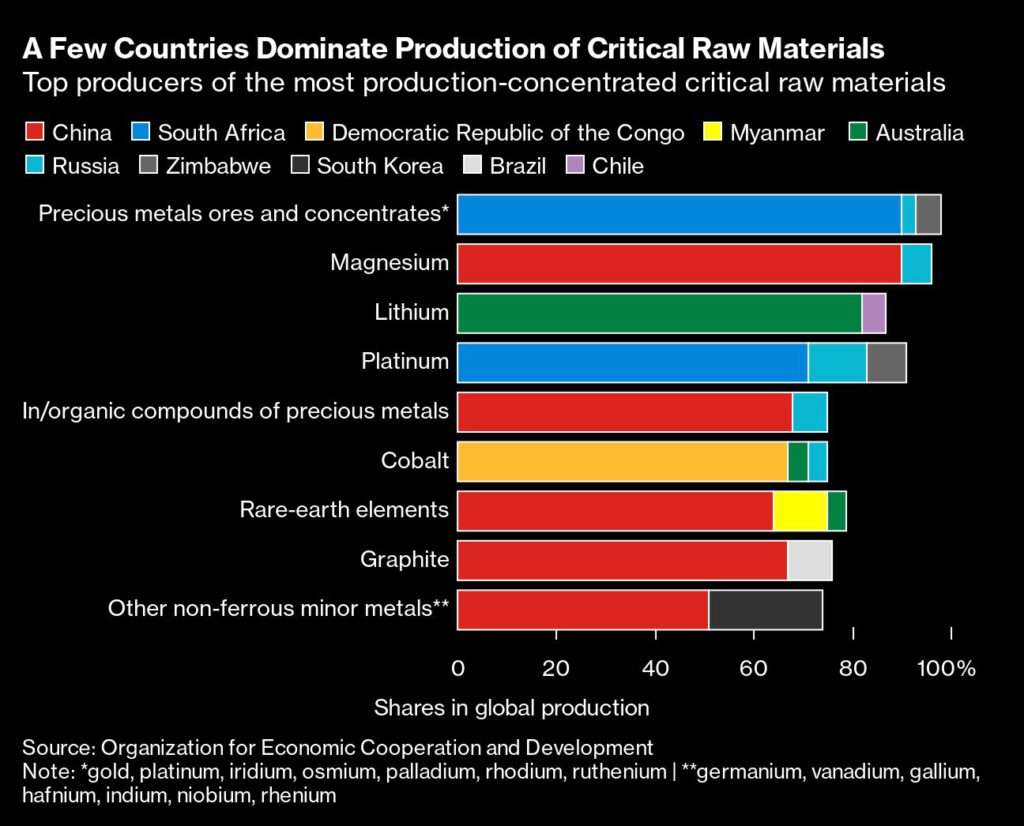
    As part of their broader economic security strategies, Washington and Brussels are seeking to counter China’s domination of the supply chain for so-called critical minerals, a broad term that includes inputs for electrical vehicles and other green energy technologies.

    Key to their combined efforts is working with resource-rich nations to develop standards on investment, trade, research and environmental issues that the US and EU see as an alternative to working with China.

    The allies, who’ve identified more than a dozen potential projects, have taken on a daunting challenge. The lengthy and expensive process of developing mining or refining projects means Beijing’s dominance will likely continue for decades. And US officials have conceded it’s impossible to fully replace China.

    US and EU officials aim to reach an agreement later this month and officially launch the project in March, according to one of the people. They will discuss the plan at the Munich Security Conference in Germany next week, said a separate person.

    The EU and the US are discussing how to optimize their efforts in fostering international cooperation on critical raw materials, Olof Gill, a spokesperson for the European Commission, said in a response to questions, adding that an important aspect of these talks is to find “the best synergies” between the EU’s critical raw materials club and other international activities.

    A US State Department official, who asked not to be identified discussing internal matters, said the two sides believe separate outreach plans to resource-rich nations duplicated efforts and risked creating confusion. They also want to ensure alignment on the broader goal of reducing the West’s dependence on China for the production and processing of many critical minerals like lithium, manganese and cobalt, and properly coordinate mobilizing state finances and private companies, the official said.

    The EU was already a part of the US-led minerals security partnership alongside Australia, Canada, Finland, France, Germany, India, Italy, Japan, South Korea, the UK and others, which aims to funnel foreign investment into the green energy sector.

    The EU has also signed its own minerals pacts with several countries, including the Democratic Republic of Congo, which supplies about 70% of the world’s supply of cobalt, and Zambia.

    As well, Central Asian members of the C5+1 group — which includes Kazakhstan, the Kyrgyz Republic, Tajikistan, Turkmenistan, and Uzbekistan — have also expressed interest in the minerals security partnership, the US State Department official said.

    Separate EU-US talks on a bilateral critical minerals agreement remain stalled over labor rights and concerns over the feasibility of adopting a trade pact in an election year.

    US officials, who have already struck a bilateral deal with Japan, have wanted to kick-start new mining and processing projects by acting as a bridge between private companies seeking raw materials and developing nations that have relied in recent years mainly on China for resource investments.

  • Uzbekistan is aiming to double exports to the EU countries by the end of 2024

    Uzbekistan is aiming to double exports to the EU countries by the end of 2024

    President Shavkat Mirziyoyev has publicly expressed his concern over the country’s export volumes in recent months, replacing Deputy Investment, Industry and Trade Minister Badriddin Abidov, and firing a slew of local officials in a bid to shake up the country’s economic order book. According to Mirziyoyev, Uzbekistan should be exporting around 30 percent more than it currently does,

    Despite Uzbekistan’s efforts in recent years to position itself as a leading player in sectors like energy, minerals and textile production, Tashkent is determined to do more, particularly given the volume of foreign shipments decreased in four regions and two major industries last year.

    One of the challenges lies in the fact that half of Uzbek exports go to just four countries: Russia, China, Kazakhstan, and Turkey – meaning the Central Asian nation is eager to diversify and find new partners. Uzbekistan joined the EU’s GSP+ preferential tariff arrangement in 2021, but exporters haven’t fully taken advantage of the range of goods covered by the scheme, according to the Uzbek government.

    OECD overview of Uzbekistan 

    In 2021, Uzbekistan was the number 76 economy in the world in terms of GDP (current US$), the number 81 in total exports, the number 78 in total imports, the number 165 economy in terms of GDP per capita (current US$) and the number 79 most complex economy according to the Economic Complexity Index (ECI) .

    During the last five reported years the exports of Uzbekistan have changed by $7.31B from $7.37B in 2016 to $14.7B in 2021. The most recent exports are led by Gold ($4.53B), Non-Retail Pure Cotton Yarn ($1.61B), Refined Copper ($741M), Petroleum Gas ($722M), and Radioactive Chemicals ($407M).

    The top imports of Uzbekistan are Packaged Medicaments ($1.04B), Motor vehicles; parts and accessories (8701 to 8705) ($1.01B), Cars ($656M), Refined Petroleum ($608M), and Wheat ($535M), importing mostly from China ($5.63B), Russia ($5.12B), Kazakhstan ($2.47B), South Korea ($1.92B), and Turkey ($1.87B).

    Another obstacle is the international certification of products, with less than 35% of enterprises in key industries meeting global standards.

    President Mirziyoyev has now set ambitious goals, aiming to increase export volume to EU countries to $1.2 billion and nearly doubling the number of product categories exported to the EU. The plan includes implementing 1,700 international standards and 19 regulations by the end of 2024, along with transitioning 1,200 enterprises to global quality standards.

    The Uzbek government is also looking to deepen its ties with China, with a view to becoming an export partner for Chinese firms. On a recent visit to China, which was a main focus of Uzbek media in recent weeks, President Mirziyoyev made a detour to Shenzhen to visit EV giant BYD, where joined the manufacturer’s CEO Wang Chuanfu in watching the launch of a BYD plant in Jizzakh. This comes with the right to export Uzbek-manufactured BYD vehicles in Central Asia.

    While some may view this as a welcome state focus on exports, others might interpret it as a sign that free-market reforms haven’t had the desired impact. As Uzbekistan strives to become an industrial, high-middle income country at a time of geopolitical insecurity its diversification of trade partners will be key. The scrutiny will be on its commitment to reforms and promotion of private-sector-led growth, as investors and entrepreneurs consider the country for potential partnerships and business opportunities.

  • Казахстан: гонка за критически важным сырьем и иностранными инвестициями ускоряется

    Казахстан: гонка за критически важным сырьем и иностранными инвестициями ускоряется

    Минеральные ресурсы Казахстана приобретают все большее значение в связи с ростом глобального спроса на руды и металлы.   Выступая 19 января 2024 года на круглом столе в Риме, президент Токаев призвал инвесторов рассматривать Казахстан как наиболее благоприятную инвестиционную юрисдикцию в Центральной Азии.

    Согласно оценкам, представленным на сайте администрации президента, Казахстан готов стать центральным инвестиционным хабом в Центральной Азии. В стране более чем 5000 неразведанных месторождений на сумму более 46 триллионов долларов США.  В стране производится 19 из 34 видов важнейшего сырья. Месторождения еще 9 металлов и материалов, таких как кобальт, вольфрам, литий и другие, могут быть использованы с условием привлечения необходимых инвестиций.

    Для сравнения: по состоянию на 2020 год природные ресурсы Соединенных Штатов оценивались в 45 триллионов долларов, значительную часть из которых составляли древесина и уголь. Саудовская Аравия обладает природными ресурсами на сумму 34,4 триллиона долларов, в большей части, нефтью.  Стоимость минеральных ресурсов страны была повышена до 2,5 триллиона долларов в январе 2024 года. Природные ресурсы Канады оцениваются в 33,2 триллиона долларов. Металлы в Канаде включают медь, свинец, никель и цинк, а также драгоценные металлы, такие как золото, платина и серебро. Природные ресурсы Австралии оцениваются в 19,9 триллиона долларов, включая уголь, древесину, медь, железную руду, золото и уран.

    Подробнее о 10 странах с наибольшим количеством природных ресурсов

    К 2029 году Казахстан планирует на 40% увеличить добычу полезных ископаемых

    5 февраля 2024 года был опубликован «Национальный план развития Республики Казахстан до 2029 года»

    Перед отраслью добычи металлов и прочих полезных ископаемых поставили задачу обеспечить 40%-ный прирост к концу десятилетия (т.е. 8% год). Выполнение поставленных задач необходимо решать в связке с такими ключевыми вызовами как: истощение текущей ресурсной базы и перспективы добычи новых материалов, снижение конкурентоспособности продукции, выраженное в высокой энергоемкости отрасли при предполагаемом дефиците энергии, росте стоимости труда при относительно низкой производительности и сложной логистике.

    Несмотря на наличие залежей, месторождений, готовых к освоению, недостаточно. Ожидается снижение добычи меди, хрома и железа. Не реализован потенциал по производству никеля, кобальта, лития и других редких металлов.

    Для решения этих проблем планируется:

    • Провести геолого-геофизические исследования на площади более 400 тыс. кв. км (сопоставимо с размерами Парагвая, Ирака или Узбекистана) и восполнить 20–50% запасов по критическим металлам.
    • Стимулировать геологоразведку за счет софинансирования, освобождения от НДС, амортизации 25% расходов.
    • Создать инфраструктуру для хранения и обработки геоматериалов, построив фондохранилище и кернохранилища.
    • Пересмотреть налоговую ставку для инвесторов, осваивающих техногенные минеральные образования.

    Предстоящие задачи и возможности их реализации с участием национальных и международных компаний будут обсуждаться на предстоящем форуме MINEX Kazakhstan в Астане!

    Для получения дополнительной информации перейдите на сайт форума: 2024.minexkazakhstan.com

  • Kazakhstan: a breakneck race for Critical Raw Materials and Foreign Investment is on!

    Kazakhstan: a breakneck race for Critical Raw Materials and Foreign Investment is on!

    Kazakhstan’s untapped mineral resources are becoming increasingly important due to the global demand for critical raw materials.  On 19 January 2024, president Tokaev participated in the investment meeting in Rome and urged investors to consider Kazakhstan as the most favourable investment jurisdiction in Central Asia.

    According to the estimates, presented on the President’s administration website with over 5,000 unexplored deposits valued at over $46 trillion, Kazakhstan is poised to become a central investment hub in Central Asia.  Currently, the country produces 19 out of 34 critical raw materials. Deposits for 9 more like cobalt, tungsten, lithium, and others can be exploited with the necessary investment.

    To put these figures into perspective, as of 2020 the United States’ natural resources were estimated at $45 trillion, with a significant portion being timber and coal. Saudi Arabia has $34.4 trillion worth of natural resources — notably oil.  The value of its mineral resources has been upgraded to $2.5 trillion in January 2024. Canada’s natural resources has an estimated $33.2 trillion worth of natural resources. Metals in Canada include copper, lead, nickel, and zinc, and precious metals like gold, platinum, and silver. Australia has an estimated $19.9 trillion in natural resources including coal, timber, copper, iron ore, gold, and uranium.

    Read more about 10 Countries with the Most Natural Resources

    By 2029, Kazakhstan plans to increase mineral resource production by 40%

    On 5 February 2024, the Government published the National Development Plan of the Republic of Kazakhstan until 2029.

    Kazakhstan aims to increase mineral production by 40% by 2029 according to its new National Development Plan. However, the mining industry faces challenges like resource depletion, decreasing competitiveness due to high energy intensity, rising labour costs, and complex logistics.

    Despite having mineral deposits, there is a shortage of fields ready for development. Production of copper, chromium, and iron is expected to decline, while the potential for nickel, cobalt, lithium, and other rare metals remains untapped.

    To address these issues, Kazakhstan’s government plans to:

    • Conduct geological and geophysical exploration over 400,000 square kilometres (comparable to the size of Paraguay, Iraq, or Uzbekistan) and replace 20–50% of reserves for critical metals.
    • Encourage geological exploration through co-financing, VAT exemption, and 25% depreciation of expenses.
    • Establish infrastructure for the storage and processing of geomaterials by constructing a storage facility and core storage facilities.
    • Reconsider the tax rate for investors developing man-made mineral formations.

    These challenges and opportunities will be discussed at the upcoming MINEX Kazakhstan Forum in Astana, with the participation of national and international companies.

    For more information and registration details, participants are encouraged to visit the official website: https://2024.minexkazakhstan.com/

  • European Lithium poised to become key player in production on the continent

    European Lithium poised to become key player in production on the continent

    European Lithium Ltd  is gaining traction in the lithium and rare earth sectors in its namesake target market, says Martin Place Securities, with a series of strategic initiatives placing it on a growth trajectory.

    The key drivers of this growth include the company’s Wolfsberg Lithium Project, a diverse portfolio that spans across Europe, and a listing on the Nasdaq.

    The company’s market capitalisation, as of January 30, stands at A$117 million.

    Revaluation due

    In its appraisal, Martin Place Securities suggests that the company’s stock is currently trading below its see-through asset backing of around A$0.80, indicating room for a substantial market revaluation.

    The report sets a value target of A$0.58 per share for European Lithium Ltd by the end of 2025.

    Martin Place Securities sees European Lithium as uniquely positioned to play a significant role in the European Union’s clean energy transition, especially with the EU’s target to phase in electric vehicles by 2035.

    The company’s diversified portfolio, strategic partnerships and involvement in critical mineral projects such as the Wolfsberg Lithium Project and the Tanbreez REE deposit, place it at the forefront of an industry poised for growth.

    Nasdaq milestone

    European Lithium’s flagship asset, the Wolfsberg lithium spodumene mining project, is slated for a Nasdaq listing, which is expected to impart a fully diluted value of A$0.61 per share, considerably enhancing the company’s market presence.

    The project, situated in Austria with a production capacity of 8.8ktpa LHM, is poised to become the first European Union producer of battery-grade lithium.

    A March 2023 definitive feasibility study (DFS) pointed to a net present value (NPV) of US$1,504 million, bolstered by high lithium hydroxide (LiOH) prices.

    “Wolfsberg would be one of the first operating lithium mines in Europe where EU regulations for the energy transition call for growing a major lithium industry to assist in the phasing in of electric vehicles there by 2035,” the report said.

    “BMW, recognising the need for security of supply, has entered into an offtake agreement with a US$15 million prepayment for all of the Wolfsberg Zone 1 output for its own battery manufacturing centre in Germany.”

    The company also has plans to access the largest lithium resource in Ukraine, which is also potentially one of Europe’s largest hard rock lithium resources.

    The report suggests that, following a resolution to the conflict in that country, an EU-Ukraine strategic partnership on critical raw materials could sponsor this development of the Shevchenkivske and Dobra deposits.

    Growth prospects in Austria and Ukraine

    The company is actively exploring additional lithium resource projects in Austria and is advancing towards acquiring significant lithium deposits in Ukraine.

    These ventures represent a strategic expansion and diversification of the company’s lithium asset portfolio.

    The lithium sector is showing signs of bottoming out, indicating a potential upswing that could benefit European Lithium’s strategic investments and market position.

    World’s largest REE deposit

    Along with its lithium exposure, European Lithium Ltd (ASX:EUR, OTCQB:EULIF) holds a 7.5% stake in the Tanbreez deposit in Greenland, touted as the world’s largest rare earth element (REE) deposit.

    The involvement in the Tanbreez REE deposit underscores European Lithium’s commitment to diversifying its portfolio in the critical minerals sector, aligning well with global trends and demands.

    This investment could yield a pass-through value potential of more than A$0.20 per European Lithium share, further enhancing the company’s asset base.

    The company is likely to target a Nasdaq listing for Tanbreez in 2025 to fund its development.