A planned antimony mining project in the Kriva Palanka region of eastern North Macedonia has rapidly evolved from a local planning dispute into a matter of national and geopolitical significance, after a €5 million US-backed financing agreement thrust the country’s critical minerals potential into the international spotlight.
The funding deal, signed at the headquarters of the US International Development Finance Corporation, involves Pela Global Limited, a company already active in North Macedonia focused on gold, silver and antimony exploration near the Krstov Dol sites and the village of Luke. For the Macedonian government, the agreement represents an opportunity to position the country within the emerging global critical minerals supply chain and deepen integration with European and transatlantic structures. Antimony — used in flame retardants, batteries and a range of high-technology applications — has attracted growing strategic interest as Western governments seek to diversify supply away from China.
But on the ground in Kriva Palanka, the picture is more complex. Community reactions are divided along familiar lines. Some residents are demanding clarity on what will be mined, how extraction will proceed and what environmental safeguards will apply, with concerns about water contamination, air quality and long-term land degradation prominent in local debate. In the village of Luke itself, however, support for reopening the mines is more pronounced — years of outmigration have hollowed out the local population, and for those who remain, the prospect of stable employment is a practical necessity rather than an abstract promise.
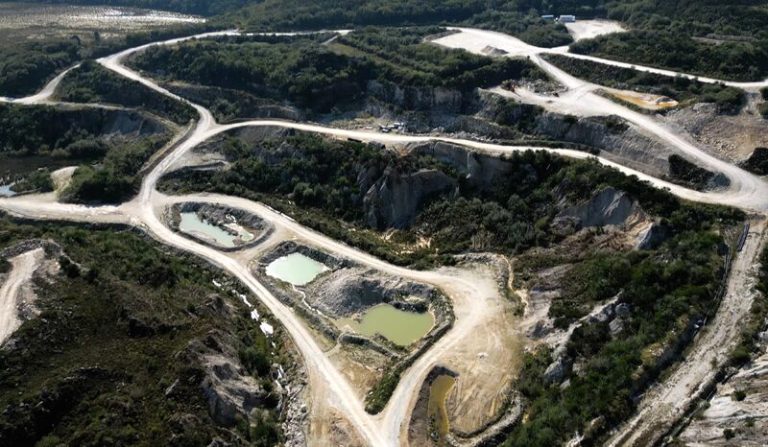
The Macedonian energy ministry has been careful to frame its role. Officials stressed that North Macedonia is not a direct contracting party to the financing deal but “participates as a witness and partner supporting the process,” and that any mining would be subject to strict environmental standards. The current concession at the Luke site, granted in 2016 to RI Energetika Pela for 30 years, covers lead, zinc, gold, silver and copper but does not currently extend to antimony — meaning a separate permit would be required before any antimony extraction could begin. An adviser at the ministry told local media the project remains in an early exploration phase, with feasibility and profitability assessments still to follow.
Kriva Palanka mayor Sasko Mitovski has set out a series of conditions he considers non-negotiable: a fully closed production process, no release of harmful substances, and no measurable impact on water, soil or air. He has also called for bank-backed financial guarantees to cover potential environmental damage and emphasised that decisions of this magnitude require broad input from experts, academics, civil society and local communities — not a simple binary vote. A local referendum remains a legal possibility under Macedonian law, though the mayor cautioned it must be grounded in factual and expert evidence rather than political narratives.
Politics has nonetheless entered the picture. The opposition Social Democratic Union of Macedonia has alleged that companies linked to the project have ties to figures close to the ruling VMRO-DPMNE government led by Prime Minister Hristijan Mickoski — claims that, while unverified, have added to public scepticism in an already polarised environment.
For many observers, Kriva Palanka has become a test case for whether North Macedonia can manage critical minerals development in a way that is transparent, environmentally responsible and democratically legitimate — or whether it will repeat cycles of industrial promises that generate lasting environmental and social costs.