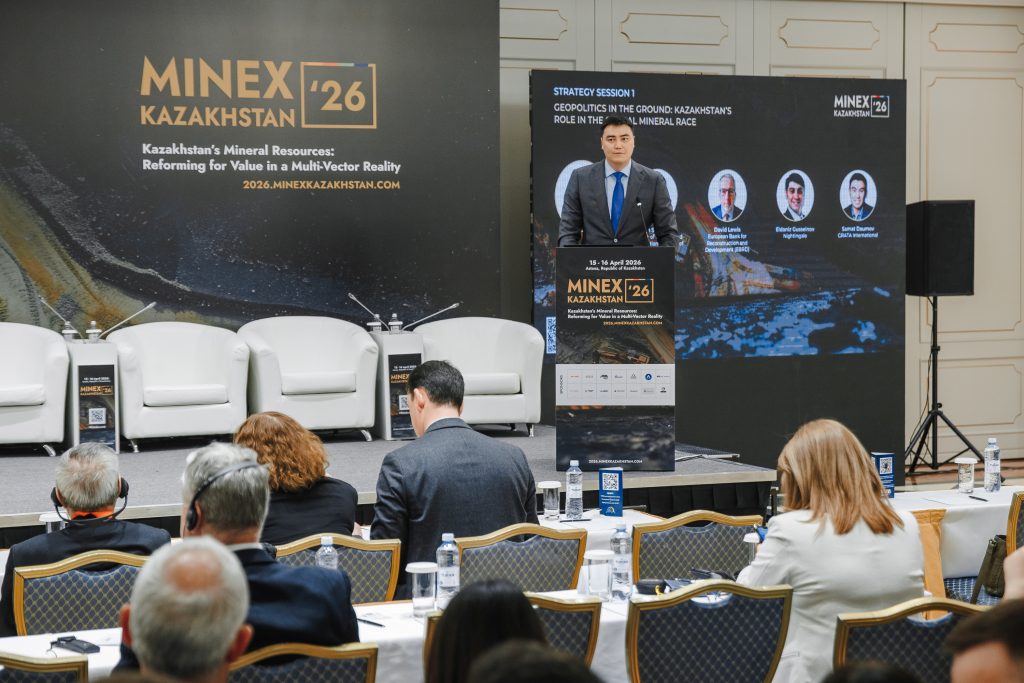
Kazakhstan is expanding access to its subsoil resources and modernising the infrastructure underpinning its geological research sector, as the government advances a strategy to draw in a new class of investor — one committed not just to extraction but to building processing capacity inside the country.
Speaking at the MINEX Kazakhstan 2026 forum in Astana, vice minister of industry and construction Iran Sharkhan confirmed that auctions for exploration and production rights across 50 deposits of solid minerals are planned for 2026, significantly broadening the pool of opportunities available to both domestic and international investors. The auctions will be conducted through Kazakhstan’s newly launched Unified Subsoil Use Platform, which has digitalised 22 state services and allows investors to browse available areas and submit applications without intermediaries.
To support the science underpinning exploration, a modern laboratory complex is under construction in Astana on the basis of the National Geological Survey, with commissioning targeted for 2028. The facility is expected to raise the quality and speed of geological research, providing a stronger data foundation for the exploration decisions of both state bodies and private investors. Geological survey coverage has now reached 2.038 million square kilometres against a 2026 target of 2.2 million square kilometres, with a shift to more detailed mapping scales prioritised to sharpen the identification of prospective areas. Seventeen new deposits — including Kok-Zhon, Altyn-Shoko and Samombet — were added to the state register in 2025, bringing the total to approximately 10,000.
Sharkhan reaffirmed that the legislative framework is being redesigned to reward investors who commit to value-added activity. A royalty system is set to replace the existing mineral extraction tax, and a strategic investor status will provide preferential conditions to companies that take on domestic processing obligations. Amendments to the Subsoil and Subsoil Use Code introduced in 2025 have also targeted the digitalisation of regulatory procedures and the simplification of licensing processes. “Kazakhstan is moving from a raw materials model to a value-added economy,” Sharkhan said. “The priority is deep processing of raw materials within the country, technology development and attracting strategic investors oriented toward long-term impact.”