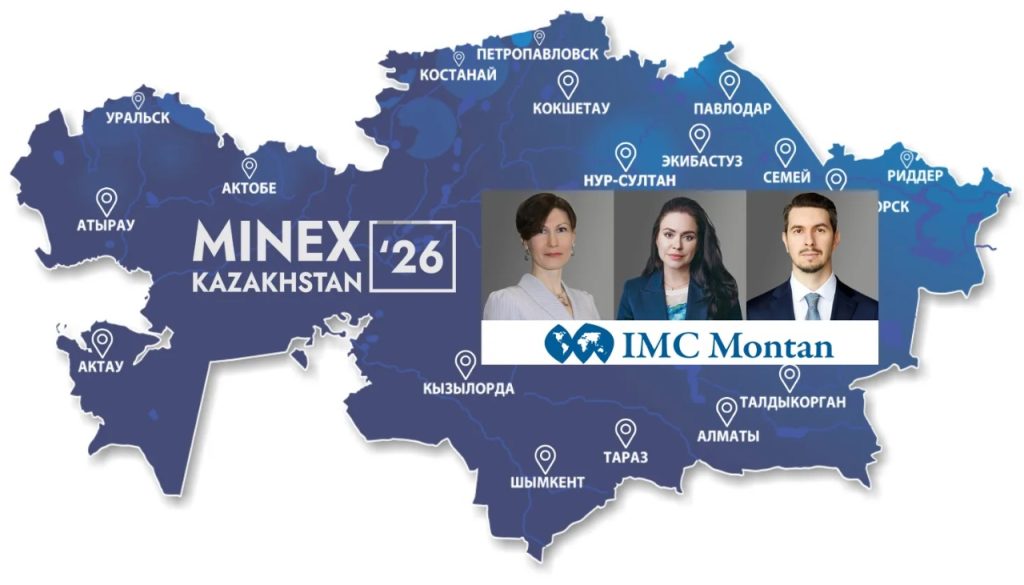
This year, IMC Montan is co-organizing the session “ESG Transformation and the ‘Social License’ in Kazakhstan’s Mining Sector” at the Minex Kazakhstan forum. The company’s experts explain why the ESG agenda is becoming not just a trend, but an economic necessity.
IMC Montan’s decision to co-organize a session dedicated to sustainable development is driven by the times. Kazakhstan has reached the point of regulatory implementation of ESG principles for business. Previously, this agenda was the prerogative of companies traditionally following international trends and seeking to meet investor or partner requirements. Now, ESG in Kazakhstan is actively developing not only due to external conditions. The mining sector is one of the most sensitive to ESG factors, so sharing experience on this topic will be valuable for all forum participants.
What issues in this area do you consider most relevant for subsoil users today?
When it comes to broad issues that go beyond national legislation and form part of sustainable development principles and the application of best available technologies, key topics include mining waste management, energy efficiency, rational water use, and biodiversity conservation. Closure and reclamation aspects deserve special mention. We are confident that forum participants will be interested in unconventional case studies addressing these issues. For example, relatively few experts have real hands-on experience with closure and reclamation works — yet these activities have a significant impact on the overall project economics, and underestimating these costs can become a critical factor. Environmental responsibility is playing an increasingly important role for business, and companies want to see financial benefits or preferences from implementing their environmental policies. The current agenda for subsoil users is therefore focused on asset lifecycle management: from waste handling during operations to post-investment assessment of closure and reclamation obligations.
You mentioned the topic of mining and processing waste management. Could you share some interesting case studies?
Mining companies must think carefully about where and how their large-tonnage mineral waste (overburden, processing tailings) will be handled. The main challenge is the sheer volume generated — conventional surface disposal requires significant land areas. The situation is further complicated by the conditions at mine sites: difficult terrain, proximity to populated areas, or the presence of environmentally or socially significant features. Naturally, subsoil users are interested in finding alternative approaches. There is also growing interest in recovering valuable components from mining waste and using waste as construction material or as a component thereof.
However, waste disposal remains one of the most painful issues, as it is not only an environmental concern but equally an economic and land-property one. The most interesting case studies sit at the intersection of technological and legal solutions. Successful examples show that waste can be not just a financial burden, but a resource — if the rationale and documentation can be structured in line with circular economy principles.
In our practice, we have encountered a number of innovative solutions. For example, placing tailings in exhausted open-pit voids (with or without prior waterproofing), or producing a specialized material from tailings (a recultivant) for backfilling mined-out areas — treating it not as waste disposal but as product manufacturing. Such unconventional approaches naturally require robust environmental safety justifications, but they open new opportunities. Both tailings management approaches yielded a tangible economic effect (in the range of $27–50 million USD), while requiring careful review of the legal framework and regulatory outlook to eliminate critical administrative risks — not just fines, but potential production shutdowns.
An important regulatory stimulus emerged in Kazakhstan at the beginning of 2026 with the adoption of the “Concept for Managing All Types of Waste in the Republic of Kazakhstan for 2026–2030.” Waste management in the mining and metallurgical industries is identified as one of its strategic priorities. The planned development of the country’s regulatory framework regarding the utilization of mining waste (including as technogenic mineral formations) provides an additional incentive for subsoil users to seek optimal solutions.
You separately mentioned closure and reclamation. In your view, what practical challenges do subsoil users face when fulfilling their closure and reclamation obligations?
In our view, the main problem is a lack of understanding of the goals and principles of successful reclamation, which ultimately leads to ineffective solutions. In our practice, we frequently encounter “template” approaches to reclamation planning, and consequently, an underestimation of the associated costs. International practice has long established the core criteria for successful reclamation — environmental (such as site safety in terms of physical, geochemical and ecological parameters, protection of public health and safety, absence of water pollution post-closure, and ecological system integrity) and social (minimizing socioeconomic impacts of closure and generating socioeconomic benefits). Closure and reclamation plans should be developed as early as possible in the project design phase. Each of the mentioned criteria requires consideration during planning. Issues such as the adequacy of mine water management measures, forecasting the geochemical stability of waste dumps post-closure, and stakeholder engagement must be studied and solutions justified.
In Kazakhstan, subsoil users are required to prepare reclamation plans at the design stage — however, in our observation, such plans tend to be formal documents rather than strategic ones. This can ultimately lead to insufficient financial provision for the required scope of reclamation and closure works when the time comes. That said, effective measures do not always mean costly ones. Some decisions made during overall production planning can reduce closure costs — such as the previously mentioned option of placing tailings in open pits, or accounting for the potential formation of acid drainage and managing it during waste rock stockpiling.
Turning to the topic of international standards — in your personal view, can their implementation bring real benefits to business?
Absolutely. Drawing on our practical experience working with industry enterprises across the CIS, we can confidently speak not just of benefits, but of the strategic necessity of implementing international standards. Integrating ESG principles enables a meaningful restructuring of risk management systems. We observe how chaotic responses to environmental and social incidents at many enterprises are being replaced by a systematic approach to predictive analysis and prevention. Standards also act as a catalyst for corporate culture: there is a marked increase in business accountability at all levels, which directly affects companies’ reputational assets.
It is telling that the initiative most often comes from environmental protection departments — as those most attuned to regulatory changes. However, we have recently noted growing engagement from senior management as well. It is no secret that the cost of using natural resources is steadily rising — and the cost of environmental mistakes is rising even faster.
Kazakhstan is now at a unique juncture: accumulated experience and current demand from both the state and the market are creating the conditions for a qualitative leap in eco-social responsibility.
We have discussed challenges, unconventional solutions, economic effects and regulatory changes in the ESG space. What other areas of work — in this or other fields important to subsoil users — can IMC Montan’s experts shed light on?
IMC Montan has been supporting mining projects for many years, including in the areas of environmental management, sustainable development and risk management. Our accumulated experience — spanning more than 1,000 completed projects worldwide — has allowed us to develop a comprehensive understanding of existing challenges and an expert approach to risk mitigation and overall project management. At the session, we will share illustrative case studies, present quantitative and qualitative characteristics of the approaches being implemented in natural resource management, and do our best to make the meeting both engaging and useful. Information about session participants and discussion topics is available at: https://2026.minexkazakhstan.com/ru/forum-agenda/tehnicheskaya-sessiya-2/