MINEX Forum Spotlights nGRND’s Vision for Sustainable Mining Finance at PDAC 2026
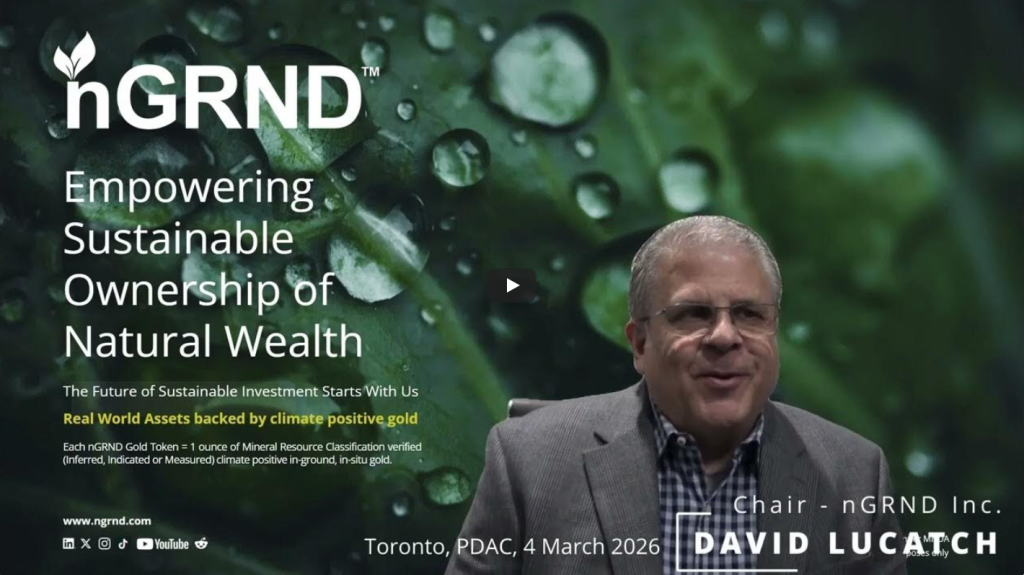
As a PDAC media partner for Europe and Central Asia, MINEX Forum continued to highlight innovations that can attract investment and accelerate the adoption of best-in-class technologies for sustainable mining. In its recent interview with David Lucatch, Chair of nGRND Inc., MINEX Forum explored a business model that challenges one of mining’s oldest assumptions: that value can only be unlocked by extracting metal from the ground.
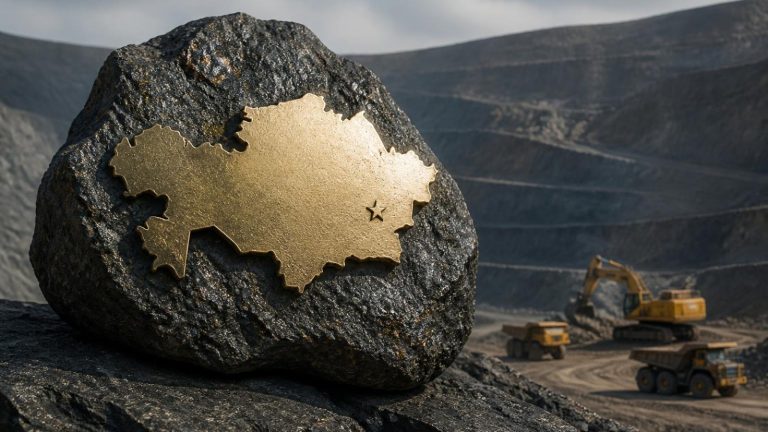
nGRND, short for “in-Ground,” is advancing a novel concept built around the securitisation and tokenisation of verified in-ground gold reserves. The company’s vision is bold and deliberately provocative: to become “the world’s biggest resource company that doesn’t mine.”
A new way to unlock mineral value
In the interview, David Lucatch explained that nGRND is a land management and sustainability company working with gold discovery and exploration firms to monetise verified in-ground gold resources without physically mining them.
The company uses recognised technical documentation, such as NI 43-101 reports and other verified geological reports, to confirm the existence of gold resources. It then purchases those verified in-ground ounces from site owners and transforms them into a digital asset proposition for investors.
What makes the model distinctive is that it does not stop at the mineral resource itself. nGRND also seeks to integrate carbon, ESG and avoided mining programmes, creating an additional sustainability layer around the asset. In effect, the company aims to combine the enduring value of gold with the measurable benefits of reduced environmental disturbance, carbon impact mitigation and biodiversity protection.
This approach positions nGRND at the intersection of mining, environmental finance and blockchain-enabled asset structuring.
“We don’t just digitise gold — we redefine it”
nGRND describes itself as a company that is redefining how the world perceives, values and provides democratised access to natural wealth. Its proposition is centred on tokenising verified climate-positive in-ground gold reserves while integrating benefits from avoided mining and environmental restoration frameworks.
The company’s message is clear: gold can be reframed not merely as a mined commodity, but as a climate-positive, real-world asset. That framing is captured in its positioning:
Responsible innovation – Real-world value – Climate positive verified impact
This is a significant departure from the traditional mining investment thesis. Rather than focus solely on extraction, production growth and commodity cycles, nGRND is attempting to create value from preservation, optionality and sustainability.
Why gold, and why now?
David Lucatch made the case that gold is the ideal starting point for this model. He noted that roughly 93% of all gold is ultimately used as stored value—whether in jewellery, coins, bullion or central bank holdings—while only a small proportion is consumed for industrial or trade purposes. In his view, this makes gold uniquely suited to a system where the asset’s value can be recognised and monetised without immediate extraction.
For nGRND, the long-term opportunity is substantial. Lucatch said the company’s ambition is to monetise nearly 250 million ounces over the next decade.
That ambition reflects broader shifts in the global mining and investment landscape. Juniors and mid-tier explorers often hold significant resource inventories but struggle to convert those ounces into market value. Many trade at a fraction of the implied value of their resources, and raising capital to advance projects often leads to repeated equity dilution. nGRND’s model is designed to address precisely that problem.
Non-dilutive capital for explorers and developers
One of the strongest themes in the interview was the potential for nGRND to provide non-dilutive capital to exploration and mining companies.
Mr. Lucatch pointed out that many public companies may hold large resource bases while trading at only a few dollars per ounce in the ground. The more they raise through conventional financing, the more dilution they create for existing shareholders. By contrast, nGRND’s programme is intended to generate revenue by purchasing in-ground ounces and layering in future carbon and ESG value, thereby placing revenue on a company’s books without altering its capital structure.
That could be especially relevant for:
- discovery and exploration companies
- brownfield or retired assets
- stranded deposits
- projects that are currently uneconomic or inaccessible
- properties constrained by environmental, geographic or regulatory factors
David Lucatch was clear that nGRND is not trying to interfere with active producers whose business depends on mining and selling gold. Rather, the company sees opportunity in assets where extraction may not make sense now—or for decades.
This opens an intriguing pathway for projects located under sensitive areas, near protected land, or in settings where mining would face high environmental or logistical barriers. In such cases, keeping the gold in the ground may itself become part of the value proposition.
The importance of jurisdictional stability
The success of such a model depends not only on geology, but also on geopolitics. Since nGRND’s premise is to keep resources in the ground over long time horizons—Lucatch referred to agreements of around 30 years with renewal features—the company must be confident that control over those resources can be maintained.
For that reason, nGRND is prioritising geopolitically stable jurisdictions. He noted that even previously attractive mining regions can become more uncertain over time, citing recent examples of nationalisation risk. For a company whose asset thesis depends on long-term preservation rather than near-term extraction, legal certainty and jurisdictional continuity are essential.
At present, nGRND is looking at opportunities involving Canadian, American, European, Australian, South American and South African companies, while remaining open to additional jurisdictions where the business model can be executed securely.
Global investor access through regulated token issuance
Another key part of the nGRND proposition is access to capital through digital markets. Lucatch said the company plans to launch its in-ground gold token to investors globally, excluding the United States and restricted jurisdictions. The investor base is expected to include both institutional and retail participants.
According to the interview, nGRND’s token issuance and generation partner is regulated in Dubai, and the structure is blockchain-based. The company believes this gives it a compliant route to market while offering broad international reach.
This matters because nGRND is not simply creating a mining finance instrument. It is attempting to build a bridge between real-world mineral assets, sustainability-linked value creation and digital finance infrastructure.
No direct competitor—yet
David Lucatch suggested that nGRND’s model is highly differentiated. While there are already businesses involved in tokenising physical gold, he argued that nGRND has not identified a direct competitor offering the same combination of:
- verified in-ground gold monetisation
- avoided mining and sustainability integration
- compatibility with both private and publicly listed companies
- non-dilutive financing potential
That combination could appeal to a market increasingly focused on ESG alignment, capital efficiency and alternative asset structures.
Relevance for Europe and Central Asia
For MINEX Forum audiences across Europe and Central Asia, the concept may be especially timely. The region includes a wide range of mining jurisdictions with large undeveloped or stranded mineral inventories, as well as governments and companies seeking new ways to attract investment while minimising environmental impact.
Lucatch indicated that Central Asia is still a new area for nGRND, but one the company is open to exploring. That leaves the door open for future engagement in a region where resource development, sustainability policy and foreign investment priorities increasingly intersect.
If the model proves scalable, it could offer a new option not only for companies seeking capital, but also for governments interested in balancing resource monetisation, environmental protection and long-term land stewardship.
A different future for mineral wealth
The significance of the MINEX Forum interview lies in the fact that nGRND is not merely proposing another financing instrument. It is proposing a different philosophy of resource ownership and value creation.
Instead of asking how quickly a gold deposit can be extracted, financed and sold, nGRND asks a different question: can the value of that resource be realised while leaving it in the ground?
That idea will undoubtedly attract scrutiny. Questions remain around market adoption, valuation frameworks, regulatory treatment and long-term execution. But the concept is difficult to ignore, particularly at a time when the mining sector is under pressure to decarbonise, reduce land disturbance and find more creative funding pathways.
For MINEX Forum, whose long-term objective is to promote investment and best-in-class technologies for sustainable mining, the conversation with David Lucatch reflects precisely the kind of innovation now reshaping the industry’s horizon.
nGRND’s ambition is striking, but its proposition is simple at its core: natural wealth does not always have to be extracted to be valuable.
If that idea gains traction, “the world’s biggest resource company that doesn’t mine” may become more than a slogan. It may become a new category in global mining finance.