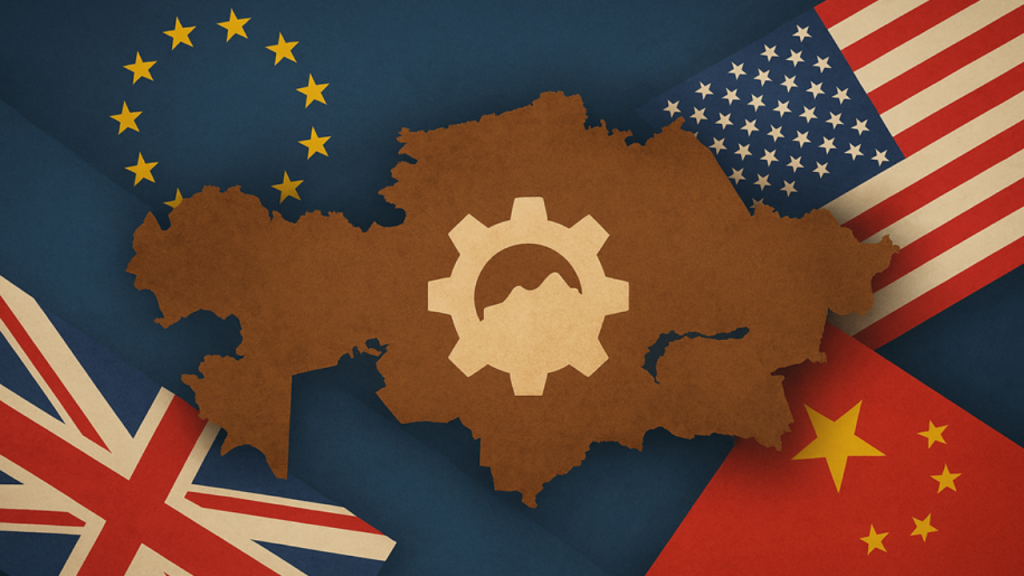
The 2026 Critical Minerals Ministerial in Washington has signaled the definitive end of Central Asia’s era as a “landlocked” geopolitical afterthought. For decades, the five nations of the region were viewed through the narrow lens of the “Great Game”—a buffer zone between Russian security interests and Chinese infrastructure investments. However, the “New Order” proposed by the Trump administration, articulated by Vice President JD Vance and Secretary of State Marco Rubio, has repositioned Kazakhstan, Uzbekistan, and their neighbors as the indispensable pivot of a new Western-aligned industrial statecraft.
The Mineral Sovereignty Pivot
The strategic argument for Central Asian states to embrace the U.S.-led FORGE (Forum on Resource Geostrategic Engagement) initiative and the proposed Preferential Trade Zone rests on the promise of escaping “coercive dependencies”. For years, Central Asian producers have been vulnerable to the same market distortions Vance identified in Washington: a “foreign supply” (read: China) that floods markets to crash prices and kill domestic projects.
By joining the new trading bloc, countries like Kazakhstan and Uzbekistan are being offered a “necessary foundation for private financing” and a “price floor” enforced by adjustable tariffs. This mechanism is a game-changer for the region. It essentially guarantees that if Kazakhstan develops its potentially world-class rare earth element (REE) reserves—estimated by some to reach 20 million metric tons—its investments will be shielded from predatory pricing strategies designed to maintain Beijing’s monopoly.
Kazakhstan: The Vanguard of the New Order
Kazakhstan has moved first and most aggressively to align with this reindustrialization doctrine. President Kassym-Jomart Tokayev’s branding of critical minerals as the “new oil” is not mere rhetoric; it is backed by a landmark memorandum of understanding (MOU) with the U.S. signed in November 2025, which focuses on technology transfer and processing capacity.
Perhaps most significantly, Kazakhstan’s accession to the Abraham Accords in November 2025 serves as a profound geopolitical signal. While traditionally a Middle Eastern normalization framework, its expansion to Kazakhstan—the first member with preexisting ties to Israel—is being used to facilitate secure, tech-driven supply chains that reduce the region’s reliance on China. This “unorthodox” alignment places Astana at the heart of the Pax Silica vision, where silicon, minerals, and energy are treated as shared strategic assets among “trusted partners”.
Uzbekistan and the C5+1 Renaissance
Uzbekistan is rapidly following this blueprint. On February 5, 2026, during the Ministerial, Tashkent signed its own strategic MOU with the U.S. to secure supply chains for rare earths and critical minerals like lithium, magnesium, and indium. For President Mirziyoyev, this is a path to modernize a mining sector that has often relied on outdated Soviet-era surveys.
The broader C5+1 diplomatic platform, now celebrating its tenth anniversary, has evolved from a symbolic talk shop into a “pragmatic, project-driven economic coordination framework”. This “renaissance of American influence” is evidenced by the $17 billion in investment projects agreed upon following recent summits and the integration of the Middle Corridor (Trans-Caspian International Transport Route) into the Trump Route for International Peace and Prosperity (TRIPP).
The Argument for Central Asian Alignment
The “New Order” offers Central Asia three structural advantages that neither Moscow nor Beijing can—or will—match:
-
Vertical Value Integration: Unlike China’s “extract-and-export” model, the U.S. framework emphasizes domestic processing and refining. This allows Central Asian states to capture high-value segments of the supply chain rather than remaining mere “resource bases”.
-
Market Stability: The Project Vault and price floor mechanisms provide a buffer against “market whiplash”. For a region where commodity price volatility can destabilize entire national budgets, this sovereign de-risking is a vital survival tool.
-
Connectivity Autonomy: By backing the Middle Corridor/TITR, the U.S. and its partners are providing the region with its first viable route to global markets that does not pass through Russia or China. This reduces the ability of larger neighbors to use transit as a tool of political pressure.
Central Asia is currently in a “hedging game,” and both Pakistan and Central Asian states have approached these initiatives with a degree of caution to avoid immediate Chinese retaliation. However, the message from the 2026 Ministerial is clear: in an economy of “real things,” those who control the minerals control the future. For Kazakhstan and Uzbekistan, the American proposal is not just about mining; it is about finally securing their economic and territorial sovereignty.