
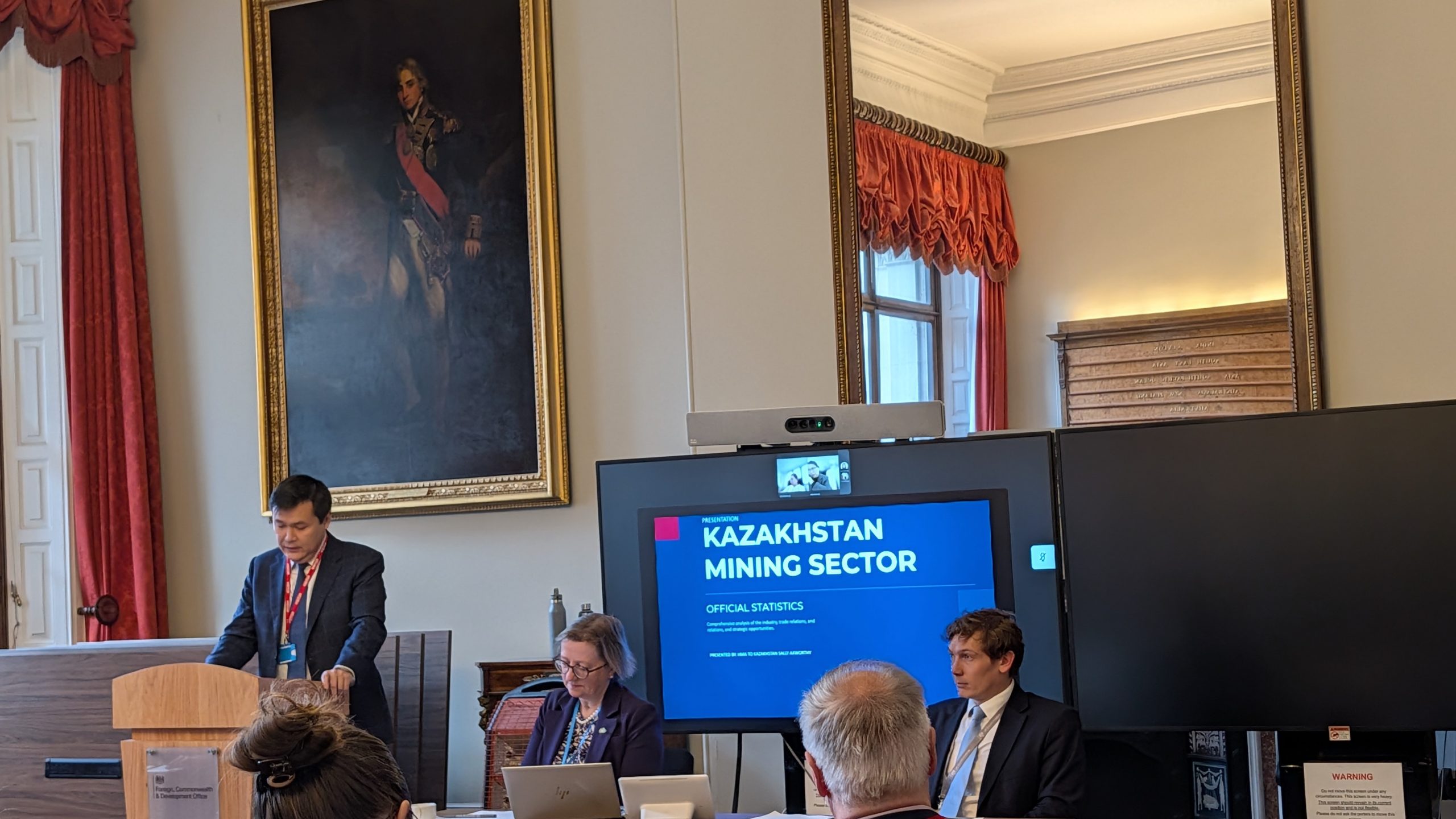
Reflections from the FCDO Mining Roundtable and recent insights from Astana
“Beyond Resources.” That was the unspoken theme defining today’s discussions at the Foreign, Commonwealth & Development Office (FCDO) in London on 20 Jan. The question on the table was a trillion-dollar one: How does the UK secure the building blocks of its energy transition in an increasingly fractured world?
The answer lies in the Central Asia’s steppes. But as the discussions revealed, the “frontier” days are over. Kazakhstan is no longer just a source of raw ore; it is rapidly becoming the strategic linchpin of the UK’s industrial future. From the race for rare earths to the rise of the “Middle Corridor,” here is an inside look at how the partnership is being recalibrated—and why 2026 marks the shift from potential to execution.
Recalibrating the UK-Kazakhstan relationships in the critical raw materials race
The UK-Kazakhstan relationship has undergone significant transformations since independence, with bilateral cooperation growing stronger every year. Critical minerals are a crucial aspect of this relationship, with the UK seeking to establish a reliable supply chain for technology and investment.
The Mining reinforced a message that is becoming increasingly clear: the UK–Kazakhstan relationship is no longer defined solely by extraction, but by systems, standards, and shared strategic ambition. it is evident that Kazakhstan has shifted from a “frontier market” to a strategic necessity for the UK’s energy transition. With 99 of the 118 periodic elements available in-country, Kazakhstan is the linchpin of the UK’s Critical Minerals Strategy. However, the UK faces an “execution gap” as China and the US deploy more aggressive, state-backed capital to secure off-take agreements.
This broader recalibration was also powerfully articulated in a recent interview by The Astana Times with UK Ambassador to Kazakhstan, HMA Sally Axworthy, whose remarks provided important context for today’s discussion on mining and critical minerals.
Taken together, the roundtable and the interview point to a partnership that is evolving well beyond resources.
Current Market Landscape
Kazakhstan’s “winning combination” of resource wealth and a modernizing regulatory framework (2018 Mining Code) is attracting unprecedented global interest.
- Key Assets: 11% of global Titanium (Boeing/Airbus supply), 40% of global Uranium, and significant deposits of Rhenium, Beryllium, and Rare Earth Elements (REEs).
- Legal Security: The Astana International Financial Centre (AIFC), operating under English Law, remains the primary vehicle for de-risking UK investment.
Risks and Mitigations
- Nationalisation Concerns: There is a trend toward increasing state control and preferential treatment for local investors.
- Mitigation: Utilise AIFC protections and UK Export Finance (UKEF) to wrap projects in sovereign-level guarantees.
- Supply Chain Diversification: Dependence on Chinese-controlled logistics remains a threat.
- Mitigation: Invest in the “Middle Corridor” logistics nodes to ensure independent market access.
From raw materials to value creation
Kazakhstan’s extraordinary endowment of critical minerals — from uranium and chromium to vanadium, rhenium and rare earths — is well understood. What is changing is how Kazakhstan wants to participate in global value chains.
As Ambassador Axworthy emphasised, Kazakhstan is seeking not only to supply raw materials, but to process, refine and add value domestically. This aligns closely with UK priorities under its Critical Minerals Strategy, which focuses on:
- supply-chain resilience,
- diversification away from single-country dependencies, and
- embedding high environmental, social and governance standards.
Concrete examples already exist. Joint ventures such as Maritime House with Zhezkazgan Redmet on rhenium recycling, supplying Rolls-Royce turbines, and Ferro-Alloy Resources’ vanadium project, expected to meet up to 10% of global demand, show how UK technology, finance and standards can combine with Kazakhstan’s resource base.
These are not abstract ambitions — they are working models.
The Competitive Challenge: Speed vs. Standards
The UK is currently being outpaced in “time-to-market” by global rivals who offer more lucrative, less regulated entry paths.
| Competitor | Strategy | Competitive Advantage |
| China | “Infrastructure-for-Minerals” swaps. | Speed: Immediate state-backed financing and dominant control of 70% of current exports. |
| USA | Geopolitical “Friend-shoring” via the Defence Production Act. | Access: Massive capital injections to secure REEs and bypass Chinese processing hubs. |
| United Kingdom | Technical consultancy and ESG-led investment. | Quality: High technical standards and legal transparency, but perceived as “slow” and “risk-averse.” |
Navigating Geopolitical Realities: Multivector Diplomacy
Ambassador Axworthy reaffirmed that the UK views Kazakhstan as a strategic partner, not a zero-sum competitor:
- Multivector Approach: Kazakhstan’s diplomatic flexibility (balancing ties with EU, China, and the US) ensures no single power dominates.
- Alignment on Sovereignty & Multilateralism: Kazakhstan’s support for the UN, SDGs, and conflict resolution aligns with UK priorities.
- Strategic Partnership Agreement (SPA): The UK’s SPA with Kazakhstan (currently being ratified) provides a legal framework for joint projects in energy, defence, and critical minerals.
Key Challenges & Solutions:
| Challenge | UK’s Strategic Response |
| China’s Dominance in Critical Minerals | UKEF’s guarantees and London’s financial hub position the UK as a competitive alternative. |
| Talent Shortages | UK universities (Durham, Birmingham) train Kazakh engineers for AI and automation. |
| Regulatory Complexity | EITI alignment and joint processing projects reduce risks. |
| Competition from the US/EU | First-mover advantage in SME funding and digital innovation. |
Finance, technology and standards as strategic enablers
A key takeaway from today’s roundtable was that finance is as strategic as geology.
UK Export Finance demonstrated how long-tenor, sovereign-backed guarantees can unlock projects across mining, processing and infrastructure, particularly where capital intensity and risk have historically slowed investment. This complements the UK’s strength as a global financial hub — including the role of the London Metals Exchange — highlighted by Ambassador Axworthy in Astana.
Equally important is the role of technology and data. Several participants pointed to the need for:
- digitalisation of legacy geological data,
- AI-ready datasets,
- Improved mine safety systems, and
- Smarter, more sustainable operations.
These are precisely the areas where UK firms — from engineering and digital mining to ESG advisory and geoscience — can play a decisive role.
Skills, education and people-to-people ties
One of the most candid discussions today centred on skills shortages, particularly engineers and geoscientists. This challenge is not unique to Kazakhstan — it is global — but it reinforces why education is such a critical pillar of the bilateral relationship.
As outlined in The Astana Times, the UK’s educational footprint in Kazakhstan is expanding:
- British universities including Cardiff, Coventry and De Montfort now operate campuses in-country.
- Geological exploration and mining-related disciplines are part of this offer.
- Nearly half of Bolashak scholars have studied in the UK, creating a deep reservoir of shared professional culture.
Education, transparency initiatives such as the Extractive Industries Transparency Initiative, and English-law institutions like the Astana International Financial Centre are not peripheral — they are central to investor confidence.
Partnership, not pressure, in a competitive landscape
Kazakhstan sits at the crossroads of Europe and Asia, and competition for its critical minerals is intense. China, the EU, the US, Japan and Korea are all active.
Yet a recurring theme — both today and in Ambassador Axworthy’s interview — was that this is not a zero-sum game.
The UK’s approach is deliberately pragmatic:
- partnership over pressure,
- long-term engagement over transactional deals,
- respect for Kazakhstan’s multivector foreign policy.
As former UK Foreign Secretary David Cameron put it during his 2024 visit: the UK is not asking Kazakhstan to choose — but to partner for mutual security and prosperity.
Beyond mining: a multidimensional relationship
What makes the recalibration particularly compelling is that mining and critical minerals sit within a much wider ecosystem of cooperation:
- Green startups and venture capital,
- AI and digital innovation,
- Architecture and urban development,
- Culture, education and tourism.
From British-designed landmarks in Astana and Almaty, to venture capital funds backing green and women-led startups, to growing cultural and academic exchanges, the relationship is increasingly people-driven.
2026 Outlook: The Transition from “Quarry” to “Hub”
Based on the strategic pillars discussed today, here is what the mining landscape in Kazakhstan will look like by 2026:
- The Value-Add Mandate
By 2026, the era of simply exporting raw ore will be ending. The Kazakh government is pivoting toward in-country processing. We expect to see a surge in “Midstream” projects—refineries and metallurgical plants—where UK technology in chemical engineering and automation will be the primary currency of trade.
- Digitalisation and the “Green” Mine
The 2026 mining code will likely reward “Smart Mines.” As Kazakhstan moves toward its 2060 Net Zero goals, British expertise in AI-driven geological mapping and carbon-neutral extraction will shift from “nice-to-have” to “license-to-operate.”
- The Middle Corridor Reality
By 2026, the Trans-Caspian International Transport Route (TITR) will be the primary artery for critical minerals moving to Europe. UK firms in logistics, insurance, and port infrastructure will play a silent but vital role in ensuring these minerals reach the West without geopolitical interference.
Final reflection
Critical minerals may be the catalyst, but trust, standards, skills and shared ambition are the real foundations of the UK–Kazakhstan partnership.
The “winning combination” mentioned by HMA Sally Axworthy—UK expertise and Kazakh resources—is powerful, but it is not guaranteed. To win in 2026, UK firms must match their technical excellence with a more aggressive commercial posture and faster capital deployment.
Today’s FCDO roundtable made clear that the opportunity ahead is not simply about securing supply — it is about co-creating resilient, sustainable and technologically advanced value chains that serve both countries’ long-term interests.
The minerals are there. The roadmap is signed. The challenge now is execution — and the momentum is clearly there.
Continuing the conversation: MINEX Kazakhstan 2026
The themes discussed at today’s roundtable—regulatory reform, multi‑vector foreign policy, critical mineral security, green transition, and technological modernisation—will continue at the MINEX Kazakhstan 2026: 16th Mining & Exploration Forum, taking place on 15–16 April 2026 in Astana.
For those who are interested in the future of Kazakhstan’s mining and critical minerals sector—and in the broader UK–Kazakhstan partnership—this Forum will be an ideal platform to continue today’s discussion, share expertise, and shape the next wave of projects and collaborations.
MINEX has long provided a platform where government, industry, investors, financiers and technology providers can engage in open, practical dialogue on the future of Kazakhstan’s mineral sector. For those involved in critical minerals, mining reform, processing, finance and downstream integration, it will be a timely opportunity to deepen discussions that are already well underway.
🔗 https://2026.minexkazakhstan.com/
