Month: February 2024

  • Мажилис РК обеспокоен удорожанием угля на внутреннем рынке

    Мажилис РК обеспокоен удорожанием угля на внутреннем рынке

    Цены на топливо на внутреннем рынке Казахстана в период отопительных сезонов постоянно растут, в том числе из-за компаний-посредников. Депутатский запрос, связанный с удорожанием угля, в ходе пленарного заседания мажилиса озвучил депутат Сергей Пономарёв. Об этом пишет портал Informburo.kz.

    По словам г-на Пономарёва, посредники в разы увеличивают конечную стоимость топлива. В качестве примера он привёл цены на уголь в Шетском районе — 25 тыс. тенге за 1 т, при этом непосредственно на выходе с Шубаркольского месторождения сырьё стоит практически втрое меньше — 8,5 тыс. тенге за 1 т.

    Мажилисмены хотят, чтобы к решению проблемы подключилось Агентство РК по защите прав потребителей. Ведомству необходимо выделить недобросовестные компании-посредники и добиться уменьшения цен на уголь, который жители республики покупают в розницу.

    Кроме того, в своём запросе депутаты отметили ещё один противоречивый момент в развитии отрасли. Как подчеркнул г-н Пономарёв, некоторые компании, ведущие добычу угля, «ничего не дают государству взамен», что запрещает республиканский кодекс о недрах.

    К примеру, мажилисмен недоволен деятельностью предприятия «Актас Комир», которое до сих пор не построило производство спецкокса в Карагандинской области, хотя ежегодно наращивает объём угледобычи.

    Депутаты также предлагают, чтобы Высшая аудиторская палата Казахстана провела оценку эффективности программы индустриально-инновационного развития и выявила, какие отраслевые компании используют госсредства нерационально.

  • The Mazhilis of the Republic of Kazakhstan is concerned about the rise in price of coal on the domestic market

    The Mazhilis of the Republic of Kazakhstan is concerned about the rise in price of coal on the domestic market

    Fuel prices on the domestic market of Kazakhstan are constantly rising during the heating seasons, including due to intermediary companies. A parliamentary request related to the rise in coal prices was voiced by deputy Sergei Ponomarev during a plenary meeting of the Majilis. The portal Informburo.kz writes about this .

    According to Mr. Ponomarev, intermediaries significantly increase the final cost of fuel. As an example, he cited coal prices in the Shet region – 25 thousand tenge per 1 ton, while directly at the exit from the Shubarkol deposit, raw materials cost almost three times less – 8.5 thousand tenge per 1 ton.

    Majilismen want the Agency of the Republic of Kazakhstan for the Protection of Consumer Rights to get involved in solving the problem. The department needs to identify unscrupulous intermediary companies and achieve a reduction in prices for coal, which residents of the republic buy at retail.

    In addition, in their request, the deputies noted another controversial point in the development of the industry. As Mr. Ponomarev emphasized, some companies mining coal “give nothing to the state in return,” which is prohibited by the republican subsoil code.

    For example, the Majilisman is dissatisfied with the activities of the Aktas Komir enterprise, which has not yet built a special coke production facility in the Karaganda region, although it is increasing its coal production every year.

    The deputies also propose that the Supreme Audit Chamber of Kazakhstan conduct an assessment of the effectiveness of the industrial and innovative development program and identify which industry companies use public funds irrationally.

  • Глава государства принял председателя правления АО «Национальная атомная компания «Казатомпром» Меиржана Юсупова

    Глава государства принял председателя правления АО «Национальная атомная компания «Казатомпром» Меиржана Юсупова

    Касым-Жомарт Токаев заслушал отчет о результатах деятельности «Казатомпрома» за 2023 год, а также о целях и планах компании в краткосрочной и среднесрочной перспективах.

    Президенту было доложено, что по итогам прошлого года показатели по производству и продажам урановой продукции составили более 21 и 18 тысяч тонн соответственно. Как сообщил Меиржан Юсупов, доля перевозок урановой продукции по Транскаспийскому международному транспортному маршруту в 2023 году существенно увеличилась. 64% от всех отгрузок урана из Казахстана в западные страны были перевезены по данному транзитному коридору.

    Кроме того, Глава государства был проинформирован о реализуемых инвестиционных проектах группы компаний «Казатомпром», а также о социально значимых проектах, направленных на развитие и поддержку регионов присутствия.

    Президенту также было доложено о работе по расширению и восполнению минерально-сырьевой базы.

    По итогам встречи Глава государства дал ряд конкретных поручений по повышению эффективности работы «Казатомпрома».

  • The president of Kazakhstan met Meirzhan Yusupov the Chairman of the Board of NAC Kazatomprom

    The president of Kazakhstan met Meirzhan Yusupov the Chairman of the Board of NAC Kazatomprom

    Kassym-Jomart Tokayev heard a report on the results of Kazatomprom’s activities for 2023, as well as on the company’s goals and plans in the short and medium term.

    The President was informed that at the end of last year, the production and sales of uranium products amounted to more than 21 and 18 thousand tons, respectively. As Meirzhan Yusupov reported, the share of transportation of uranium products along the Trans-Caspian International Transport Route in 2023 has increased significantly. 64% of all uranium shipments from Kazakhstan to Western countries were transported along this transit corridor.

    In addition, the Head of State was informed about the ongoing investment projects of the Kazatomprom group of companies, as well as socially significant projects aimed at developing and supporting the regions of presence.

    The President was also informed about the work to expand and replenish the mineral resource base.

    Following the meeting, the Head of State gave a number of specific instructions to improve the efficiency of Kazatomprom.

  • Cornish Metals shares rise on new drill results from tin project in Cornwall

    Cornish Metals shares rise on new drill results from tin project in Cornwall

    Cornish Metals (LON, TSXV: CUSN) shares rose on Monday on new drill results from its flagship South Crofty tin project in southwest England.

    Earlier, the company reported results from the first six drill holes of the ongoing 9,000-metre Carn Brea drill program.

    All six drill holes intersected the Wide Formation lode structure, which is characterized by strong tourmaline alteration and variable tin mineralization, similar to all historically mined tin-bearing structures in the South Crofty area.

    This structure has been confirmed over a strike length of at least 1.6 kilometres, a downdip extent of at least 525 metres, with thicknesses ranging from 1.8 to 4.8 metres, and remains open.

    Highlighted Wide Formation drill intercepts include 1.21 metres grading 0.87% tin and 1.90 metres grading 0.83% tin. Drilling at the newly identified Great Flat lode splay also returned 3.38 metres grading 1.01% tin and 1.00 metre grading 1.56% tin.

    Additional notable intercepts include 0.30 metre grading 7.48% tin and 3.09 metres grading 1.21% tin between the two structures.

    There is currently no primary mine production of tin in Europe or North America, and the US has included the metal in a list of minerals considered critical to the country’s economic and national security.

    South Crofty could generate up to 5,000 tonnes of tin a year, with first production expected in 2026. The company said the mine will create up to 270 direct jobs and support a further 750 in the region, one of the UK’s most underprivileged.

    Shares of Cornish Metals rose 9.3% by 2:10 p.m. EDT. The company has a market capitalization of C$91 million ($67 million).

  • Запасы урана выросли после того, как казахстанская горнодобывающая компания сократила добычу

    Запасы урана выросли после того, как казахстанская горнодобывающая компания сократила добычу

    Акции уранодобывающих компаний продлили рост, что сделало их наиболее прибыльными австралийскими акциями в этом году после того, как крупнейший в мире производитель металла, используемого для производства ядерного топлива, снизил планку добычи.

    Казатомпром снизил прогноз добычи на этот год с 12% до 14%. Компания, котирующаяся на Лондонской фондовой бирже и контролируемая правительством Казахстана, в январе предупредила, что, скорее всего, она не достигнет своих целей по производству в течение следующих двух лет.

    Акции Paladin Energy Ltd. подскочили на 7,4% в Сиднее, а акции Boss Energy Ltd. подскочили на 8,1%. Несколько более мелких горнодобывающих компаний выросли еще больше: акции Deep Yellow Ltd., владеющей проектами в Австралии и Намибии, выросли более чем на 18%, а акции Bannerman Energy Ltd. выросли на целых 8,3%.

    Предупреждение о производстве является последним в серии сбоев в поставках, в том числе переворота в Нигере в прошлом году, который прервал поставки в Европу, которые привели к тому, что спотовые цены на уран достигли 15-летних максимумов. Это происходит на фоне возрождения интереса к ядерной энергетике, поскольку правительства пытаются декарбонизировать свою экономику, чтобы достичь целевых показателей нулевого уровня выбросов.

    Сокращение производства в Казахстане «просто приводит к еще большему дефициту на рынке, чем сейчас», – сказал Мэтт Гриффин, управляющий со-портфелем австралийских малых компаний в Maple Brown Abbott Ltd. Маловероятно, что это окажет какое-либо влияние на австралийское производство. , но «цены будут выше по всем направлениям», сказал он.

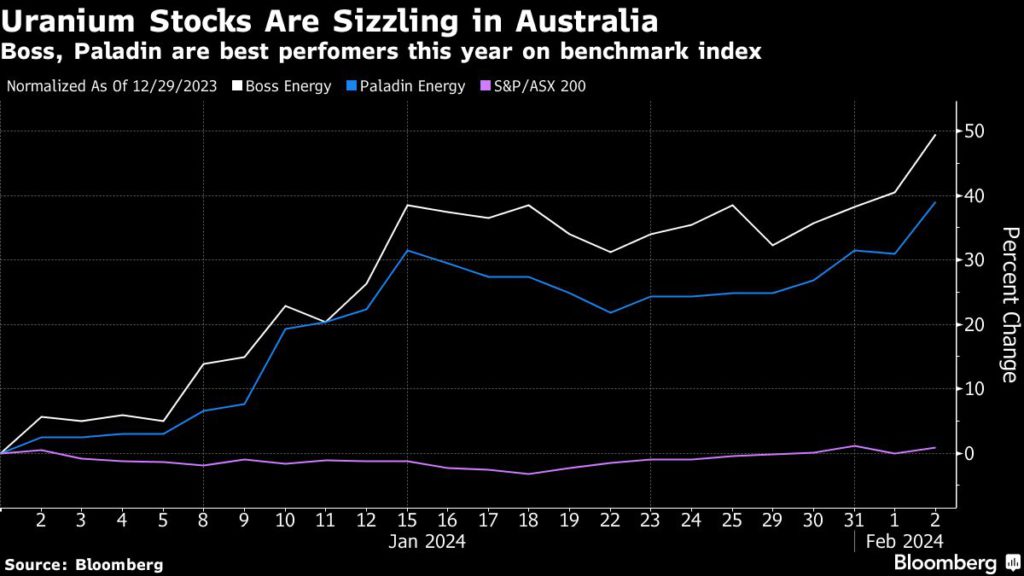
    Акции Boss Energy и Paladin, базирующиеся в Перте, являются двумя наиболее доходными акциями австралийского индекса S&P/ASX 200 в этом году, поднявшись на 48% и 39% соответственно.

    Добыча урана в других частях мира также выросла после заявления Казатомпрома. Акции CGN Mining Co. на торгах в Гонконге выросли на 8,2%, а акции Cameco Corp. на торгах в Нью-Йорке в четверг выросли на 5,9%. Global X Uranium ETF, который отслеживает результаты деятельности нескольких горнодобывающих компаний, в четверг подскочил на 6,2% до самого высокого уровня с 2014 года.

  • Uranium stocks extend surge after Kazakh miner cuts output

    Uranium stocks extend surge after Kazakh miner cuts output

    Uranium miners extended a rally that’s made them the best-performing Australian stocks this year after the world’s biggest producer of the metal used to produce nuclear fuel cut its output target.

    Kazatomprom lowered its guidance for production for this year by 12% to 14%. The company, listed in London and controlled by the Kazakhstan government, had warned in January that it was likely to fall short of its output goals over the next two years.

    Paladin Energy Ltd. shares jumped as much as 7.4% in Sydney and Boss Energy Ltd. was up as much as 8.1%. A couple of smaller miners surged even more: Deep Yellow Ltd., which has projects in Australia and Namibia, soared more than 18%, while Bannerman Energy Ltd. climbed as much as 8.3%.

    The production warning is the latest in a series of supply setbacks — including a coup in Niger last year that disrupted shipments to Europe — that have pushed spot uranium prices to 15-year highs. That’s happening amid a revival of interest in nuclear power as governments try to decarbonize their economies to meet net zero targets.

    The reduction in output from Kazakhstan “just leaves the market in even more of a deficit than it already is,” said Matt Griffin, co-portfolio manager of Australian small companies at Maple Brown Abbott Ltd. There’s unlikely to be any impact on Australian production, but “prices are going to be higher across the board,” he said.

    Boss Energy and Paladin, both based in Perth, are the two best-performing stocks on Australia’s benchmark S&P/ASX 200 Index this year, rising 48% and 39%, respectively.

    Uranium miners in other parts of the world also rose following the Kazatomprom announcement. CGN Mining Co. advanced as much as 8.2% in Hong Kong, while Cameco Corp. closed up 5.9% in New York on Thursday. The Global X Uranium ETF, which tracks the performance of several miners, jumped 6.2% on Thursday to the highest level since 2014.

  • Germany invests $1.1bn to counter China on raw materials

    Germany invests $1.1bn to counter China on raw materials

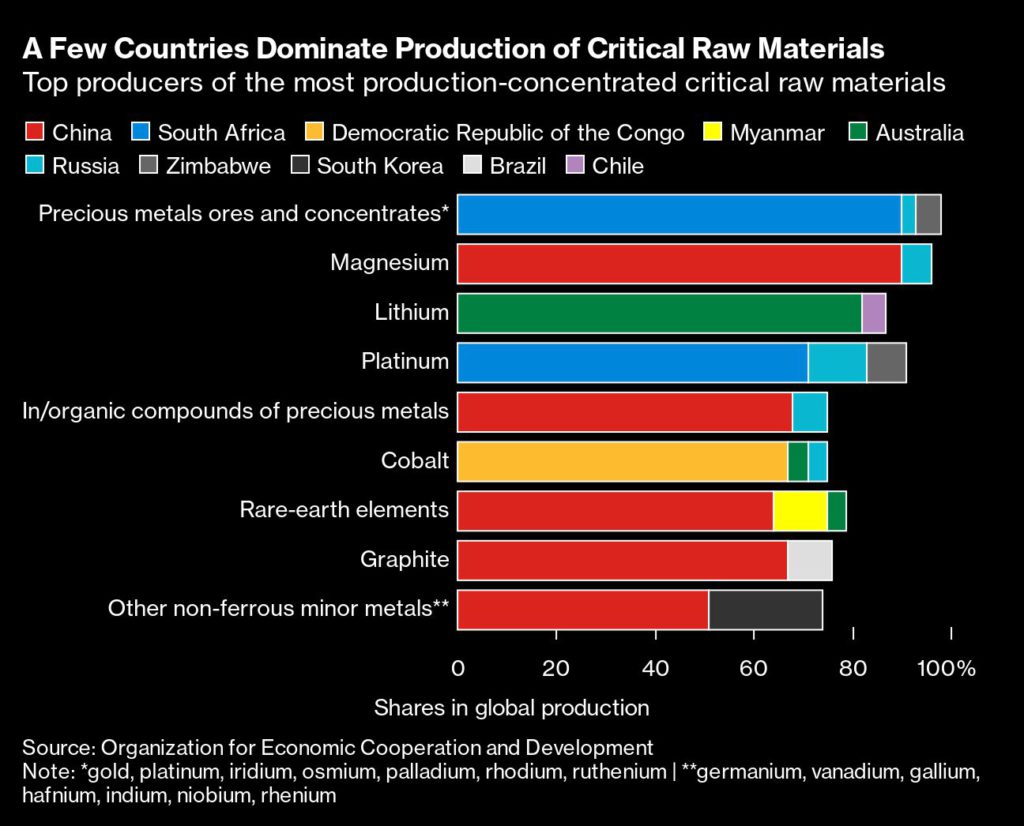
    The German government earmarked about €1 billion ($1.1 billion) for raw materials investments as it seeks to reduce dependency on producers such as China for critical minerals, according to people familiar with the plan.

    A selection process will be established to determine which projects — including in extraction, processing and recycling materials — are eligible, the people said, speaking on condition of anonymity. Financing, via Germany’s state-owned KfW development bank, will consist of equity capital to make acquisitions of minority stakes.

    Projects in Germany and abroad will “contribute to the security of supply of critical raw materials,” an Economy Ministry spokeswoman said. The ministry didn’t give details on how the state fund would be structured.

    Pandemic-triggered supply-chain disruptions across the globe and Russia’s invasion of Ukraine exposed the vulnerability of Europe’s reliance on energy and raw materials for high-tech and green projects. Chancellor Olaf Scholz’s government pledged to ratchet up efforts to access to critical materials over the longer term.

    Raw materials including cobalt, copper, lithium, silicon and rare earth metals are needed to make microchips, wind turbines and batteries for electric vehicles.

    As Germany’s parliament approves Scholz’s 2024 budget on Friday, the billion-euro fund is to be set up for four years. Investments will be coordinated with Italian and French initiatives in the raw materials sector, the people said. Policymakers will focus on mineral projects defined as critical in the European Union’s Critical Raw Materials Act.

    Veronika Grimm, a member of Scholz’s panel of independent economic advisers, said the aim of diversifying raw-material supplies must be a “top priority” for the EU as a whole.

    “The raw-material fund can be an element, but it won’t be a enough,” Grimm told Bloomberg.

    KfW declined to comment on the plans. The lender is expected to make a statement about its role managing the project at its annual news conference next week on Feb 7. The EU agreed on measures in November under the Critical Raw Materials Act to boost domestic mining and reduce dependency on any one country.

    While Germany still has to set up a structure to organize its investments into raw materials, Japan could provide a model. Since 2004, the state-owned Japan Organization for Metals and Energy Security has invested in the storage of raw materials, explored reserves, provided loans or guarantees for commodity companies and bought their shares directly.

  • В Карагандинской области освоят полиметаллическое месторождение

    В Карагандинской области освоят полиметаллическое месторождение

    ТОО «ОралЭлектроСервис» возобновит добычу на полиметаллическом месторождении Узынжал, расположенном в Шетском районе Карагандинской области. Участок разрабатывали в 2018−2019 годах, после чего работы приостановили для дополнительной геологоразведки. Обновлённый план горных работ недропользователь разместил на Едином экологическом портале Казахстана.

    Компания рассчитала параметры освоения Узынжала на 10 лет — с 2024 по 2033-й. В этот период месторождение будут отрабатывать открытым способом, в последующие же годы потребуется переход на подземный способ добычи. Проектная мощность карьера — 500 тыс. т полиметаллических руд в год.

    По вещественному составу рýды месторождения относятся к цинково-свинцовым. Содержание свинца варьируется от 0,02% до 31,8% при среднем значении 2,73%. Среднее содержание цинка, в свою очередь, доходит до 1,2%. Помимо этих двух металлов, в рудах есть другие ценные для извлечения компоненты: серебро (в среднем 41,4 г/т), кадмий (0,017%) и барит (9,6%).

    Запасы всех балансовых руд участка (окисленных, смешанных и сульфидных) составляют 12 500 тыс. т. Вероятнее всего, перерабатывать сырьё будут на собственной обогатительной фабрике. В проектной документации отмечено, что рекомендации к техрегламенту на проектирование ОФ были составлены ещё на основе исследования свойств руд в 2010−2011 годах.

  • A polymetallic deposit will be developed in the Karaganda region

    A polymetallic deposit will be developed in the Karaganda region

    OralElectroService will resume production at the Uzynzhal polymetallic deposit, located in the Shet district of the Karaganda region. The site was developed in 2018–2019, after which work was suspended for additional geological exploration. The subsoil user posted the updated mining plan on the Unified Environmental Portal of Kazakhstan.

    The company calculated the parameters for the development of Uzynzhal for 10 years – from 2024 to 2033. During this period, the deposit will be mined using open-pit mining; in subsequent years, a transition to underground mining will be required. The design capacity of the quarry is 500 thousand tons of polymetallic ores per year.

    According to the material composition of the ores of the deposit, they are classified as zinc-lead. Lead content ranges from 0.02% to 31.8% with an average of 2.73%. The average zinc content, in turn, reaches 1.2%. In addition to these two metals, the ores contain other components valuable for extraction: silver (average 41.4 g/t), cadmium (0.017%) and barite (9.6%).   

    The reserves of all balance ores at the site (oxidized, mixed and sulfide) amount to 12,500 thousand tons. Most likely, the raw materials will be processed at their own processing plant. The design documentation notes that recommendations for the technical regulations for the design of the processing plant were drawn up on the basis of a study of the properties of ores in 2010−2011.